Page 1 of 2 Next >> Looking for at least a partial return on their vast investment, Ford added a road going version to the GT40 line-up in 1965. Apart from a slightly detuned engine and wire wheels, there was little that distinguished the competition and street versions of the GT40. There was nevertheless a demand for the fastest Ford road car ever, particularly in the United States. Unfortunately, it did not comply with the stricter American legal requirements on various grounds and the right-hand drive only configuration also deterred potential clients.
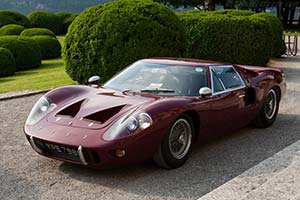
These issues were addressed by a second road going GT40, which featured so many changes that it received a new type name. Known as the Mark III, it was still based on the same steel monocoque chassis as the successful racer. This was filled with foam where possible for sound deadening and added safety. The sill-mounted rubber bag tanks were replaced by stronger but smaller aluminium tanks. A more fundamental change was the relocation of the gear-shifter to the centre console to accommodate for a potential left-hand drive configuration.
Like the earlier road going GT40, the Mk III used a milder specification of the Ford small-block. This was virtually identical to the one used in the Shelby Mustang GT350 and produced just over 300 bhp. To create some luggage space, the 'spaghetti' exhaust system of the competition car was replaced by a more straightforward configuration that exited on either side of the gearbox. This did hamper performance but allowed a box to be fitted on top of the gearbox. Due to this location, the contents of the box did have the tendency to get very hot. Page 1 of 2 Next >>

 Ultimatecarpage.com
> Cars by brand
> United States
> Ford
Ultimatecarpage.com
> Cars by brand
> United States
> Ford
 GT40 Mk III
 Looking for at least a partial return on their vast investment, Ford added a road going version to the GT40 line-up in 1965. Apart from a slightly detuned engine and wire wheels, there was little that distinguished the competition and street versions of the GT40. There was nevertheless a demand for the fastest Ford road car ever, particularly in the United States. Unfortunately, it did not comply with the stricter American legal requirements on various grounds and the right-hand drive only configuration also deterred potential clients.