
| sport |
 Ultimatecarpage.com
> Cars by brand
> Great Britain
> Jaguar
Ultimatecarpage.com
> Cars by brand
> Great Britain
> Jaguar
 Racing cars
> Other Sportscars XJ13 Racing cars
> Other Sportscars XJ13
|
| Jaguar XJ13 |
| Article | Image gallery (19) | Specifications | User Comments (2) |
|
|
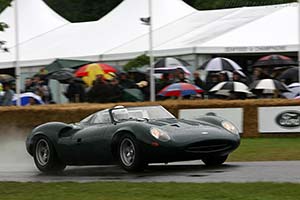
Page 1 of 1  With five wins in seven years, Jaguar was the most successful manufacturer at Le Mans in the 1950s. Amazingly the engine responsible for these victories was directly derived from the XK six cylinder that also powered the company's range of road going sports cars. From 1958 onwards sports racers were limited to a three litre replacement, which left the Jaguar D-Type obsolete. Some privateers attempted to race a three litre version of the straight six engine, but in that configuration it could not match the Aston Martins or Ferraris. In the early 1960s, Jaguar briefly returned to its practice with the development of racing versions of the new E-Type, but again found itself beaten by Ferrari. With five wins in seven years, Jaguar was the most successful manufacturer at Le Mans in the 1950s. Amazingly the engine responsible for these victories was directly derived from the XK six cylinder that also powered the company's range of road going sports cars. From 1958 onwards sports racers were limited to a three litre replacement, which left the Jaguar D-Type obsolete. Some privateers attempted to race a three litre version of the straight six engine, but in that configuration it could not match the Aston Martins or Ferraris. In the early 1960s, Jaguar briefly returned to its practice with the development of racing versions of the new E-Type, but again found itself beaten by Ferrari.Officially, Jaguar's racing days were over, but behind the scenes a new engine and chassis were on the drawing boards that were intended to bring Jaguar back to the forefront of endurance racing. A logical development of the XK six cylinder engine would be a V12 and that configuration had been discussed since the mid-1950s within Jaguar. Unlike the XK engine, the V12 was destined to be racing engine first and then be introduced in street cars. In the early 1960s the displacement regulations had been relaxed again, so the new V12 could be developed for an upcoming Le Mans engine. Development of the new engine was entrusted to Claude Bailey. A total of seven prototype engines were constructed, two of which were built to racing specification with twin overhead camshafts. The two six cylinder banks were angled 60 degrees and like the rest of the engine, completely constructed from aluminium. Initially the V12 was equipped with six twin choke Carburetors, but they were quickly discarded for the more advanced Lucas Fuel Injection system. Displacing just under five litre, the new engine produced 445 bhp on carbs and with Fuel Injection just over 500 bhp. Jaguar's engineers estimated that another 200 bhp could be freed through careful tuning. The new monocoque chassis combined the lessons learned with the D-Type and followed the latest mid-engine trend. Similar to the Lotus 25, the monocoque was constructed from aluminium and no longer required heavy steel subframes to house the suspension. Jaguar's new sports racer beat Colin Chapman's Lotus 49 by using the engine as a fully stressed member; the engine and gearbox carried the rear suspension. The rolling chassis was clothed in a thin aluminium body, penned by Malcolm Sayer, who had also been responsible for the slippery shape of the D-Type. Completed late in 1966, the new car weighed in at just under 1000 kg. Dubbed the XJ13, for Experimental Jaguar Number 13, the new racing car first took to the track early in 1967. In complete secrecy David Hobbs tested the XJ13 on the MIRA track and quickly broke the track record. The car and engine were thoroughly development, but keeping the project secret had the first priority as Jaguar's board feared that any word of the new V12-engined car would have negative effects on the demand for the current range of six cylinder powered sports cars. Almost ready to take Ford and Ferrari on at Le Mans, Jaguar was once again faced with regulation changes. For 1968, the displacement limit for prototype racing cars like the XJ13 were once again lowered to three litres. Still very much a secret, the highly advanced XJ13 was retired while Jaguar's engineers worked on preparing the V12 for street use. In 1971, the V12 was finally ready to go into production in the third evolution of the popular E-Type. To celebrate the introduction of the new engine, Jaguar decided to use the XJ13 in a publicity video about the development of the V12 E-Type. Unfortunately, a tyre blew on the steep banking of the MIRA track and on its first public appearance, the XJ13 was virtually destroyed. Although the damage was extensive, Jaguar decided to have the car completely rebuilt. In the following years, the company's Heritage department showed the unique machine at various events both stationary and driving. At some point the healthier of the two engines was over-revved and destroyed. The second engine used a welded piston and could only be driven slowly. The final blow for the XJ13's driving career seemingly came a few years ago when the car fell off a kerb, punching a hole in the sump. The car was retired to the museum and only very rarely shown. Fortunately Jaguar again did not let the company's biggest 'could have beens' sit in a derelict state and commissioned several old employees to once more rebuild the car. The all volunteer group's biggest task was rebuilding the unique engine, which shared next to no parts with the later production V12s. The chassis was cleaned while the body completely resprayed. Jaguar hoped to have the car ready in time for the 2006 Le Mans parade, but the debut had to be postponed three weeks and the XJ13 was paraded around the track during the Le Mans Classic event. Fully functional for the first time in many years, the Jaguar XJ13 is seen above during the 2007 Goodwood Festival of Speed, where it was blasted up the hill. Page 1 of 1 |
| Article | Image gallery (19) | Specifications | User Comments (2) |
| All Cars - Contact us - Privacy Statement - Top | © 1998 - 2026 Ultimatecarpage.com |