
| sport |
 Ultimatecarpage.com
> Cars by brand
> Italy
> Alfa Romeo
Ultimatecarpage.com
> Cars by brand
> Italy
> Alfa Romeo
 Racing cars
> Other Sportscars 8C 2900B MM Touring Spider Racing cars
> Other Sportscars 8C 2900B MM Touring Spider
|
| Alfa Romeo 8C 2900B MM Touring Spider |
| Article | Image gallery (14) | 412030 | Specifications |
|
|
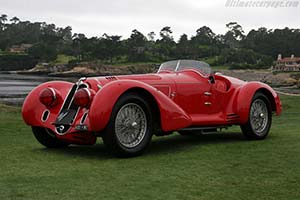
Page 1 of 1  First introduced in the 8C 2300, the Vittorio Jano designed eight cylinder engine scored at least one victory in every major race and championship. In its initial 1931 configuration, the engine displaced 2336 cc, it grew gradually to 2905 cc, primarily by increasing the stroke. The engine was created by mounting two alloy blocks of four cylinders on a single crankcase. On top of the two blocks an alloy head was installed, housing two camshafts. Aspiration was forced, through two Roots-Type Superchargers. First introduced in the 8C 2300, the Vittorio Jano designed eight cylinder engine scored at least one victory in every major race and championship. In its initial 1931 configuration, the engine displaced 2336 cc, it grew gradually to 2905 cc, primarily by increasing the stroke. The engine was created by mounting two alloy blocks of four cylinders on a single crankcase. On top of the two blocks an alloy head was installed, housing two camshafts. Aspiration was forced, through two Roots-Type Superchargers.Although the engine increased in size throughout its career, its layout and auxiliaries remained very much similar to Jano's 1931 design. One of the best known racing cars powered by the 8 cylinder engine was the Tipo B or P3 of 1932, which is to date considered as one of the finest Grand Prix racers ever constructed. Run by Enzo Ferrari's Scuderia Ferrari, the Alfa Romeos were almost unbeatable. From its 1931 introduction, the 8C 2300 took four straight victories in the 24 Hours of Le Mans, driven by talented drivers like Tazio Nuvolari and Luigi Chinetti. Tazio Nuvolari's brilliance was even more visible when driving the P3, the first single seater racer ever. The P3 was unbeaten in 1933, but eventually succumbed to defeat by the greater budgets being spent by Mercedes-Benz and Auto Union. With the rise of the German Grand Prix teams, Alfa Romeo focused more of its attention on sportscar and road racing. Designed specifically for Italy's most legendary road race, the Mille Miglia, was the 8C 2900. Much like the contemporary Grand Prix racers, the 8C 2900 featured all-round independent suspension, with wishbones at the front and swing-axles at the rear. Installed in the chassis was a 220 bhp version of the 2.9 litre eight cylinder engine. A total of six of these road racers, later known as 8C 2900A, were constructed. Three of these were entered in the 1936 running of the Mille Miglia. The new cars were immediately successful and occupied the first three places at the finish with the Brivio and Ongaro driven 8C on top. A year later a second victory was scored. With the winning cars as a base, a road going customer version was constructed. Dubbed 8C 2900B, the road car featured a de-tuned engine, but other than that is very similar to the racer. Two versions were available, the 2800 mm short wheelbase (Corto) and 3000 mm long wheelbase (Lungo) versions. Most of these were sent to Touring to be fitted with Berlinetta, Spyder and Roadster bodies. With its competition chassis and high top speed it was faster and quicker than anything its competition had to offer. Due to its high price, only a very few of these supercars were constructed (10 Lungo and 20 Corto chassis). Being very similar to the competition 8C 2900A, it came as no surprise the 8C 2900B was used as a racer as well. To suit this purpose Alfa Romeo constructed a further 13 8C 2900B chassis fitted with the 220 bhp engine. Many of these were fitted with roadster bodies and were competed in road races like the Mille Miglia. After the two 8C 2900A victories in 1936 and 1937, another two victories were scored by the 8C 2900B in 1938 and 1947. No other Alfa Romeo has scored as many 'MM' victories as the 8C 2900. Page 1 of 1 |
| Article | Image gallery (14) | 412030 | Specifications |
| All Cars - Contact us - Privacy Statement - Top | © 1998 - 2026 Ultimatecarpage.com |