Go to Ultimatecarpage.com

Car search: Quick Advanced 
  Ultimatecarpage.com  > Cars by brand  > Italy  > Ferrari
225 Inter Vignale Berlinetta
Cars statistics: 5055 cars, 431 makes, 39426 images; Events statistics: 215 reports, 41349 images; Forum statistics: 85,362 members, 41,972 topics; more...


  Ferrari 225 Inter Vignale Berlinetta
 

Ferrari 225 Inter Vignale Berlinetta Ferrari 225 Inter Vignale Berlinetta Ferrari 225 Inter Vignale Berlinetta Ferrari 225 Inter Vignale Berlinetta Ferrari 225 Inter Vignale Berlinetta Ferrari 225 Inter Vignale Berlinetta
Click here to save all images    Image credits: Wouter Melissen 

Model history:
Click here to download printer friendly version Ferrari's earliest production cars all shared common components that were first found on the Ferrari 125 S. Their exact specification and dimensions varied to create individual models. From 1948 two distinct model lines were available; the 166 MM and the 166 Inter. Although both names refer to famous race victories (the 1948 Mille Miglia and the Copa Intereuropa that same year), only the 166 MM was sold as a full racing car. With a milder engine and a longer wheelbase, the 'Inter' was considered a road car.

Both models sported a 2-litre version of the Gioacchino Colombo designed V12 engine. The 166 in the type name referred to the unitary displacement of the engine in 'cc'. The milder street spec used just one Weber Carburetor. This was sufficient to draw 115 bhp from the all-aluminium single overhead camshaft engine. By comparison, the triple Weber equipped 166 MM engine was good for around 140 bhp. The engine was mated to a five-speed gearbox that was also built in-house.

Ferrari's first chassis design was even more universally used in those early years as the engine. The chassis frame was constructed from two elliptical steel side-members with several cross-members for added rigidity. At the front the suspension consisted of double wishbones with a transverse leaf spring and hydraulic shock absorbers. The rear suspension was even more straightforward with a live-axle and longitudinal semi-elliptic leaf springs. As was inevitable in the day, braking was provided by hydraulic drums.

Although Ferrari 'standardized' their line-up, the cars were still delivered as rolling chassis only for custom coach-builders to body. Additionally the final finish and trim of each of these was catered to the individual demands of the customers. This meant that no two Inters were identical. Introduced in March of 1948, the first 166 Inter featured a Touring built Coupe body that would become the most popular choice. Vignale, Stabilimenti Farina, Bertone and Ghia were also commissioned to cloth the 166 Inter chassis.

In its 2-litre guise the V12 was already a development (enlargement) of Colombo's original design, which had a displacement of just 1.5 litre. There was however room left to add even more volume to the engine, resulting in the 195 (2.3 litre) and 212 (2.6 litre) versions of the same engine. The changes were so minimal that many of the existing engines were later modified to give them some additional punch. The 166 Inter model was officially replaced in 1950 by the similar but larger engined 195 Inter. A year later, this was joined in the line-up by the 212 Inter.

Production of Ferrari's first road car eventually ceased in 1952. In those five years just 142 examples were produced of the 166, 195 and 212 Inters. The Inter's real successor was the 250 GT introduced two years later, which really established Ferrari as a road car manufacturer. Interestingly the 250 GT engine was yet a further development of the Colombo 'short block' V12 and the chassis also shared many traits with the very first Ferraris.


Chassis: 0223EL
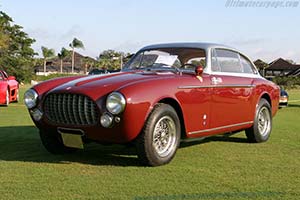
Chassis 0223EL Although a larger '225' or 2.7 litre version of the V12 engine had also become available, the featured car is the only Inter chassis to sport the engine. It is often referred to as a 212 Inter but the larger engine warrants the '225 Inter' type name. It is fitted with a Giovanni Michelotti designed body that was built by Vignale. In recent years the unique Ferrari has been often raced and shown at a wide variety of events. It is seen here at the 2005 Cavallino Classic and the Palm Beach International, a Concours d'Elegance a day later.

Article by Wouter Melissen, last updated on May 17, 2006

Add your comments on the Ferrari 225 Inter Vignale Berlinetta


General specifications
Country of origin Italy
Chassis number 0223EL
Numbers built one-off
Produced in 1952
Body design Vignale

Engine
Configuration 60º V12
Location Front, longitudinally mounted
Construction light alloy block and head
Displacement 2.715 liter / 165.7 cu in
Bore / Stroke 70.0 mm (2.8 in) / 58.8 mm (2.3 in)
Compression 8.5:1
Valvetrain 2 valves / cylinder, SOHC
Fuel feed 3 Weber Carburettors
Aspiration Naturally Aspirated
Power 210 bhp / 157 KW @ 7200 rpm
BHP/Liter 77 bhp / liter

Drivetrain
Chassis body on steel tubular frame
Front suspension independent with transverse leaf spring and hydraulic dampers
Rear suspension live axle, semi-elliptic longitudinal leaf springs, hydraulic dampers and anti-roll bar
Steering worm and sector
Brakes drums, all-round
Gearbox 5 speed Manual
Drive Rear wheel drive

Dimensions
Weight 1000 kilo / 2204.6 lbs
Wheelbase / Track (fr/r) 2600 mm (102.4 in) / 1270 mm (50 in) / 1250 mm (49.2 in)

Performance figures
Power to weight 0.21 bhp / kg

Resources
Related articles
Useful links