
| lmp |
 Ultimatecarpage.com
> Cars by brand
> Germany
> Porsche
Ultimatecarpage.com
> Cars by brand
> Germany
> Porsche
 Racing cars
> LMP RS Spyder Evo Racing cars
> LMP RS Spyder Evo
|
| Porsche RS Spyder Evo |
| Article | Image gallery (144) | Chassis (3) | Specifications | User Comments (3) |
|
|
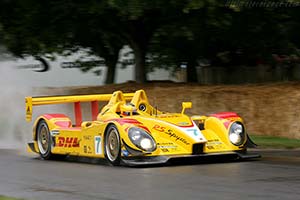
Page 1 of 1  Over the years Porsche have built a rock solid reputation in sportscar racing with a collection of victories that is unmatched. This is something to cherish, but it also sets the bar very high for every new Porsche racing car; anything but winning can be considered a failure. Complementing all the know-how gathered over the years, the one thing that is required to make a car really successful is proper funding. At the end of the 1990s Porsche decided that funding was better spent on a brand new model than on a replacement for the 1998 Le Mans winning 911 GT1 EVO. The purists were horrified to learn that Porsche had abandoned a V10 engined sports racer in favour of a Sports Utility Vehicle. From a business perspective this new strategy proved to be the right one and the Cayenne really turned Porsche's fortunes around. Over the years Porsche have built a rock solid reputation in sportscar racing with a collection of victories that is unmatched. This is something to cherish, but it also sets the bar very high for every new Porsche racing car; anything but winning can be considered a failure. Complementing all the know-how gathered over the years, the one thing that is required to make a car really successful is proper funding. At the end of the 1990s Porsche decided that funding was better spent on a brand new model than on a replacement for the 1998 Le Mans winning 911 GT1 EVO. The purists were horrified to learn that Porsche had abandoned a V10 engined sports racer in favour of a Sports Utility Vehicle. From a business perspective this new strategy proved to be the right one and the Cayenne really turned Porsche's fortunes around.The motorsport department was not shut down completely and concentrated on the production of racing variants of the 911 model. Campaigned by privateers (often with factory support), these 911 GT3s were highly successful and took a class win at Le Mans seven years running. With the financial problems resolved, it was time for Porsche to increase the motorsport program once again. At that time sportscar racing was made up of two classes; LMP1 and LMP2. The differences between the classes were limited with the P1 intended for manufacturers and the P2 class for privateer teams. After having a close look at the regulations, the German manufacturer concluded that the P1 regulations favoured diesel engines too much, so they decided to develop a P2 racer for privateers to run. Porsche did not sell diesel engined cars and clearly had no intention to do so in the future. Internally known as the 9R6, the new Porsche racer was christened RS Spyder. The design followed a familiar pattern of a carbon fibre monocoque with double wishbones at every corner. It did distinguish itself from the competition by using the specifically developed 3.4 litre V8 engine as a full load bearing member of chassis. Breathing through the mandatory restrictors this 'MR6' engine developed a quoted 480 bhp. It was mated to a six speed gearbox operated by paddles behind the steering wheel. The package was rounded off by a carbon fibre body of a very conventional design. The total package weighed in at the minimum weight of 750 kg. After extensive testing throughout 2005, the RS Spyder was ready in time to debut in the American Le Mans Series (ALMS) for the season's final round at Laguna Seca. Being a privateer class, Porsche could not enter the car themselves, but in Penske Motorsports found the next best option. The Roger Penske run organisation had once before served as Porsche's representative in the United States many years before with the all conquering 917/30, so the competition was rightfully wary of the new arrival. Their worst fears were confirmed when the bright yellow racer took a convincing class win at its debut, many laps ahead of the closest rivals. For 2006 Penske (Porsche) concentrated on the ten rounds of the ALMS and ignored Le Mans as they felt the car was not strong enough to survive the 24 Hours race. This was underlined at the season opening Sebring 12 Hours where the two Porsches were again blisteringly quick, but lacked reliability. Despite several gearbox related retirements, the RS Spyder dominated its class throughout the season and even managed to take a scratch win. At the end of the season Lucas Luhr and Sacha Maassen were crowned LMP2 champions. Halfway through the 2006 season, Acura announced its intention to build LMP2 engines and cars from 2007 onwards. Anticipating the increased level of competition, Porsche completely reworked the RS Spyder's bodywork and carried through some further detail changes. Officially the power figure was hiked to 503 bhp, but 540 bhp could be closer to the truth. ALMS was again the sole focus of the program and in Dyson, Porsche found a second customer. So at Sebring four Porsches took to the track against three Acura engined machines. Unfortunately the modifications made over the winter were not enough to make the RS Spyders reliable as teething problems paved the way for a debut win for Acura. This was rectified in the remainder of the season with the RS Spyder winning its class at every occasion and taking eight outright victories against the much more powerful LMP1 cars. Entering the third full season of the program, Porsche finally expanded to Europe and sold three chassis to be raced in the 2008 Le Mans Series. More importantly two of these teams would bring the RS Spyder to race at Le Mans for the first time. For 2008 the cars were updated in detail only and looked very similar to the 2007 spec RS Spyder. The first competitive outing for the RS Spyder was the Sebring 12 Hours, where the car had struggled so much the previous two years. All that was quickly forgotten as one of the Penske Porsches not only managed to win its class, but also beat the Audi R10 and Peugeot 908 for the overall victory. During the following three races, Penske won another race outright and recorded an additional class win. In Europe the three RS Spyders proved to be superior to the other LMP2 machines, dominating the first three races of the Le Mans Series. All eyes were now on Le Mans, where both Van Merksteijn and Team Essex would field their RS Spyders. It would be the first time the quick prototype racer tackled the legendary endurance race as in previous years Porsche did not believe the car was reliable enough to survive 24 hours of hard racing. During the practice sessions, it was quickly obvious that the RS Spyder was once more the car to beat in its class, although it could not rival the top runners. Changing conditions and some minor problems could not stop the two Porsches to score a one-two in class with the Van Merksteijn car taking top honours. In less than three years the Porsche RS Spyder has now pretty much won everything and certainly ranks as the best LMP2 car around. With little more to prove, will Porsche now move up to the LMP1 class and really challenge the top runners? Page 1 of 1 |
| Article | Image gallery (144) | Chassis (3) | Specifications | User Comments (3) |
| All Cars - Contact us - Privacy Statement - Top | © 1998 - 2026 Ultimatecarpage.com |