
| f1 |
 Ultimatecarpage.com
> Cars by brand
> Great Britain
> Ferguson
Ultimatecarpage.com
> Cars by brand
> Great Britain
> Ferguson
 Racing cars
> Formula 1 P99 Climax Racing cars
> Formula 1 P99 Climax
|
| Ferguson P99 Climax |
| Article | Image gallery (38) | Specifications |
|
|
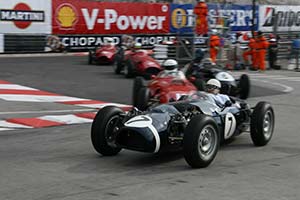
Page 1 of 1  All wheel drive systems had become a popular option for vehicles Venturing out into rough terrain when at the end of the 1950s Harry Ferguson felt that his new system was so efficient that it could also be used on racing tracks. There had been similar attempts in the past, but the system proved difficult to implement and the additional drivetrain often soaked up a lot of the engine's performance. To prove his point he did not just join a local racing series, but he immediately went all out by having a Formula 1 car designed. He did so at a time when the sport was going through some fundamental changes and it was very difficult for a new team to keep. All wheel drive systems had become a popular option for vehicles Venturing out into rough terrain when at the end of the 1950s Harry Ferguson felt that his new system was so efficient that it could also be used on racing tracks. There had been similar attempts in the past, but the system proved difficult to implement and the additional drivetrain often soaked up a lot of the engine's performance. To prove his point he did not just join a local racing series, but he immediately went all out by having a Formula 1 car designed. He did so at a time when the sport was going through some fundamental changes and it was very difficult for a new team to keep.Harry Ferguson was determined to make it a success and hired former Jaguar and Aston Martin employees as technical directors. When the project started, Cooper was still in the process of convincing the rest of the world that the mid-engined layout was really a step forward. Ferguson's engineers must have figured that the four wheel drive system would eliminate most of the new layout's advantages and that a 50:50 weight balance was going to be key, so they chose for a conventional front engined layout. There was nothing extraordinary about the tubular spaceframe chassis drafted up either. To compensate for the additional weight of the more complex drivetrain, many of the non-load bearing parts were made from very lightweight exotic materials. As the project was nearing completion the announcement of changing the maximum displacement from 2.5 to 1.5 litre was a major disappointment. All of a sudden efficiency was even more important and the future of the project looked dim. It also did not help that the British manufacturers were reluctant to accept or just ignored these rule changes, so there was no suitable engine available for the 1961 season. As a stop-gap the British teams were forced to use a modified version of the old four cylinder Climax engine, whereas Ferrari was miles ahead with their powerful V6 engines. Ferguson carried on and the car was completed in time for the British Grand Prix at Aintree. In the months building up to the introduction, Ferguson's PR machine had done a very good job and the Ferguson P99 was prominently featured in many automotive magazines. Of course the main point of interest was the four wheel drive system. It consisted of a transferbox bolted directly to the five speed gearbox. The engine was installed at an angle to make room for the driveshaft to the front differential. The rear driveshaft was installed on the left side of the chassis and the driving position was slightly off-centre to the right. Similar to the weight balance, the torque was virtually evenly divided between the front and rear wheels. Thanks to very smart packaging the completed car was very low and looked quite the part. For the British Grand Prix the car was handed to Rob Walker, who entered it livered in his familiar colours for Jack Fairman. He struggled with the car, even though the wet conditions were in its favour, throughout the race and was eventually relieved from his duties by Stirling Moss. In Moss' hands the Ferguson started to show its real class as the talented British racer piloted it up the leaderbord. Unfortunately the car was disqualified for receiving a push-start earlier in the race. Impressed by the P99, Moss spent a lot of time that summer adopting a new driving style, better suited to the four wheel drive car. He showcased the car's true potential at the non-Championship race at Oulton Park, where he scored a victory in damp conditions. After that Grand Prix win, the car was fitted with a larger, 2.5 litre engine for Tasman and Indy racing, but never proved to be as successful as it had been in Moss' hands. In 1964 Peter Westbury made the most of the four wheel drive system by winning the British Hillclimb Championship. After its long racing career, the unique Ferguson P99 was loaned to the Donnington Collection. It remained in the hugely impressive museum for nearly four decades alongside most of the other but less successful four wheel drive F1 cars. The P99 was retrieved from the Collection by the Ferguson family in 2004 and submitted to a full restoration. Although the car was in very original condition, the very complicated project took 18 months to complete. In the fall of 2005 the Ferguson was reunited with Stirling Moss, who raced it at the Goodwood Revival. He was back in the car at the Monaco Historic Grand Prix a few months later. Moss also practiced the car at Goodwood in 2006 but he felt he could no longer do the car justice and handed it to Barrie Williams for the race. In damp conditions he fought his way up the order from 18th to third. He has driven the unique car at every Revival since, fighting for victory at each occasion. The Ferguson family has now decided to part with the unique racing car. The only four wheel drive car to win a Formula 1 race, will be offered in RM Auctions' 2010 Automobiles of London sale on October 27th. It is still in remarkably original condition and is fitted with the 2.5 litre Climax engine used in the final races of its contemporary career. The pre-sale estimate is £475,000-£575,000. Page 1 of 1 |
| Article | Image gallery (38) | Specifications |
| All Cars - Contact us - Privacy Statement - Top | © 1998 - 2026 Ultimatecarpage.com |