Page 1 of 1 To complicate things for the racing car manufacturers, 1930s Grand Prix races were held on both twisty technical and high speed tracks. In the first years of the decade the sport's governing body did not set any real restrictions on what cars were eligible; it was hard enough to get a full field in these years of severe depression. Few manufacturers were capable of producing a single vehicle for both track types, so they exploited the lack of restrictions by racing a nimble or a powerful Grand Prix car depending on the track. Alfa Romeo and Maserati both fielded special high speed cars using twin six cylinders and a V16 created from two eight cylinders respectively.
With the various versions of the Type 35 Bugatti had been a dominant force in motor racing for many years but by the turn of the decade, the winningest racer ever was showing its age. For 1931 a replacement was readied with a twin overhead camshaft eight cylinder engine. Dubbed the Type 54, it was available with a variety of displacements with an optional Supercharger. Like the Type 35, this was a nimble machine perfectly suited to the more technical tracks, but it was no match for the powerful Italians. Bugatti's first attempt to build a high speed monster was the ill-fated Type 45/47, which like the Alfa featured two parallel engines, but it was never raced.
The 1931 season had been a great success, but now that the Monza Grand Prix neared, Bugatti became increasingly worried about not having a competitive car. In a remarkable thirteen days the Type 45 chassis was equipped with a Type 50 engine to form the Type 54 Grand Prix car. Displacing just under five litres, the big supercharged eight cylinder engine produced a stunning 300 bhp. To cope with all this power a special reinforced three-speed gearbox was installed, instead of the commonly used four speed 'box. The chassis and suspension were of the typical Bugatti design with a ladder frame suspended by live axles front and rear. The wheel mounted drums were operated by cables.
In the hands of Louis Chiron and Archille Varzi, the first two Type 54s debuted at Monza. Both cars suffered from tyre problems, but Varzi still managed to secure a promising third position. It quickly became clear that the powerful engine and the ladder frame chassis were not a match made in heaven as the Type 54 proved to be very difficult to drive. Many years later Phil Hill tried one at the Monterey Historics and called it the scariest car he had ever raced. Nevertheless Varzi managed to score a win at Avus in 1933 where the long straights more than compensated for the time lost in the two corners. The car's troubled career came to a dramatic finale when Count Stanislas Czaykowski lost his life in the 1933 Monza Grand Prix.
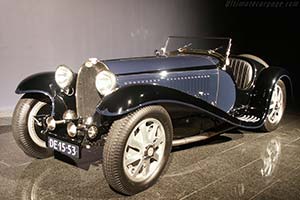
As the interest in Grand Prix racing grew once more, new rules were introduced for 1934. The most important was the maximum weight of 750 kg, which left the heavy Type 54 obsolete for the Grands Prix, but it could continue in the less important Formula Libre races. After their active career at least two Type 54s were equipped with two seater roadster bodies for road use. Another one was subject to several modifications and raced for many more years; it was qualified on pole for the 1950 Watkins Glen Grand Prix. The Type 54 chassis also formed the basis for the beautiful Type 55 road cars. Page 1 of 1

 Ultimatecarpage.com
> Cars by brand
> France
> Bugatti
Ultimatecarpage.com
> Cars by brand
> France
> Bugatti
 Type 54 Bachelier Roadster
 To complicate things for the racing car manufacturers, 1930s Grand Prix races were held on both twisty technical and high speed tracks. In the first years of the decade the sport's governing body did not set any real restrictions on what cars were eligible; it was hard enough to get a full field in these years of severe depression. Few manufacturers were capable of producing a single vehicle for both track types, so they exploited the lack of restrictions by racing a nimble or a powerful Grand Prix car depending on the track. Alfa Romeo and Maserati both fielded special high speed cars using twin six cylinders and a V16 created from two eight cylinders respectively.