Go to Ultimatecarpage.com

Car search: Quick Advanced 
 groupc Ultimatecarpage.com  > Cars by brand  > Japan  > Mazda
Racing cars  > Group C / IMSA GTP
     787B
Cars statistics: 5055 cars, 431 makes, 39426 images; Events statistics: 215 reports, 41349 images; Forum statistics: 85,365 members, 41,972 topics; more...


  Mazda 787B
 

Mazda 787B Mazda 787B Mazda 787B Mazda 787B Mazda 787B Mazda 787B
Click here to save all images    Image credits: Wouter Melissen 

Model history:
Click here to download printer friendly version Mazda entered the record books in 1991 as the first Japanese manufacturer to win the 24 Hours of Le Mans outright. Of the three companies from the land of the rising sun, Mazda was the smallest and the least likely to achieve this feat. Nissan and Toyota were however outdone by a combination of meticulous preparation and a superb drive in a gradually developed machine.

Like all of Mazda's previous racing efforts, the endurance program served to showcase the capabilities of the 'Wankel' or 'rotary' engine the manufacturer had already secured a license for in 1961. Up until 1991 the Mazda prototypes were not capable of keeping up with the conventionally engined competition and had to contend to 'IMSA GTP' class victories. Time was running out, however, as drastic engine regulation changes would soon make the rotary engine illegal.

In 1990 Mazda debuted the all-new 787 in the 24 Hours of Le Mans. Like the company's previous prototypes, the chassis was designed by Nigel Stroud and constructed in England. The tubs were then sent to Japan for completion by Mazda's racing subsidiary Mazdaspeed. What set it apart from the earlier designs, was the use of carbon-fibre composites with a honeycomb structure for the complete chassis. For 1991 the suspension geometry was changed to accommodate for larger wheels and carbon-ceramic discs were fitted for the first time to create the 787B.

Three decades of constant development had resulted in the R26B rotary engine, which featured four rotors, variable inlet trumpets and three spark plugs per rotor. One of the biggest modifications compared to the 1990 version of the R26B was the variable trumpet system, which was now continuously variable instead of sliding between several predetermined positions. At 9,000 rpm the compact engine produced an impressive 700 bhp and torque was increased to 608 Nm at 6,500.

Efficiency was a key factor in this period at Le Mans due to the restricted amount of fuel available for each car. In preparation for the race, Mazdaspeed's engineers figured that completing 367 laps in 24 hours would be sufficient for victory, so they set about optimising the new 787B to achieve that goal. As a result the maximum engine revs were limited to 8,500 rpm, restricting the power to 650 bhp. Much emphasis was also put on achieving the highest cornering speeds possible as that would improve performance without affecting consumption.

Covering all bases, Mazdaspeed also obtained the services of Le Mans legend Jacky Ickx as an adviser. He suggested using Hugues de Chaunac's Oreca team to run the cars in Europe after competing with the French squad in the Dakar rally. Early in 1991 Oreca conducted a long distance test at Paul Ricard with an evolution of the 787, followed by another with the final 787B in April. At that time, the 787B had already made its competition debut at Suzuka where it placed sixth, followed by a ninth position at Monza.

For Le Mans, Mazda brought two 787Bs and a 787 as back-up. The cars were entered in the C2 class along with the other 'current generation' Group C cars. The C1 class was for the cars built to the new regulations and fitted with the Formula 1 inspired 3.5 litre, naturally aspirated engines. To encourage the production of C1 cars, they were favoured by the regulations and most of the earlier cars received weight penalties. Mazda handily convinced the governing bodies to keep the minimum weight for their cars at 830 kg.

Assigned to drive the 787Bs were David Kennedy, Stefan Johansson and Maurizio Sandro-Sala (#18) and Volker Weidler, Johnny Herbert and Bertrand Gachot (#55). The #56 Mazda 787 was handled by Takashi Yorino, Yojiro Terada and Pierre Dieudonné. Practice revealed that the time and resources were well spent as the 'B' proved to be over 5 seconds faster than the 1990 spec 787. Particularly the carbon-ceramic brakes, never used before by any manufacturer at Le Mans, were a great asset.

Due to the modest results in Mazda's previous outings at Le Mans, the Japanese manufacturer did not rank among the pre-race favourites, which included the likes of Jaguar, Mercedes-Benz, Toyota and Peugeot. In qualifying the two 787Bs set the 12th (#55) and 17th (#18) fastest times but they had to start in 19th and 23rd place respectively as the rules dictated that the C1 cars would take the first slots on the grid. The 787 was 24th fastest and started in 30th position.

During the race the Mazda drivers were given a very specific lap time to run with an eye on completing the calculated 367 laps without running out of fuel. This pace was higher than the competition could have imagined and especially caught out the Jaguar cars, which had to slow down in the morning to preserve fuel. Faster still were the Sauber-Mercedes C11s but the additional weight they were forced to carry also had an effect on reliability.

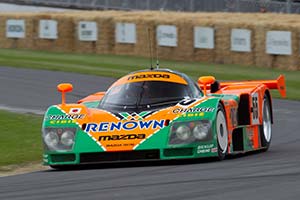
The bright-orange and green #55 turned out to be the faster of the two 787Bs and it was running second when the leading Sauber was forced into the pit for a prolonged stop. This handed the lead to the very skilfully driven Mazda 787B with less than three hours to go. The flawless performance resulted in the historic victory; the first for a Japanese car, the first for a rotary engine and the first with carbon-ceramic brakes. The other two Mazdas finished in a more than commendable 6th and 8th.

The Le Mans winning Mazda 787B was returned to Japan and disassembled in front of the gathered media. Close inspection of the parts suggested that the car could have run for another 24 hours without problems. A third 787B was built to replace the Le Mans winner in the remaining rounds of the championship. These 'sprint' races did not particularly suit the Mazda and no notable results were scored.

Reluctant on giving up on sports car races without defending the Le Mans crown, Mazda fielded a V10-engined, TWR developed car in 1992 but it would prove no match for the now thoroughly developed Peugeot 905s. Mazda's withdrew from sports car racing at the end of the year and since then has only supported privately backed efforts as an engine supplier. To date, the Mazda 787B remains the only Japanese machine to have ever mastered the legendary 24 Hours of Le Mans.


Chassis: 787B - 002
Chassis 787B - 002 Chassis 002 was the second of three 787Bs constructed for Mazda's 1991 sports car racing program. It made its competition debut at the Fuji 1,000 km race in May, finishing sixth overall and first in the GTP class. The car's next outing was the 24 Hours of Le Mans where it was driven to the historic victory by youngsters Herbert, Weidler and Gachot. It was retired from active service after the race and has since been the pride of the Mazda museum.

In the late 1990s the car was given several outings around the world. At one of these occasions the rear-end was slightly damaged. Ahead of the 20th anniversary celebrations of the Le Mans victory, chassis 002 was restored to full running order by Mazdaspeed. After a shake-down by former Mazda works drivers, the car was shipped to Le Mans. Here it was demonstrated twice ahead of the race, first by actor and Mazda spokes-person Patrick Dempsey and on Saturday morning by Johnny Herbert. He immediately was back on the pace and the rotary engine's glorious howl provided the best soundtrack of the weekend.

Article by Wouter Melissen, last updated on June 27, 2011

Add your comments on the Mazda 787B

 This car is a legend!  
pablo_81
06-27-2011
One of my favorite cars. Their sound is furious and heavenly!
     

General specifications
Country of origin Japan
Chassis number 787B - 002
Numbers built 3
Produced in 1991
Body design Nigel Stroud for Mazdaspeed

Major wins
1991 24 Hours of Le Mans (Bertrand Cachot / Johnny Herbert / Volker Weidler)

Engine
Configuration R26B R4
Location Mid, longitudinally mounted
Displacement 2.616 liter / 159.6 cu in
Fuel feed Electronic Fuel Injection
Aspiration Naturally Aspirated
Power 700 bhp / 522 KW @ 9000 rpm
Torque 608 Nm / 448 ft lbs @ 6500 rpm
BHP/Liter 268 bhp / liter

Drivetrain
Chassis carbon fibre monocoque
Suspension (fr/r) double wishbones, inboard coil springs over shock absorbers, anti-roll bar
Steering rack-and-pinion
Brakes carbon-ceramic discs, all-round
Gearbox Mazda-Porsche 5 speed Manual
Drive Rear wheel drive

Dimensions
Weight 830 kilo / 1829.8 lbs
Length / Width / Height 4782 mm (188.3 in) / 1994 mm (78.5 in) / 1003 mm (39.5 in)
Wheelbase / Track (fr/r) 2660 mm (104.7 in) / 1534 mm (60.4 in) / 1504 mm (59.2 in)

Performance figures
Power to weight 0.84 bhp / kg

Resources
Suggested reading
  • Never Stop Challenging - Mazda's Conquest of Le Mans, by Pierre Dieudonné
Related articles
Useful links