Go to Ultimatecarpage.com

  Ultimatecarpage.com  > Cars by brand  > Italy  > Ferrari
Racing cars  > Other Sportscars
     166 MM Touring Barchetta Speciale
Cars statistics: 3880 cars, 379 makes, 27362 images; Events statistics: 153 reports, 26309 images; Forum statistics: 75,551 members, 37,962 topics; more...


Ferrari 166 MM Touring Barchetta Speciale

Ferrari 166 MM Touring Barchetta Speciale Ferrari 166 MM Touring Barchetta Speciale Ferrari 166 MM Touring Barchetta Speciale Ferrari 166 MM Touring Barchetta Speciale Ferrari 166 MM Touring Barchetta Speciale Ferrari 166 MM Touring Barchetta Speciale
Click here to save all images    Image credits: Rob Clements 


Click here to download printer friendly version Ferrari's first sports racing cars rank among the historians biggest nightmare; the cars were continually changing mix of engines, chassis and body styles. The car that is currently believed to be the oldest existing Ferrari chassis, s/n 002C, has been fitted with at least three different engines and as many bodies. At the end of 1948 Ferrari launched their first 'production' car and from then onward the history of Ferrari cars gets a little less complex. To commemorate the victory of a Ferrari 166 Sport in the Mille Miglia, the new competition car is dubbed 166 MM.

Technically the 166 MM was very similar to the first Ferraris, and shared the tubular frame that was characteristic for all of the company's sports cars of the 1940s and 1950s. Suspension was equally straightforward with wishbones at the front and a live rear axle at the rear. Where the early Ferraris really excelled was in the engine compartment, which housed the beautifully Gioacchino Colombo designed V12. In its first configuration the tiny engine only displaced 1.5 litre, but in its third incarnation had grown in size to just under two litres or 166 cc per cylinder.

What set the 166 MM apart from the previous Ferrari racers was the new car's body design and construction, for which a third party was commissioned. What the small car needed was a lightweight body; a task ideally suited for Touring of Milan whose Superleggera designs were the lightest available. At the car's Turin launch the press quickly dubbed the Touring bodystyle fitted 'Barchetta', which is Italian for little boat. The name stuck, as did the design, which today is the most famous Touring design ever fitted on a Ferrari chassis.

Ferrari had intended the 166 MM mainly as a customer racing car, but when they discovered the potential a number of works cars were also constructed. Between 1948 and 1950 just 30 examples were constructed of which 25 were fitted with the Touring Barchetta body. By the time the last 166 MM was constructed, Ferrari had diverted their attention at exploring the full potential of the long block Lampredi design V12. In those early 1950s the interest in two litre racers quickly grew and to meet the demand Ferrari constructed a second series of 166 MMs in 1953.

Both in the hands of the works drivers and privateers the 166 MM proved to be a very commendable racer, with a large number of class and overall victories. The most famous of these victories was scored at Le Mans in 1949, where Ferrari scored a victory the first time out. The winning car was entered by Lord Selsdon, but the later North American Ferrari importer Luigi Chinetti did most of the driving, 23 hours to be precise. The only reason Lord Selsdon took the helm of his Ferrari was to comply with the regulations.

The 166 MM was a big success on and off the track and contributed greatly to the conversion of the Scuderia Ferrari racing team to a full fledged manufacturer of road and racing cars. After being abandoned for a number of years, the Colombo engine was revived and would form the basis of the 250 GT series powerplant, which had an identical bore as the 166 MM engine.

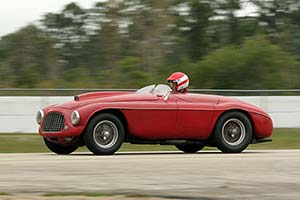
Pictured is one of the most exciting barn-finds of recent years; Ferrari 166 MM, s/n 0052 M. Although it was never really lost, it was hidden from the public eye for almost fifty years. It finally reappeared in the September/October 2006 issue of Cavallino Magazine, some two years after the first contact was made with the late owner's relatives. Symbolic Motorsport brokered a deal for the current owner and the highly original machine left the Arizona desert and entered his stable early in 2006. In the following months he started to take the car apart for a mechanical rebuild, carefully preserving the car's patina.

During the disassembling process of the engine he made some very interesting discoveries; it was no ordinary 166 MM, but in fact the slightly different Formula 2 engine. The first major clue was the gear drive for the camshafts instead of the usual chain drive. The engine stampings also suggested it was built in the same batch as the engines fitted to the two-litre F2 racers. It was the very first 166 MM to feature this type of engine and the matching numbers suggest it was fitted with it from its conception in 1950. It is now believed that 0052 M was in fact a factory experimental machine.

In the meantime marque expert Marcel Massini spent many hours in his archive to compare old pictures to get a clear view on the unique machine's competition history. He discovered it was raced at Le Mans in 1950 by the 1949 winner Lord Selsdon and a new co-driver Jean Lucas. An accident at Tertre Rouge meant a premature end for the Ferrari. During the next few years, it was actively raced in Europe with considerable success. Recognizable by its large hood scoop and red brake drums, it was also most likely also featured in the Touring 166 MM brochure. Its racing career ended in 1955 and it subsequently changed hands various times before being sold to a Californian in 1959, who rarely drove it. The 166 MM eventually ended up in the hands of an Arizonian who stored the car for the next forty-five years.

After its front-page magazine feature, the original and special 166 MM was first shown in public at the 2007 Cavallino Classis were the 166 MM model was one of the featured themes. The owner briefly drove his 166 MM on the Moroso track, before showing it on the concours field in front of the Breakers Hotel in Palm Beach. Courtesy of the mechanical, the owner told us that 0052 M now yields the best of both worlds: the highly original look and feel, while it drives like new.

During the car's stay in Florida, our photographer Rob Clements caught up with the oldest original Ferrari racing car and its very proud owner to capture every little detail. Despite the very un-Florida weather, the above gallery shows he succeeded very well. We would like to thank the owner for his help with the shoot and his patience in answering all our questions.

Article by Wouter Melissen, last updated on February 05, 2007

Add your comments on the Ferrari 166 MM Touring Barchetta Speciale

 Truth Mirrors fiction.  
nikbj68
02-12-2007
Ever heard of a Canadian Rock band called RUSH? (Bear with me....)

Check out the lyrics to their 1981 song "Red Barchetta":

"My uncle has a country place, that no one knows about
He says it used to be a farm, before the motor law.
And on sundays I elude the ’eyes’ and hop the turbine freight
To far outside the wire, where my white-haired uncle waits.

Jump to the ground
As the turbo slows to cross the borderline.
Run like the wind,
Excitement shivers up and down my spine.
Down in his barn
My uncle preserved for me, an old machine ---
For fifty-odd years,
To keep it as new has been his dearest dream.

I strip away the old debris, that hides a shining car
A brilliant red Barchetta, from a better, vanished time.
I fire up the willing engine, responding with a roar
Tires spitting gravel, I commit my weekly crime...

Wind in my hair ---
Shifting and drifting ---
Mechanical music ---
Adrenalin surge ---

Well-weathered leather
Hot metal and oil
The scented country air.
Sunlight on chrome
The blur of the landscape
Every nerve aware.

Suddenly, ahead of me, across the mountainside
A gleaming alloy air-car shoots towards me, two lanes wide.
I spin around with shrieking tires, to run the deadly race
Go screaming through the valley as another joins the chase.

Drive like the wind -
Straining the limits of machine and man.
Laughing out loud
With fear and hope, I’ve got a desperate plan.

At the one-lane bridge
I leave the giants stranded
At the riverside.
Race back to the farm
To dream with my uncle
At the fireside. "

  I guess I just like old Ferraris.  
NicFromLA
02-09-2007
This car only has 160hp, drives like a truck and looks like it belongs in a junk yard, but if I had a few million to drop on this car would I? You’d better believe it. What does that say about me? I guess I just like old Ferraris.
     
General specifications
Country of origin Italy
Chassis number 0052 M
Numbers built 25 (all barchettas)
Produced from 1948 - 1950
Introduced at 1948 Turin Motor Show
Body design Carlo Felice Bianchi Anderloni for Touring

Engine
Configuration Tipo 166 F2 60º V 12
Location Front, longitudinally mounted
Construction aluminium alloy block and head
Displacement 1.995 liter / 121.7 cu in
Bore / Stroke 60.0 mm (2.4 in) / 58.8 mm (2.3 in)
Compression 8.5:1
Valvetrain 2 valves / cylinder, SOHC
Fuel feed 3 Weber 36 DCF Carburettors
Aspiration Naturally Aspirated

Drivetrain
Chassis/body body on steel tubular frame
Front suspension independent with transverse leaf spring and hydraulic dampers
Rear suspension live axle, semi-elliptic longitudinal leaf springs, hydraulic dampers and anti-roll bar
Steering worm and peg
Brakes drums, all-round
Gearbox 5 speed Manual
Drive Rear wheel drive

Dimensions
Weight 650 kilo / 1433 lbs
Length / Width / Height 3607 mm (142 in) / 1524 mm (60 in) / 1067 mm (42 in)
Wheelbase / Track (fr/r) 2200 mm (86.6 in) / 1250 mm (49.2 in) / 1200 mm (47.2 in)

Performance figures
Power 160 bhp / 119 KW @ 7000 rpm
BHP/Liter 80 bhp / liter
Power to weight 0.25 bhp / kg

Resources
Suggested reading Cavallino Magazine, 154 (September/October 2006)
Related articles
Useful links


Ultimatecarpage.com - All Cars - Contact us - Privacy Statement - Top © 1998 - 2010 Ultimatecarpage.com