Go to Ultimatecarpage.com

Car search: Quick Advanced 
  Ultimatecarpage.com  > Cars by brand  > Germany  > Porsche
Racing cars  > GT Cars
     935/2.0 'Baby'
Cars statistics: 3263 cars, 324 makes, 21949 images; Events statistics: 124 reports, 20949 images; Forum statistics: 57,641 members, 34,500 topics; more...


Porsche 935/2.0 'Baby'

Porsche 935/2.0 'Baby' Porsche 935/2.0 'Baby' Porsche 935/2.0 'Baby' Porsche 935/2.0 'Baby' Porsche 935/2.0 'Baby' Porsche 935/2.0 'Baby'
Click here to save all images    Image credits: Wouter Melissen 


Click here to download printer friendly version In the quest to take an overall win at Le Mans, Porsche had moved far away from the principal that the company's racing cars should at least be related to the road cars. So after the 1970 and 1971 editions were won by the 917, it was no surprise that Porsche returned to their roots with a range of 911 based racers. The first of these were the Carrera RSR models based on the naturally aspirated 911. From the 1976 season these were replaced by a Group 4 and Group 5 racer derived from the recently introduced 911 Turbo or '930'. Especially the Group 5 car, dubbed the 935, had the priority of the Works team as that year's World Championship would be run for this type of racer.

Both the road going 930 and its racing derivatives found their roots in the experimental RSR based Turbos that were extensively raced in the three litre prototype class in the previous years. Taking in account the 1.4 turbo equivalency factor, it used a 2.1 litre six cylinder engine, which would be enlarged to three litres for the road car. The 934 Group 4 car was very similar to the street spec 911 Turbo and only raced by privateers and was nevertheless very successful in its class. The Group 5 homologation allowed for many more modifications with a minimum weight based on displacement as its most important rule.

In order to fit in the 'under the four litre' and '970 kg' group, the 935's engine could displace no more than 2857 cc. By using a slightly smaller bore of 92 mm, a displacement of just over 2.8 litre engine was created. A very large KKK turbocharger was hung behind the engine, mated to an intercooler. In this specification the turbocharged engine was good for 590 - 630 bhp depending on tune. The four speed gearbox was derived similar to that fitted to the Turbo road car and it was an altogether more sturdy 'box than the one that had proven to be the RSR Turbo's weak spot.

What really set Group 4 and Group 5 apart was the amount of work allowed on the chassis and body. The suspension was uprated with coil springs instead of torsion bars, adjustable anti-roll bars, and vented and cross-drilled discs were fitted all around. Outwardly the first incarnation of the 935 was very similar to the RSR Turbo with the basic 911 nose, extremely flared wheel-arches and a massive rear wing. After extensive testing, the original nose with the headlights poking out was found to create drag. It was controversially replaced by a flat nose with the lights moved into the bumpers.

Two cars were ready in time for the season opening races at Mugello and Vallelunga and with back to back wins the 935 looked set to become an instant success. It all changed dramatically when the sport's governing body asked whether the original 930 engine cover would still fit as required by the rules. The big intercooler prevented this and until a solution was found, the 935 was not allowed to race. A quick fix was the installation of the intercoolers fitted on the 934, but it took several races before that setup was made reliable. In the mean time BMW had been reeling in victories, but fortunately for Porsche, the revised 935s were ready in time to claim enough points to clinch the World Championship.

While assembling the first customer 935s late in 1976, Porsche was already busy developing the Works car for 1977 to defend the title. There were many detail changes to the running gear, suspension and aerodynamics, but what really set the 935/77 apart from its predecessor was the engine. Replacing the single large turbocharger were two smaller KKK units. These were used in the hopes of reducing turbo lag and also saw performance increase to 630 bhp and 680 bhp at the end of the season. With the bugs fully ironed there was very little the competition could do and the two-car Works team reigned supreme. One 935 was fielded at Le Mans, but was forced to retire fairly early on with a blown engine.

In the highly competitive and prestigious German championship, there were seperate Group 5 races for 'Division One' cars of under two litres and for 'Division Two' for over anything over that. BMW and Ford had highly entertaining fights in the Division One, whereas Porsche was the only serious contender in the second division. It got even worse for Porsche when it was announced that only the two-litre race of the 1977 Norisring round would be aired on television. Mainly to prove a point and get some additional air-time, Porsche Motorsport supremo Ernst Fuhrmann ordered his department to build a 935 derivative that would fit in the two-litre class with less than two months to go before the Norisring race.

Taking in account the 1.4 equivalency factor, the six cylinder engine could displace no more than 1425 cc and for the 935/2.0 or 'Baby', Porsche's engineers brought the displacement down to exactly that. Unlike the 935/77s, the 'Baby' sported just one turbocharger, but nevertheless produced a staggering 380 bhp. Amazingly they also managed to bring the weight down to below the minimum weight of 750 kg from the 880 kg that the unbalasted 935 weighed in at. Completed at the very last minute, there was just time enough to shake the car down once at Weissach, before it would make its racing debut.

The poor preparation was reflected in practice where poor engine response and very long gearing greatly hampered the performance. Jackie Ickx managed to no better than thirteenth, but in the race he quickly fought his way up to sixth. He then had to retire as poor insulation had heated the cockpit up too much for him to continue. For the next round, the Grand Prix support race at Hockenheim, all these bugs were ironed out and Ickx scored a convincing victory. Porsche had proven that they could take on the best in any class and the Porsche 935/2.0 'Baby' was never raced again.

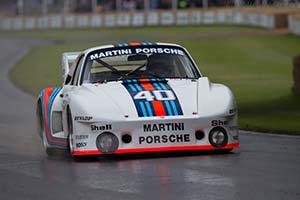
After its two-race career, the 935/2.0 'Baby' was retired and became part of the Porsche factory museum collection. It is seen here during a rare outing at the 2007 Goodwood Festival of Speed. It was driven by former Porsche Le Mans winner Vern Schuppan, today probably best known for his highly exclusive 962CR road cars.

Article by Wouter Melissen, last updated on 03 / 27 / 2008

Add your comments on the Porsche 935/2.0 'Baby'


General specifications
Country of origin Germany
Chassis number 935/01 - 001
Numbers built one-off
Produced in 1977

Engine
Configuration Type 911/79 B 6
Location Rear, longitudinally mounted
Construction aluminum block and head
Displacement 1.425 liter / 87 cu in
Bore / Stroke 71.0 mm (2.8 in) / 60.0 mm (2.4 in)
Compression 6.5:1
Valvetrain 2 valves / cylinder, SOHC
Fuel feed Bosch Fuel injection
Aspiration KKK Turbo

Drivetrain
Chassis/body unitary steel with fiberglass body panels
Front suspension McPherson struts, lower wishbones, adjustable anti-roll bar
Rear suspension double wishbones, coil springs over dampers, anti-roll bar
Steering rack-and-pinion
Brakes vented and cross-drill discs, all-round
Gearbox Type 915/50 5 speed Manual
Drive Rear wheel drive

Dimensions
Weight 750 kilo / 1653.5 lbs
Length / Width / Height 4680 mm (184.3 in) / N/A / N/A
Wheelbase / Track (fr/r) 2271 mm (89.4 in) / 1501 mm (59.1 in) / 1557 mm (61.3 in)

Performance figures
Power 380 bhp / 283 KW @ 8200 rpm
BHP/Liter 267 bhp / liter
Power to weight 0.51 bhp / kg

Resources
Suggested reading Porsche, Excelence was expected, by Karl Ludvigsen
Useful links


Ultimatecarpage.com - All Cars - Contact us - Privacy Statement - Top © 1998 - 2008 Ultimatecarpage.com