
 Ultimatecarpage.com
> Cars by brand
> France
> Delage
Ultimatecarpage.com
> Cars by brand
> France
> Delage
 Racing cars
> Pre 1950 GP DH V12 Racing cars
> Pre 1950 GP DH V12
|
| Delage DH V12 |
| Article | Image gallery (16) | Specifications |
|
|
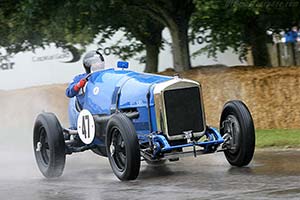
Page 1 of 1  In the 1920s speed was everything and the easiest way to achieve record breaking speeds was to install a massive engine in a car chassis. Thanks in no small part of the rapid development of military airplanes in the WWI, these powerful engines were readily available. Automobile manufacturer Louis Delage did not have such a large engine in his line-up yet, but he was very interested in getting into the lucrative airplane engine market. What better way to test the prospected new engine than in a racing car? In 1923 he commisioned his designer and cousin Charles Planchon to build two sprint racers; one with a road car derived six cylinder engine and one with a massive V12 engine, which could later be adopted for aiplane use. In the 1920s speed was everything and the easiest way to achieve record breaking speeds was to install a massive engine in a car chassis. Thanks in no small part of the rapid development of military airplanes in the WWI, these powerful engines were readily available. Automobile manufacturer Louis Delage did not have such a large engine in his line-up yet, but he was very interested in getting into the lucrative airplane engine market. What better way to test the prospected new engine than in a racing car? In 1923 he commisioned his designer and cousin Charles Planchon to build two sprint racers; one with a road car derived six cylinder engine and one with a massive V12 engine, which could later be adopted for aiplane use.Planchon settled on a displaced of just over ten litres, courtesy of a bore and stroke of 90 and 140 mm respectively. The heart of the engine was an enormous cast aluminium crank case, which housed the crankshaft in seven roller bearings. Angled at 60 degrees, each of the banks was made up of six individual cylinder barrels. The overhead valves were operated by single central mounted camshaft and actuated by exposed push-rods and rockers. The massive engine was said to produce 350 bhp, but 280 is a more likely figure. The V12 was bolted into a ladder frame and also served to increase rigidity. With live axles, semi-elliptic leaf springs and cable operated drums, the rest of the chassis was very conventional. Equipped with a tightly wrapped body, the one-off Type DH V12 debuted at the 1923 Gaillon Hillclimb. Delage's ace driver Rene Thomas took a convincing win in the V12 and he also set the second and third fastest times in two of the six cylinder sprint racers. It was the start of a very long career of the DH V12 as a Works racer in a wide variety of sprint races, record runs and hillclimbs. A highlight in the career of the V12 engined machine was Thomas' land speed record breaking run at Arpajon on July 6th, 1924. Sadly his 143 mph record stood for just one week as it was broken at the some location by Ernest Eldridge in the 21.7 litre engined Fiat 'Mephistopheles'. During the DH's successful career, Delage also conquered the Grand Prix racing world with the highly advanced 15 S8 and at great expense. When the much coveted World Championship was won, Louis Delage was forced to drastically cut back his spending and gave up on racing completely. Although five years old by then, the Delage sprint cars were much coveted and Delage sold them with much ease. The Type DH was sold to the Brooklands based Thomson & Taylor company, who both the car for an aspiring racing driver by the name of John Rhodes Cobb. He pretty much took off where Thomas had left off and year after year broke the Brooklands track record with his French machine. His fastest record breaking run was in 1930 when he covered five miles at an average of 129.36 mph. By 1933 Cobb took delivery of the even larger engined Napier Railton, but not surprisingly there were other drivers keen to take his place in the hugely successful Delage. According to the Brooklands rules, the car should have been retired in 1935 for being over ten years old, but thanks to the impeccable reputation of the Thomson & Taylor company, the meticulously prepared machine was allowed to race for another season. In that season it was raced by Kay Petre, who used it to better the Ladies' Record with a 134.24 mph run. At the end of the 1935 season, the hugely successful sprint racer and record braker was finally retired from active duty, although it continued to serve as a test vehicle at Brooklands for several more years. During the War, it was briefly used on the roads by its new owner, but he quickly forgot about the car and left it in a barn. A small fire removed all fluids from the machine and within a few years after last lapping Brooklands, the DH V12 was a very sad and rusty sight. Fortunately, a new owner set about restoring the car and with update Bentley brakes, he started racing it in historic events. Needless to say, the Delage won its class first time out at Silverstone in 1950. Two years later, the car suffered a heavy accident and again was subject to fire damage. The owner was badly hurt in the accident and the Delage was handed to the current owner's father, who lived nearby. In the preceding thirty years, the charred Delage had been almost continuously used and was already in need of a thorough refurbishment even before the fire. In fact the fire was caused by a worn cylinder, which virtually exploded and ripped a fuel line apart in the process. Being a completely unique machine, the new owner faced a daunting projecting of having to rebuild or in most cases recreate many of the engine parts. Although not visible from the outside, the single cylinders were replacing by six sets of two cylinders, but the twelve separate cylinder heads were retained. After fourteen years, the Type DH was finally to race again and fittingly 'debuted' at the GP de l'Automobile Club Francais race at Rouen-les-Essarts. The current owner showed that the restoration was not in vain as he reached an impressive top speed of 138 mph. Since that 1966 race, the V12 engined Delage has a set fixture in British historic events; particularly in hillclimbs. Among the most successful racing cars ever constructed, the one-off Delage DH V12 is pictured above in action during the 2007 Goodwood Festival of Speed. Page 1 of 1 |
| Article | Image gallery (16) | Specifications |
| All Cars - Contact us - Privacy Statement - Top | © 1998 - 2026 Ultimatecarpage.com |