Go to Ultimatecarpage.com

Car search: Quick Advanced 
  Ultimatecarpage.com  > Cars by brand  > Great Britain  > McLaren
F1
Never miss another Ultimatecarpage.com update, news feature or event report by subscribing to our mailing list to receive all the news in your mailbox ...


McLaren F1

McLaren F1 McLaren F1 McLaren F1 McLaren F1 McLaren F1 McLaren F1
Click here to save all images    Image credits: Wouter Melissen / Rob Clements 


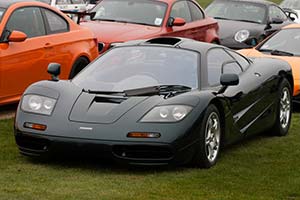
Click here to download printer friendly version In the months before his untimely death in June of 1970, Bruce McLaren was working on a proper McLaren road car. He of course held in the back of his head that if sufficient numbers were built, he could take it racing in the 24 Hours of Le Mans. Sadly all work on this project was halted after the company founder's fatal crash at Goodwood. Fortunately the company survived and in the following two decades several Formula 1 World Championships and also Indy 500 wins were added to the many CanAm successes scored while Bruce was still alive. Now run by Ron Dennis, McLaren was at the top of its powers in the late 1980s and in 1988 the team's drivers Alain Prost and Ayrton Senna won fifteen of sixteen F1 races. Not surprisingly the company in general and chief designer Gordon Murray in particular looked for a new challenge and Bruce McLaren's idea of a McLaren road car was revived, although this time with no motorsport intentions.

Talented South African designer Gordon Murray was pretty much given carte blanche to design the world's best and fastest driver's car. This McLaren would go head to head with Ferrari, Porsche and Lamborghini exotic street machines. Murray's curriculum vitae already sported several championship winning F1 cars, including the 1988 McLaren MP4/4. Murray first informed the world of McLaren's plans in 1989 when he showed a design sketch of the upcoming Formula 1 inspired supercar. It would take another three years, before the aptly named McLaren F1 was shown to the public at the start of the Monaco Grand Prix weekend. That race was fittingly won by McLaren's Ayrton Senna. It was not his only road car project as in his spare time Murray was also working on another unique car that would be later sold as the ‘Light Car Company Rocket’. This motorcycle-engined machine was built to a completely different concept and specs than the McLaren road car, so the two projects did not conflict.

Generally speaking, supercars are ‘no compromise’ driving machines with performance as the main focus with little need for practicality and/or comfort. Never easily pleased, Murray wanted the tarmac-shredding performance but wouldn’t compromise on practicality and comfort. To ensure there was plenty of performance, he made the car as light as possible; engine power might overcome the weight in a straight line, but during braking and cornering every kilogram counted. This was achieved by using a host of exotic and composite materials, with carbon fibre the most prominent. Murray's solution for making the McLaren F1 practical was to install three seats with an F1-inspired central driver seat mounted slightly ahead of the adjacent passenger seats. This setup was already used in a Ferrari concept car of the 1960s, but never made it into production. The interior also featured a highly advanced cd-player, but no radio. Ahead of both rear wheels there were two storage bins that could take as much luggage as a small hatchback of the day. To provide the driver with a genuine direct feel and again to save weight, advanced driving aids like a ‘flappy-paddle gearbox’, ABS, power steering and traction control were not fitted.

Murray used his connections with BMW dating back from his Brabham days to broker a deal with the company's engine specialist Paul Rosche to supply a bespoke V12 engine. In keeping with the F1's design philosophy, the engine had to be both lightweight and powerful. BMW not only met the requirements, but with its 6.1 litre, 627 bhp V12 engine exceeded the 550 bhp set, although it was slightly heavier than asked for. The lightweight V12 engine was mounted amidships and mated to a McLaren-developed six speed manual gearbox. To better insulate the heat from the tight engine bay, the engine and exhaust covers were covered in gold, which is highly reflective. Missing from the very slippery Peter Stevens designed exterior, was a big wing that thanks to the likes of Ferrari and Lamborghini had become a super trademark. Banned by that time in Formula 1, Murray was free to use ground effects and moving aerodynamics for the McLaren road car. Reminiscent to his 1978 Brabham F1 car, the McLaren F1 was fitted with two electric fans to suck the car to the ground. Hidden when stationary, the car also sported a small moveable wing on the tail of the car that offered stability at high speed, served as an airbrake and an additional cooling vent for the rear brakes. These advanced devices provided plenty of downforce, but without the drag created by the familiar big wings.

In the months after the Monaco launch, five prototypes were constructed and tested extensively in every thinkable condition. One was destroyed in Namibia during these tests and another was sacrificed in a mandatory crash test. It was not until the spring of 1993 that the McLaren was ready for production. Not surprisingly the car was received to universal acclaim thanks to its benchmark performance, superb packaging and immaculate fit and finish. A slight problem was the sticker price of 540,000 Pounds (excluding taxes), which not only made it the fastest production car in the world, but also the most expensive. This was particularly troublesome as the market for classic and exotic machines had just collapsed after the ridiculous price surges of the late 1980s. There was nevertheless a demand for Murray's masterpiece and production commenced. Another reason why the McLaren F1 never became a top seller was that the company never had the car certified for the United States. This would have involved sacrificing several more cars for crash testing and the addition of more advanced safety items like airbags. Between 1993 and 1998 a total of just 64 McLaren F1 road cars were constructed.

Not surprisingly, there was an immediate interest in a racing version of the McLaren F1. As mentioned earlier, the car was not designed with racing in mind, but with little effort it could be converted to comply with the GT1 regulations used in the BPR championship and most importantly at Le Mans. There were no funds to enter GT racing with a Works team, but it was calculated that the development costs could be covered if five racing cars were sold to customers. In addition to the mandatory safety equipment the F1 GTR sported a large rear wing, carbon ceramic brakes and the suspension was stiffened by replacing the rubber bushings with solid aluminum ones. To cool the driver and the gearbox, some additional vents were also cut in the carbon fibre bodywork. Courtesy of the lighter brakes and a stripped interior the racing version was 100 kg lighter than the road car. BMW modified the engine to work with the mandatory restrictors. It proved to be a great success both in the salesroom and on the track; nine examples were constructed in 1995 and ten victories were scored. The debut season of the F1 GTR was highlighted by a much coveted win in the legendary 24 Hours of Le Mans. Amazingly five of the seven cars entered lead the race at one point and at the end of the race McLaren also held the third, fourth, fifth and thirteenth position.

To commemorate the Le Mans win, McLaren produced the limited edition F1 LM late in 1995. It used a restrictor-free version of the GTR engine, which produced a staggering 680 bhp. The big rear wing was also carried over from the racing car. One prototype and five (the number of cars that finished the 1995 Le Mans) production cars were constructed, most of which were painted in the striking papaya orange also used for the company's legendary CanAm cars. For the 1996 season, a second generation of the GTR was developed. The car was lowered further and made lighter courtesy of a magnesium gearbox casing. A longer front splitter was also fitted. Another nine cars were constructed and despite strong competition from the newly developed F40 GTE, all nine BPR races were won. The tally was further increased with five victories in the All-Japan GT Championship. At Le Mans, the F1 GTR was not able to keep with the intrinsically faster prototypes.

The success of the McLaren F1 GTR had other companies interested and in 1997, the British team faced opposition from the likes of Porsche, Mercedes Benz and Nissan. Unlike McLaren, they had constructed purpose-built racing cars with the derived road cars built for homologation purposes only. McLaren anticipated the stronger competition with a third evolution of the GTR, which sported a completely different and much longer body. It was also considerably lighter, only weighing 915 kg. A sequential gearbox was also installed. For homologation purposes, McLaren constructed three road cars with the 1997 style body, dubbed the F1 GT. BMW had also taken an interest and bought several of the ten 1997 spec GTRs and raced them in the BPR series. BMW Motorsport scored five victories that year in the BPR. Le Mans was again a trophy for the prototypes, but with a second and third place, the F1 GTR took the top two positions in the highly competitive GT1 class. It’s fitting that the final chapter in the McLaren F1 history was again written by the road car, when it broke the production car speed record in 1998, clocking 240 mph at Ehra-Leissen in Germany.

The McLaren F1 remained the supreme supercar for many years and with a racing record to match, it has gone into history as one of the classic GT racers in the tradition of the Ferrari 250 GTO and Porsche 911 RS. The next generation supercars that finally surpassed the performance benchmarks still do not offer the McLaren’s complete package and most certainly do no have the car’s immaculate racing record. The only blemish on the car's record is the failure to come anywhere near the proposed production number of 300. A few years later Murray helped McLaren and Mercedes Benz design the rather bulky SLR, which does not come close in any respect to the fabled F1. He is now in the process of designing and producing a revolutionary lightweight (of course) city car. A successor to the McLaren F1 will most likely never be produced.

Article by Wouter Melissen, last updated on 03 / 20 / 2007

Add your comments on the McLaren F1

 Just clearing stuff up ..  
:Exige:
03-21-2005
Ok, im gonna clear some stuff up here. The Mclaren F1 weights about as much as a Ford Focus .. just over a metric ton. This may sound a fair bit but for a supercar of its kinda it is ultra lightweight. Murrays main obsession was to keep weight down and in effect produced an ultra lightweight car even to todays standards. You have to remember that the engine contributes for a large amount of the weight so it is unrealistic to say that you can have a high output car weighing similar to a lightweight sportscar. Ive heard many comparisons between this and the Enzos cornering. The Enzo is designed for the track and therfore has less luxuries and sacrifices ride quality. Murray wanted a soft ride and the way to do that is to soften the suspension .. which means it cannot corner as well. But it is impossible to say that this car isnt fast around corners. The Mclaren is one of the most practical supercars ever made because its quite short and has some Lambo shaming visibility. And just as an end note .. the Mclaren F1 reached an official top speed of 240.1mph which is also on a video you can download to prove it. I can pretty much say this is a better car to own than the Koenigsegg CCR purely because it posesses luxury, same acceleration, only marginally slower top speed not to forget a soundtrack that doesnt compare to any other modern production car.
 Not perfect, but pretty close  
lithiumdeuterid
03-20-2005
The McLaren F1 is certainly a landmark car, and it's not perfect, but it's pretty close. The car's tendency to understeer means it cannot go around, say, a 270-degree turn as fast as some other cars (skidpad rating of 0.88 g). However, it makes up for the understeer with precise, non-power-assisted steering, and a responsive throttle. Few cars leave you as directly connected to the road as the McLaren F1. There's nothing between your hands and the road except the steering column and the wheels/tires. I imagine the steering feedback is wonderful to behold.

Then there are the numbers. The engine is just so efficient. How many normally-aspirated cars with engines this large make over 100 HP per liter of displacement? I can't think of any off the top of my head. Top speed of something inbetween 217 and 241 mph. Does it really matter what the top speed is? Ask yourself, "If I owned this car, would I ever reach its top speed?" If you answered this question honestly, you answered "no". Acceleration is far more important than top speed, and this car has it in spades. Zero-to-sixty mph in what, 3.2 seconds? There are a few (but only a few) cars that will beat this. And all of them except the Koenigsegg CCR (2595 lbs) have other flaws that make them less desirable. Even then, the McLaren F1 is the only car to offer a centered driver seating position. That alone makes it superb.

The big (or should I say small) thing, though, is the weight. About 2513 lbs, I think. This car is going to feel a lot better to drive than the Veyron, weighing in at 4189 lbs. Add to that the fact that Gordon Murray did his best to minimize the moment of inertia of the vehicle (keeping the mass close to the center of mass), and you have a car that is going to respond quickly and precisely to whatever input you give it. This car just oozes immediacy; there are no delays anywhere, no turbo lag, no power steering, low weight, low moment of inertia. How many cars have all those things working for them?

If I had to choose a supercar as a daily driver, this would be the one.

Finally, I'd like to clarify some things:

1) Weight has nothing to do with top speed. Top speed only depends upon frontal surface area, drag coefficient, fluid density, and available power. Rolling friction plays a small part, but it's mostly air friction that limits your top speed.

2) Understeer in a rear-wheel-drive car can be eliminated by mashing down on the throttle. This doesn't help on the skidpad, but it would help in a sharp turn on a track.

3) The user "dylanMurray" claims to be Gordon Murray's son. This is obviously a farce. If that is actually Gordon Murray's son, he ought to be ashamed of himself as a parent (but never as an engineer).
 Just Unbeatable  
Mdbgt40
11-10-2004
The car is already 11 years old and still this car is one of the best supercars in the world. But this car has a challenge in performance like... the Enzo Ferrari, the Mercedes Benz' SLR Mclaren, the stunning Porsche 911 Carrera GT and..well.. a sale rival with the performance is almost the same, the TVR Typhoon. Their lap times are almost the same while testing them. The Mclaren deserves to be the best supercar in the world.

View all the user comments on the McLaren F1
     

General specifications
Country of origin Great Britain
Chassis number 068 & 016
Numbers built 107 (65 road cars)
Produced from 1993 - 1998
Body design Gordon Murray / Peter Stevens

Engine
Configuration BMW S70/2 60º V 12
Location Mid, longitudinally mounted
Construction alloy block and head
Displacement 6.064 liter / 370 cu in
Bore / Stroke 86.0 mm (3.4 in) / 87.0 mm (3.4 in)
Compression 10.5:1
Valvetrain 4 valves / cylinder, DOHC
Fuel feed Bosch Fuel injection
Aspiration Naturally Aspirated

Drivetrain
Chassis/body carbon fibre reinforced plastic monocoque
Suspension (fr/r) double unequal length wishbones, coil springs over alloy dampers, anti roll bar
Steering rack-and-pinion
Brakes vented discs, all-round
Gearbox Transverse 6 speed Manual
Drive Rear wheel drive

Dimensions
Weight 1140 kilo / 2513.3 lbs
Length / Width / Height 4287 mm (168.8 in) / 1920 mm (75.6 in) / 1120 mm (44.1 in)
Wheelbase / Track (fr/r) 2718 mm (107 in) / 1568 mm (61.7 in) / 1472 mm (58 in)

Performance figures
Power 627 bhp / 468 KW @ 7500 rpm
Torque 617 Nm / 455 ft lbs @ 4000 rpm
BHP/Liter 103 bhp / liter
Power to weight 0.55 bhp / kg
Top Speed 386 km/h / 240 mph
0-60 mph 3.2 s
0-100 mph 6.2 s

Resources
Suggested reading Driving Ambition, by Doug Nye, Gordon Murray and Ron Dennis
Related articles
Useful links


Ultimatecarpage.com - All Cars - Contact us - Privacy Statement - Top © 1998 - 2009 Ultimatecarpage.com