Page 1 of 3 Next >> In the months before his untimely death in June of 1970, Bruce McLaren was working on a proper McLaren road car. He of course held in the back of his head that if sufficient numbers were built, he could take it racing in the 24 Hours of Le Mans. Sadly all work on this project was halted after the company founder's fatal crash at Goodwood. Fortunately the company survived and in the following two decades several Formula 1 World Championships and also Indy 500 wins were added to the many Can-Am successes scored while Bruce was still alive. Now run by Ron Dennis, McLaren was at the top of its powers in the late 1980s and in 1988 the team's drivers Alain Prost and Ayrton Senna won fifteen of sixteen F1 races. Not surprisingly the company in general and chief designer Gordon Murray in particular looked for a new challenge and Bruce McLaren's idea of a McLaren road car was revived, although this time with no motorsport intentions.
Talented South African designer Gordon Murray was pretty much given carte blanche to design the world's best and fastest driver's car. This McLaren would go head to head with Ferrari, Porsche and Lamborghini exotic street machines. Murray's curriculum vitae already sported several championship winning F1 cars, including the 1988 McLaren MP4/4. Murray first informed the world of McLaren's plans in 1989 when he showed a design sketch of the upcoming Formula 1 inspired supercar. It would take another three years, before the aptly named McLaren F1 was shown to the public at the start of the Monaco Grand Prix weekend. That race was fittingly won by McLaren's Ayrton Senna. It was not his only road car project as in his spare time Murray was also working on another unique car that would be later sold as the 'Light Car Company Rocket'. This motorcycle-engined machine was built to a completely different concept and specs than the McLaren road car, so the two projects did not conflict.
Generally speaking, supercars are 'no compromise' driving machines with performance as the main focus with little need for practicality and/or comfort. Never easily pleased, Murray wanted the tarmac-shredding performance but wouldn't compromise on practicality and comfort. To ensure there was plenty of performance, he made the car as light as possible; engine power might overcome the weight in a straight line, but during braking and cornering every kilogram counted. This was achieved by using a host of exotic and composite materials, with carbon fibre the most prominent. Murray's solution for making the McLaren F1 practical was to install three seats with an F1-inspired central driver seat mounted slightly ahead of the adjacent passenger seats. This setup was already used in a Ferrari concept car of the 1960s, but never made it into production. The interior also featured a highly advanced cd-player, but no radio. Ahead of both rear wheels there were two storage bins that could take as much luggage as a small hatchback of the day. To provide the driver with a genuine direct feel and again to save weight, advanced driving aids like a 'flappy-paddle gearbox', ABS, power steering and traction control were not fitted. Page 1 of 3 Next >>

 Ultimatecarpage.com
> Cars by brand
> Great Britain
> McLaren
Ultimatecarpage.com
> Cars by brand
> Great Britain
> McLaren
 F1 LM
F1 LM
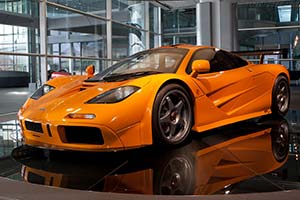
 In the months before his untimely death in June of 1970, Bruce McLaren was working on a proper McLaren road car. He of course held in the back of his head that if sufficient numbers were built, he could take it racing in the 24 Hours of Le Mans. Sadly all work on this project was halted after the company founder's fatal crash at Goodwood. Fortunately the company survived and in the following two decades several Formula 1 World Championships and also Indy 500 wins were added to the many Can-Am successes scored while Bruce was still alive. Now run by Ron Dennis, McLaren was at the top of its powers in the late 1980s and in 1988 the team's drivers Alain Prost and Ayrton Senna won fifteen of sixteen F1 races. Not surprisingly the company in general and chief designer Gordon Murray in particular looked for a new challenge and Bruce McLaren's idea of a McLaren road car was revived, although this time with no motorsport intentions.