Page 1 of 1 For many years Siata (Società Italiana Applicazioni Trasformazioni Automobilistiche) specialized in aftermarket products for Fiats. The Italian company used their intimate knowledge of Fiat's products to launch the first Siata badged, Fiat based car in 1948. This was quite an achievement as the Turin based factory had been completely destroyed during a bombing raid some five years earlier. With a new convertible body and better performance, the Siata Amica was quite an improvement over the Fiat 500 Topolino it was based on. In 1950 the range was further expanded with the Daina, which was based on the Fiat 1400 and sported coachwork by a wide variety of 'Carrozzeria'.
The introduction of the Fiat 8V in 1952 sparked the development the first Siata chassis. Constructed of tubular members, the new chassis was not designed exclusively for the 'Otto Vu', but could also take other V8s; preferably Chrysler's. Eventually only one example was ever fitted with an American engine. While the chassis was brand new, much of the running gear was retrieved from the Fiat parts bin. The suspension was independent all-round by unequal length arms; at the front the top arm operated a shock absorber. This setup was directly derived from the Fiat 1100's front suspension. Large aluminium drum brakes provided the stopping power.
With the exception of the one Chrysler engined machine, the new Siata used Fiat's somewhat unusual 70 degree V8 engine. In stock trim the two litre OHV engine produced just over 100 bhp, and with Siata's hotter camshaft and triple Weber Carburetors, the power could be boosted to 140 bhp. There are even reports of 160 bhp being achieved, but probably not very reliably. Siata's sales brochure quoted a modest 110 bhp for the base model, which came equipped with two Webers. Sporting a big ram-air duct the light-alloy engine was bolted onto the chassis together with a four speed gearbox also sourced at Fiat.
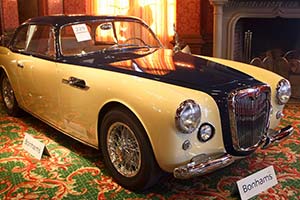
Although only around sixty chassis were produced in 1953 and 1954, the new Siata received at least half a dozen type indications. The most common of these are the 208 S for the open cars and the 208 CS for the slightly larger coupe bodied machines. Especially the Motto built Spider body was a popular choice as it fitted the lightweight and fine-handling chassis perfectly. Sadly it is not known who exactly penned this very attractive shape; it was most likely either Franco Scaglione or Giovanni Michelotti. The coachbuilder of choice for the coupe body was Stabilimenti Farina. That company folded after just six examples were produced and a further nine were constructed along the same lines by Balbo.
The Siata 208 was launched to much critical acclaim late in 1952. The journalists had nothing but praise for the fine handling and good looking Italian thoroughbred. Californian car dealer and road racer Ernie McAfee placed an order for a large number of Spiders and it is quite possible that all Motto Spiders went to the United States. However much everybody liked the little Siata, its high price drove customers away to the much cheaper MGs, Jaguars or Porsches. McAfee struggled to find buyers for the cars and some were sold as late as 1956. Like the Fiat 8V, the nimble Siata is still well loved today and good examples are rare to find and very expensive. Page 1 of 1

 Ultimatecarpage.com
> Cars by brand
> Italy
> Siata
Ultimatecarpage.com
> Cars by brand
> Italy
> Siata
 208 CS Bertone Berlinetta
 For many years Siata (Società Italiana Applicazioni Trasformazioni Automobilistiche) specialized in aftermarket products for Fiats. The Italian company used their intimate knowledge of Fiat's products to launch the first Siata badged, Fiat based car in 1948. This was quite an achievement as the Turin based factory had been completely destroyed during a bombing raid some five years earlier. With a new convertible body and better performance, the Siata Amica was quite an improvement over the Fiat 500 Topolino it was based on. In 1950 the range was further expanded with the Daina, which was based on the Fiat 1400 and sported coachwork by a wide variety of 'Carrozzeria'.