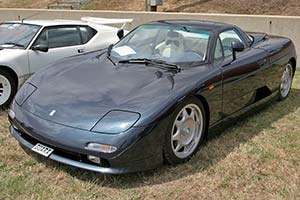
Page 1 of 1 The world had changed considerably since the 1970s, but not so much for DeTomaso, who still had the Pantera in their line-up in 1990. The original shape was finally discarded that year, although the Pantera SI mechanically was still very similar to the Pantera that was first introduced twenty years earlier. The long overdue replacement was finally unveiled during the 1993 Geneva Motor Show. It was dubbed the DeTomaso Guarà after an Argentinean hunting dog and sported a striking Barchetta body.
If the visitors at Geneva thought the Guarà looked strangely familiar, they were absolutely right. It shared its backbone chassis and designer (Carlo Gaino) with the Maserati Barchetta of 1991, which was actually built in DeTomaso's workshop. While Alejandro De Tomaso had sold Maserati to Fiat, he had obviously held on to the ill-fated Maserati racing car's chassis. The backbone style chassis itself was already well known to DeTomaso fans as it was used in the first sports cars produced by the marque in the 1960s.
The early DeTomaso backbones were prone to flexing, but by using a honeycomb structure, the 'second generation' backbone was far more rigid. Originally designed for racing, the Guarà chassis and double wishbone suspension were cutting edge. For road car use the suspension was upgraded with an anti-dive / anti-squad geometry. An equally advanced BMW sourced all-alloy V8 engine was bolted onto the chassis. The first non-Ford engine in a DeTomaso in years, it produced between 286 and 304 bhp depending on the state of tune.
Within in a year after the motor show debut of the Guarà, production commenced. In the final line-up the original Barchetta was joined by a more practical Coupe model. Unfortunately DeTomosa failed to make the Guarà comply with the strict safety and emissions regulations in the United States, which was and still is the biggest market for exotic vehicles. Between 1994 and 1998 only a handful of BMW engined Guaràs left the production line and the struggle for survival continued for DeTomaso.
In 1998 the expensive BMW engine and Getrag gearbox were discarded in favour of a much cheaper Ford V8 combined with ZF 6-speed manual. The Ford powerplant also featured advanced four-valve per cylinder heads and produced similar performance figures. It was, however, considerably heavier, lifting the Coupe's weight from 1200 to 1400 kg. A few years later a supercharged version with 400 bhp presented, but it never entered production.
Just over ten years after first being introduced, Guarà production ceased. It is estimated that around ten Barchettas and forty Coupes were built. Some of the fixed head cars were converted to Spiders by third parties. The Guarà has the sad fate of being the final car produced before DeTomaso went bankrupt in 2005. A brand new Mangusta had been developed, but the rights had been sold to an American, who marketed the car as the Qvale Mangusta. Page 1 of 1

 Ultimatecarpage.com
> Cars by brand
> Italy
> DeTomaso
Ultimatecarpage.com
> Cars by brand
> Italy
> DeTomaso
 Guarà
Guarà
 The world had changed considerably since the 1970s, but not so much for DeTomaso, who still had the Pantera in their line-up in 1990. The original shape was finally discarded that year, although the Pantera SI mechanically was still very similar to the Pantera that was first introduced twenty years earlier. The long overdue replacement was finally unveiled during the 1993 Geneva Motor Show. It was dubbed the DeTomaso Guarà after an Argentinean hunting dog and sported a striking Barchetta body.