Page 1 of 2 Next >> With a little encouragement from Vasek Polak, the Porsche and Audi distributor for California, Porsche decided to build a Group 7 version of the recently introduced 917 Group 5 sports racer to compete in the 1969 Canadian-American Challenge Cup (Can-Am for short). First established in 1966, the Can-Am Cup had quickly become one of the most popular and lucrative series in North America. At the time of Porsche's arrival, Can-Am was dominated by the seemingly unsophisticated big-block Chevrolet engined McLarens.
The Group 5 World Championship ended early in August and by that time Can-Am had already begone. Considering the limited time available, it was no surprise that the Porsche engineers only performed the absolutely necessary changes on the existing design to turn the 917 Coupe into a Can-Am car. The new 917 PA (for Porsche Audi) featured a roadster body, a larger fuel-tank and wider rear wheels. The weight was cut by 55 kg thanks to the removal of the roof and the heavy windscreen.
What remained was the pressurized aluminium spaceframe chassis and the fully independent suspension. Also left unchanged was the beautiful quad-cam flat 12 engine that displaced just under 4.5 liter and produced a hefty 580 bhp. Just like on the fixed-head 917s the exhaust exited ahead of the rear wheels. The new roadster body was very similar in shape to the three-liter 908 Spyders that were raced alongside the 917 in the World Championship that season. Fully equipped, the Porsche 917 PA tipped the scales at 775 kg.
Two examples were constructed; one was sent to North American while the other was retained by Porsche for testing purposes. Less than a week after winning the last round of the championship at Zeltweg in the regular 917, Swiss racer Jo Siffert first took to the track in the 917 PA. The white Porsche sported two blue stripes with 'Porsche Audi' markings and the starting number 0. The machine's debut came at the Mid-Ohio race, which was the first round of the championship. Five seconds off the pace, Siffert still managed to finish in a highly commendable fourth place. Page 1 of 2 Next >>

 Ultimatecarpage.com
> Cars by brand
> Germany
> Porsche
Ultimatecarpage.com
> Cars by brand
> Germany
> Porsche
 Racing cars
> Can-Am
Racing cars
> Can-Am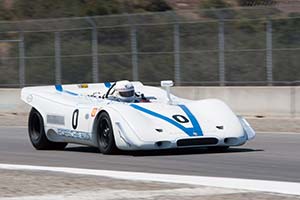
 With a little encouragement from Vasek Polak, the Porsche and Audi distributor for California, Porsche decided to build a Group 7 version of the recently introduced 917 Group 5 sports racer to compete in the 1969 Canadian-American Challenge Cup (Can-Am for short). First established in 1966, the Can-Am Cup had quickly become one of the most popular and lucrative series in North America. At the time of Porsche's arrival, Can-Am was dominated by the seemingly unsophisticated big-block Chevrolet engined McLarens.