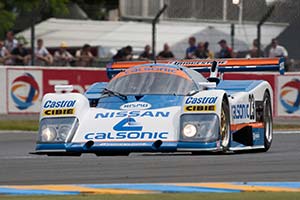
Model history: Nissan gently rolled into Group C racing in 1983 by supplying an engine to Hoshino Racing for a privately run entry in the Japanese national series. The engine was a turbocharged 'four', which was mounted in a customer March chassis. Although the results were not very encouraging, Nissan's interest was sparked and in 1985 Nissan Motorsport or Nismo was established. Several new March chassis were acquired and fitted with a development of the V6 engine used in the United States by the Electramotive team.
As part of the increased efforts, Nismo co-commissioned a brand new chassis from March for 1986. The other commissioner was BMW of North America for their IMSA GTP campaign. Dubbed the 86G, the new sports racer was designed by former McLaren engineer Gordon Coppuck using sophisticated CAD/CAM computer software. The chassis was a monocoque constructed from aluminium sheets with a honeycomb core. The cars constructed for Nissan featured a lightweight titanium front roll hoop. A major departure from earlier March Group C and GTP cars was the adoption of side-mounted radiators, which allowed for much cleaner aerodynamics.
Four chassis with gearboxes were shipped to Japan for completion at Nismo's new facilities. Here they were fitted with the same Electramotive derived engine already used during the previous year. As stipulated in the IMSA GTP regulations, the V6 was based on a Nissan production engine. Group C had no such restrictions, so the engine could be thoroughly reworked. The biggest change was replacing the original cast iron block with an aluminium one. It was also fitted with twin Garrett turbochargers compared to the single turbo used in the GTP spec. On full boost the 3-litre V6 was reputed to produce around 1000 bhp. In race tune it was still good for close to 700 bhp.
Clothed in an elegant, March developed bodywork, the new cars were officially badged 'Nissan R86V'. The first example debuted in a local race at Suzuka but did not even make it to the start due to a fire in practice. It was sent to Le Mans alongside an earlier Nissan/March 85G. The high profile entry was up against it from the start due to struggles within the Japanese and British members of team. A 16th place finish for the earlier car was but a small consolation for all the efforts. Once back in Japan the R86V that raced at Le Mans was joined by the other three cars in the Fuji 1000 km race, which counted for the World Championship. Two survived and finished a lowly 10th and 11th.
Undeterred by the poor showing in 1986 Nismo ventured on and developed a brand new V8 engine for 1987. It was designed from the ground up as a racing engine with an eye on getting both better performance figures and fuel mileage. Like the outgoing V6, the 'VEJ30' engine displaced 3 litres. Twin IHI turbos were fitted to provide the necessary boost. Nissan now had an exclusive deal with March and took delivery of three 87G chassis, which featured small improvements over the 1986 cars. With the new engine installed the new machines were dubbed 'Nissan R87E'.
With Le Mans once again the sole objective, Nissan opted not to run their new cars in any of the World Championship rounds held ahead of the race. A single entry in the Fuji 500 km was again the only preparation event for the team. The R87E failed to finish due to an engine failure. Two of the new cars and a single, privately entered R86V were shipped to Le Mans. Once again the Japanese manufacturer failed to impress with the new cars running well behind the leaders when both engines expired. The R86V also retired from the race early. Back in Japan, the three cars were raced several more times with a sixth for the R87E and a commendable fourth for the old R86V as the best results.
Apparently the new engine was blamed for the poor results and the Nismo engineers were sent back to the drawing boards. The result was the VRH30, which had similar specifications as the VEJ30 but only the crankshaft design was carried over. Again fitted with IHI turbos, the new V8 engine was good for over 750 bhp in race trim. No new tubs were ordered from March as quietly the ties between the two companies were severed. Two of each the 86G and 87G chassis were adapted to fit the VRH30 engine. Among the mechanical modifications was a lengthening of the wheelbase. For the first time Nismo worked on the cars aerodynamics as well and developed a new body in the wind-tunnel. The latest Nissans were dubbed the R88C.
The Japanese team seemed to have learned from their mistakes and entered the new cars in more races before Le Mans. Unfortunately the results were far from encouraging. Nissan's presence in the big 24-hour race consisted of two new works entered R88Cs as well as two privately fielded V6 engined machines. Three years into the program little had changed as the cars were still well off the pace of the leading Jaguars and Porsches. The reliability was still poor as well as only one of the R88Cs made it to the finish, 50 laps down on the winning Jaguar. In the Japanese championship one of the R88Cs managed to score back to back podium finishes but it was a very small consolation for another lost season.
After three disappointing seasons, drastic changes were made. In part, Nissan was forced to step up as entering the World Championship was now made mandatory to get an entry at Le Mans. A chassis deal was signed with Lola for brand new carbon-fibre moncoques and much of the operation was moved to Europe. For the new chassis a larger version of the V8 engine was developed, which ranked among the most powerful of the field. It helped Nissan claim pole at Le Mans in 1990 but reliability remained poor and in the end no victories were scored. Over their years in Group C, Nissan spent a big chunk of money but with no real results in return. Perhaps a better streamlined management could have made more of the vast resources available.
Chassis: 87G-3
Although built in 1987, chassis 87G-3 was never raced as a Nissan 87E. During the following winter, it was upgraded to 88C specification complete with a longer wheelbase and the VRH30T engine. During the 1988 season it served as one of two works cars. It was primarily raced by Kazuyoshi Hoshino; for the Japanese races he was joined by Kenji Takahashi and at Le Mans his co-pilots were Takao Wada and Aguri Suzuki. An engine failure brought an early end to the Le Mans efforts of the car but in the national races it reached the finish several times with a 5th as the best result.
At some point after its contemporary racing career the car was sold. More recently it passed into the hands of the current owner, who has had the rare Nissan prepared for historic racing. As far as we know it is the only R88C currently in private hands. The current owner is seen here in action during the 2010 Group C support race ahead of the 24 Hours of Le Mans.
Article by Wouter Melissen, last updated on November 08, 2010