Go to Ultimatecarpage.com

Car search: Quick Advanced 
 sport Ultimatecarpage.com  > Cars by brand  > Great Britain  > Mirage
Racing cars  > Other Sportscars
     M3 Cosworth
Cars statistics: 5052 cars, 430 makes, 39334 images; Events statistics: 215 reports, 41349 images; Forum statistics: 85,344 members, 41,962 topics; more...


  Mirage M3 Cosworth
 

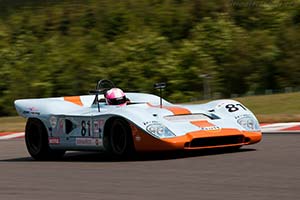
Mirage M3 Cosworth Mirage M3 Cosworth Mirage M3 Cosworth Mirage M3 Cosworth Mirage M3 Cosworth Mirage M3 Cosworth
Click here to save all images    Image credits: Wouter Melissen 

Model history:
Click here to download printer friendly version For John Wyer's Gulf Oil backed team, the drastic rule changes at the end of the 1967 proved to be a blessing in disguise. While they rendered the John Wyer Automotive (JWA) developed and highly successful Mirage M1 obsolete, the ban of the big banger sports cars ironically also brought the original GT40 back into the fray. Following Ford's withdrawal from racing, JWA was solely responsible for the construction of the cars and orders flooded in for the GT40. It was still eligible because it met the 50-car production limit to be homologated as a 'Group 4' GT car. Wyer could not only boast a full order book but one of his 'works' cars also won the all-important 24 Hours of Le Mans in 1968.

In addition to Group 4, there was also a 'Group 6' class, created for purpose-built prototype racers. Whereas Group 4 had a five-litre displacement, the prototypes were restricted to just three litres. This, conveniently, was the same limit applied to Formula 1 engines of the day. Despite the displacement off-set, the regulations were written to favour the prototypes, at least for outright speed. During the 1968 season, this was underlined by the performance of the quick but fragile Porsche 907s and all-new 908s. Wyer also became increasingly convinced that after five seasons, the GT40 was really approaching the end of the line and halfway through the 1968, he commissioned the construction of the brand-new Mirage M2 prototype racer.

Considering Wyer's close ties to Ford, the recently introduced Ford-Cosworth DFV V8 was the obvious engine of choice for the project. Unfortunately the complete 1968 production was allocated to the various Formula 1 teams and to Alan Mann for 'his' Ford F3L Group 6 racer. The only other readily available three-litre engine was BRM's V12. Specifically designed for the new Group 6 regulations, it was a straightforward design. The V12 featured twin overhead camshafts but only two valves per cylinders compared to the four of the Cosworth DFV. Equipped with Lucas fuel-injection, the British twelve cylinder engine produced around 390 bhp in 1968. John Wyer was not the first customer for the V12 as Cooper and McLaren both used the sports car engine in Formula 1.

Finding a designer for the car was also not straightforward but in Len Terry, Wyer found one of the day's leading engineers. Best known for his Indy 500-winning Lotus and the first Eagles, Terry laid down a conventional aluminium monocoque chassis. Due to use of the BRM engine, a rear subframe had to be added to share the load of the rear suspension. The V12 was mated to the also ZF five-speed gearbox that was also fitted to the GT40s produced by JWA. Suspension was by double wishbones at the front while at the rear top links, lower wishbones and twin trailing arms were fitted. The Mirage M2 was clothed in a tightly wrapped coupe body. Terry's recently established Design Auto built the chassis, suspension and body, while JWA raced the GT40.

The first Mirage M2 was ready in the fall of 1968 and extensively tested by David Hobbs and later by Robin Widdows. One of the biggest problems that emerged during the early testing was overheating despite the twin side-mounted radiators. The issues were addressed and a second car was readied for the 1969 season. Reliability worries prompted the Gulf Oil-backed team to run the GT40 in the long distance events, while the M2 was entered for sprints. The debut for the BRM-engined Mirage came at the BOAC 500 at Brands Hatch in April of 1969. Jacky Ickx and Jackie Oliver could do no better than 11th in qualifying and were forced to retire after a drive shaft failed. At the Spa 1000 km race, Ickx managed to clinch second on the grid but in the race reliability was once again an issue.

Wyer was disappointed in the BRM V12's performance, even in updated four-valve specification, so he turned to Ford again and this time did manage to secure a batch of the dominant DFV. A third chassis was constructed specifically for the V8, which was installed with a Hewland gearbox. Dubbed the M3, it debuted alongside a four-valve V12 engined sister car at the Nürburgring 1000 km race in June. A wishbone failure ended the race early for the new Mirage. Compared to the rival weight was an issue and following their example, the roof was cut off the M3 to create a Spyder body. These drastic developments did help the Mirage move up the field and at its second outing, the Zeltweg 1000 km, the M3 was on pole. A steering failure ended the race early but at the Imola 500 km race in September all pieces finally fell into place as Ickx managed to convert the M3's second pole into victory.

Despite finally scoring the first victory, the Mirage M3's future was uncertain at the end of the 1969 season. The reason was another rule-change; the homologation limit for Group 4 had been dropped to just 25 examples ahead of the 1969 season. Porsche had jumped at the opportunity and developed the purpose-built 917. Effectively a prototype racer, the new Porsche looked set to dominate together with the similar Ferrari 512 S that was also readied for 1970. As early as March of 1969, Porsche had asked Wyer to run a team of 917s and for 1970 a deal was struck. With the help of JWA's engineers, the wily 917 was turned into a driveable sports racer and the rest, so they say, is history. Although a victory at Le Mans eluded the team, the Gulf-liveried 917 have achieved legendary status due the movie Le Mans.

Even though the Mirage M2/M3 was not raced again, the lessons learned in the one troubled season did provide worthwhile information for the 1972 season when JWA once again fielded a DFV-powered Mirage prototype. Today the M2 and M3 Mirages are the least known of the many great racing cars fielded by JWA in Gulf livery. The two BRM-powered machines were sold to Jo Siffert, but were never used again in period. Wyer's men continued the development of the M3 just in anticipation of finalising the team-up with Porsche. A more slippery body with a front-mounted radiator was fitted but it was never raced in this guise. It has survived with the later configuration and, after spells in Wales and North America, is now in French hands.


Chassis: M2/300/01
Chassis M2/300/01 The first Mirage M2 built, this chassis was used during early testing and in the type's debut race with a coupe body and BRM engine until it was damaged in an accident. Later in 1969, it was rebuilt to the latest specification with an open body and front-mounted radiator. With no DFV engines readily available, it was tested early in 1970 with a V8 from the GT40 program as the 'Mirage M5'. With the Porsche deal finalised, the Mirage prototypes were not needed and the car was retired.

Since then, it has been meticulously restored and equipped with a correct Cosworth V8 engine. It is believed to be the only Mirage that exists in the M3 specification. Following a spell in a prominent American collection, it is today owned by a French enthusiast. He can be seen in action here during the 2011 Spa Classic, where he lead his race until an accident with a back marker very late in the race.

Article by Wouter Melissen, last updated on February 24, 2012

Add your comments on the Mirage M3 Cosworth


General specifications
Country of origin Great Britain
Chassis number M2/300/01
Numbers built 1
Produced in 1969
Body design Len Terry for JWA

Engine
Configuration Ford Cosworth DFV 90º V8
Location Mid, longitudinally mounted
Weight 168 kilo / 370.4 lbs
Construction aluminium block and head
Displacement 2.993 liter / 182.6 cu in
Bore / Stroke 86.7 mm (3.4 in) / 64.8 mm (2.6 in)
Compression 11.5:1
Valvetrain 4 valves / cylinder, DOHC
Fuel feed Lucas Fuel Injection
Lubrication Dry sump
Aspiration Naturally Aspirated
Power 420 bhp / 313 KW @ 9000 rpm
Torque 366 Nm / 270 ft lbs @ 7000 rpm
BHP/Liter 140 bhp / liter

Drivetrain
Body fibreglass panels
Chassis aluminium monocoque with rear subframe
Front suspension double wishbones, coil springs over dampers, anti-roll bar
Rear suspension reversed lower wishbones, top links, twin trailing arms, coil springs over dampers, anti-roll bar
Steering rack-and-pinion
Brakes discs, all-round
Gearbox Hewland DG 300 5 speed Manual
Drive Rear wheel drive

Dimensions
Weight 705 kilo / 1554.3 lbs
Wheelbase / Track (fr/r) 2400 mm (94.5 in) / 1490 mm (58.7 in) / 1490 mm (58.7 in)

Performance figures
Power to weight 0.6 bhp / kg

Resources
Suggested reading
  • Racing in the Rain, by John Horsman
Related cars
Related articles
Useful links