
 Ultimatecarpage.com
> Cars by brand
> Germany
> BMW
Ultimatecarpage.com
> Cars by brand
> Germany
> BMW
 507 Roadster 507 Roadster
|
| BMW 507 Roadster |
| Article | Image gallery (201) | Chassis (13) | Specifications | User Comments (2) |
|
|
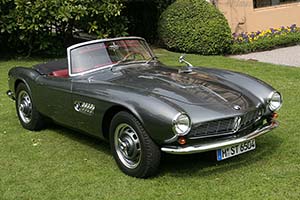
Page 1 of 1  Recovered from the War, BMW showed the all-new '501' in 1951 and commenced production late in 1952. This four-door model used an upgraded version of the 2 liter six cylinder from the pre-war 326 model which could deliver about 65-70 BHP and was not quite up to providing the 1300 kg car with spirited performance. BMW had successfully reentered the luxury car market. Recovered from the War, BMW showed the all-new '501' in 1951 and commenced production late in 1952. This four-door model used an upgraded version of the 2 liter six cylinder from the pre-war 326 model which could deliver about 65-70 BHP and was not quite up to providing the 1300 kg car with spirited performance. BMW had successfully reentered the luxury car market.BMW soon decided that more power was required and in 1954 they revealed an alloy 2.6 liter V8 engine. It was the first all alloy V8 to enter production and is said to have inspired General Motors when they developed the first Chevrolet small-block V8. The engine produced 100 bhp and there was sufficient space between the cylinders to further increase the displacement. A 3.2 litre version was introduced in 1955, which was good for another 20 bhp. The US importer for BMW cars, Max Hoffman indicated that there might be a market for a two-seater sportscar in the same vein as the legendary BMW 328, built in the late 1930s. First discussions about such a car started in 1953 already and were picked up by Ernst Loof. He had designed the BMW 328 based Veritas sports and racing cars, that were successfully raced in the late 1940s and early 1950s. When his company folded in 1953, Loof approached BMW and offered to assist in the design of the new sportscar. He actually received the green light to present his own design, with technical supervision from BMW's chief engineer Fritz Fiedler. Built by Baur in Stuttgart, the Loof designed and V8 engined two-seater was presented in 1954. It received universal acclaim and a prize at a German Concours d'Elegance. In the mean time, BMW had contacted Graf Albert Goertz, who had been strongly recommended by Max Hoffmann. On the basis of his first sketches, Goertz received a similar assignment as Loof. Ultimately BMW preferred the more elegant design of Goertz over Loof's. His car was used for comparative windtunnel alongside the Goertz car and was eventually sold off to Italy. Probably the BMW management made the correct decision, as the car presented by Goertz stands out as an icon in car design Dubbed the 507, the new BMW sports car was the star of the 1955 IAA. From the beginning onwards the car had the 3.2 Liter V8, now producing 150 bhp at 5000 revs. The chassis lay-out (including the torsion bar suspension system) was taken over from the limousine, but of course the wheelbase was greatly reduced and a special Panhard rod was added to further stabilize the rear live axle. The gearbox (located underneath the front bench in the limousine) was grafted directly to the engine. Performance was brisk, but no match to the contemporary Mercedes 300SL. The purpose of the 507 was rather more aimed at a comfortable but still sporty ride. The car is therefore officially presented as '507 Touring Sport'. Top speed, depending on the final drive was given as between 190 and 220 km/h. Specifically for the US market a 165 bhp version was offered, with a higher compression ratio. Other improvements made during production included the installation of a smaller fuel tank to increase the luggage space, and at the very end some cars were fitted with disc brakes. One of the interesting questions has always been: How fast was it in reality. An interesting test was undertaken by the Swiss magazine Automobil Revue in 1959 (after production had already stopped). They choose a US-spec car with the tallest rear axle, added a flat plate underneath the car, covered the headlights with some streamline devices and fitted highly inflated Continental Racing tires. They did reach 222 km/h, at which the turned at just over 5900 revs, still 600 below the maximum recommended level 6500 rpm. One of the most famous BMW 507s is the one owned by John Surtees from new. Equipped with the high performance engine and disc brakes, the car was given to the motorcycle racer by Count Agusta when he joined the MV Agusta Grand Prix team. Surteers later became the first World Champion on both two and four wheels. He has owned the car for over fifty years now. Despite all the acclaim the car received during its presentation, sales were disappointing. Especially in the USA where a Corvette or Jaguar XK cost about half, BMW struggled to find buyers. Reducing the planned production numbers resulted in another hike in unit costs and the car really became too expensive. During a three year production span only 254 cars were produced, including the prototypes. The fact that over 200 of these cars are still known to exist is a testimony of the timelessness of the design. It turned Graf Goertz world famous and it is still by far the most valuable classic BMW road car. Its exterior styling has influenced many BMW designs of the late 1990s like the Z3 and Z8. Details like the air vent in the front fender can still be found on the current models. Page 1 of 1 |
| Article | Image gallery (201) | Chassis (13) | Specifications | User Comments (2) |
| All Cars - Contact us - Privacy Statement - Top | © 1998 - 2026 Ultimatecarpage.com |