Page 1 of 2 Next >> Having served Lola and the company's customers very well for five seasons, the T70 was finally discontinued in 1969. Building a replacement that would be a match for the might of the Porsche 917 and Ferrari 512 was not surprisingly beyond the specialist manufacturer's modest means. One of the biggest problems was the unavailability of an engine that could match the German and Italian V12s for power and/or durability. Instead Lola set its sights on the European Two Litre Championship with the all-new T210 for which customers lined up in large numbers and competitive engines were readily available.
Ahead of the 1972 season, the sports car racing regulations were dramatically revised. The existing 'Group 5' big-bore machines were effectively banned and replaced by what in years previous had been labelled 'Group 6'. The new 'Group 5' regulations scratched all homologation requirements and featured a three litre displacement limit. Conveniently, this was an exact copy of the contemporary Formula 1 engine regulations. For specialist manufacturers like Lola, this re-opened the door to the World Championship as with the Cosworth DFV a competitive engine was once again available.
Lola's Eric Broadley jumped at the opportunity and assisted by chief engineer Bob Marston and talented young designers John Barnard and Patrick Head developed a brand new sports prototype racer for the 1972 season. Using the resources economically, a basic design was laid down that formed the basis for both a new three-litre and two-litre racer, known as the T280 and T290 respectively. Like the highly advanced T210 and subsequent T212, the new generation of Lola sports racers used a lightweight aluminium monocoque.
The biggest difference between the two new cars was obviously found in the engine compartment. One of the strengths of the Cosworth DFV engine was that it was rigid enough to be used as a stressed member of the chassis, while the smaller, four cylinder engines required an additional subframe to support the rear suspension loads. Another distinguishing factor were the in-board mounted brakes on the three-litre version, which allowed for wider wheels to be used. The rest of the T280/T290 also followed conventional lines with double wishbones at the front and reversed lower wishbones, top links and twin trailing-arms at the rear. Page 1 of 2 Next >>

 Ultimatecarpage.com
> Cars by brand
> Great Britain
> Lola
Ultimatecarpage.com
> Cars by brand
> Great Britain
> Lola
 Racing cars
> Other Sportscars
Racing cars
> Other Sportscars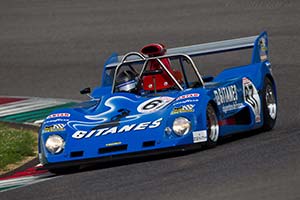
 Having served Lola and the company's customers very well for five seasons, the T70 was finally discontinued in 1969. Building a replacement that would be a match for the might of the Porsche 917 and Ferrari 512 was not surprisingly beyond the specialist manufacturer's modest means. One of the biggest problems was the unavailability of an engine that could match the German and Italian V12s for power and/or durability. Instead Lola set its sights on the European Two Litre Championship with the all-new T210 for which customers lined up in large numbers and competitive engines were readily available.