Page 1 of 2 Next >> In 1961 Jack Brabham formed his own racing team together with fellow Australian Ron Tauranac. The 1959 and 1960 Formula 1 World Champion would be responsible for running the team and driving the cars and Tauranac took care of all technical aspects. Their company was briefly known as Motor Racing Developments (MRD), but after Brabham had left Cooper early in 1962 it was renamed to Brabham Racing Developments and the cars simply badged 'Brabham'. Not surprisingly, the first cars produced by the England based team were single seaters. After the one MRD produced in 1961, the BT2 (Brabham Tauranac 2) was the first Brabham production car.
A total of eleven of the very conventional Formula Junior racing cars were produced in 1962, which enabled the newly formed manufacturer to develop their first F1 car. To bridge the gap before the new car was ready, Brabham acquired a Lotus 24 F1 racer and surprisingly not a Cooper. Tauranac hardly threw caution to the wind when he designed the highly conventional BT3. The basis of the new car was an exceptionally stiff steel spaceframe chassis, suspended by double wishbones front and rear. The BT3 was designed to take the newly developed Coventry Climax V8 engine. This was installed in the chassis mated to a Colotti-Francis six speed gearbox.
The very elegant Brabham BT3 seemed outdated even before it first raced as a result of the introduction of the monocoque Lotus 25. However unlike Lotus' Colin Chapman, who was predominantly interested in building the fastest cars, Tauranac was well aware that reliability and safety were also essential ingredients. The daunting Nürburgring track was the scene of the Brabham's Formula 1 debut. It proved to be very disappointing as Jack Brabham managed to qualify no higher than 24th and was subsequently forced to retire in lap 9 of 15 with a throttle linkage issue. He did much better in the American and South African Grands Prix by finishing fourth twice after qualifying fifth and third respectively. The unique BT3 was entered three times in 1963 for Jack with fifth as the best result.
Brabham's debut season had been fairly successful and with renewed confidence Tauranac set about designing three new cars for 1963 including a sports racer and a Formula 1 car. Dubbed the BT7, the 1963 F1 racer was very much a development of the original BT3. The suspension was slightly revised and the fragile Colotti-Francis gearbox was replaced by a five speed Hewland unit. For the body design Tauranac consulted Jaguar's Malcolm Sayer, who was renowned for penning up very slippery designs. Two cars were constructed; one for the new number one driver, Dan Gurney and the second for Jack, who had decided to focus more on managing the team. Page 1 of 2 Next >>

 Ultimatecarpage.com
> Cars by brand
> Great Britain
> Brabham
Ultimatecarpage.com
> Cars by brand
> Great Britain
> Brabham
 Racing cars
> Formula 1
Racing cars
> Formula 1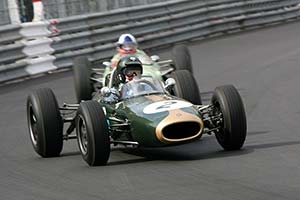
 In 1961 Jack Brabham formed his own racing team together with fellow Australian Ron Tauranac. The 1959 and 1960 Formula 1 World Champion would be responsible for running the team and driving the cars and Tauranac took care of all technical aspects. Their company was briefly known as Motor Racing Developments (MRD), but after Brabham had left Cooper early in 1962 it was renamed to Brabham Racing Developments and the cars simply badged 'Brabham'. Not surprisingly, the first cars produced by the England based team were single seaters. After the one MRD produced in 1961, the BT2 (Brabham Tauranac 2) was the first Brabham production car.