Page 1 of 2 Next >> Shortly after Mercedes-Benz recommenced road car production, the German manufacturer set their sights on motorsport in the early 1950s. Of course there were not the means available to continue the company's pre-War Grand Prix program, so instead the focus was on a production based sportscar. Unfortunately, the familiar Mercedes-Benz production cars were too heavy to be turned into a race winning machine, so it was not quite straightforward.
The motorsport department sourced as many usuable parts from the new 300 luxury model and fitted them to a new, lightweight spaceframe chassis. The most important "off-the-shelf" product was the single overhead camshaft straight six engine, newly designed for the 300. In the development process, it was somewhat modified and eventually equipped with Bosch Fuel Injection. Suspension was by double wishbones up front and the trademark swing axles.
To make sure the spaceframe chassis was as rigid as it was light, the tubular structure was very high on both sides of the driver's compartment. With these very high sills, fitting conventional doors was next to impossible, so something new was needed. The designers came up with doors hinged in the roof that opened upwards, allowing for ample access to enter and exit the car. When looked at from the from the front with both doors open, the doors resembled wings, which later earned the car the nickname 'Gullwing'.
Soon after the 300 SL, for Sport Leicht (or Sport Light), took to the track in 1952, Mercedes-Benz was back to winning form. In that season and the following season major races fell the German's way, highlighted by a victory in the Carrera PanAmericana and the 24 Hours of Le Mans. In the mean time the company's financial fortunes were also on a rise and a return to Formula 1 was proposed for 1954. This was by no means the end of the line for the 300 SL as work was well under way to turn the race winning design into a road car. Page 1 of 2 Next >>

 Ultimatecarpage.com
> Cars by brand
> Germany
> Mercedes-Benz
Ultimatecarpage.com
> Cars by brand
> Germany
> Mercedes-Benz
 300 SL 'Gullwing' Coupe
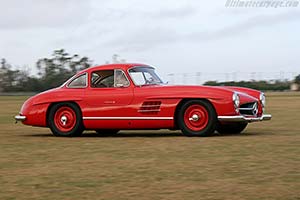
 Shortly after Mercedes-Benz recommenced road car production, the German manufacturer set their sights on motorsport in the early 1950s. Of course there were not the means available to continue the company's pre-War Grand Prix program, so instead the focus was on a production based sportscar. Unfortunately, the familiar Mercedes-Benz production cars were too heavy to be turned into a race winning machine, so it was not quite straightforward.