Go to Ultimatecarpage.com

Car search: Quick Advanced 
  Ultimatecarpage.com  > Cars by brand  > France  > Bugatti
EB 110 GT
Cars statistics: 4031 cars, 388 makes, 28569 images; Events statistics: 168 reports, 29799 images; Forum statistics: 78,086 members, 38,928 topics; more...


Bugatti EB 110 GT

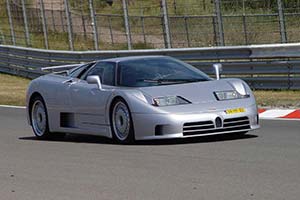
Bugatti EB 110 GT Bugatti EB 110 GT Bugatti EB 110 GT Bugatti EB 110 GT Bugatti EB 110 GT Bugatti EB 110 GT
Click here to save all images    Image credits: Wouter Melissen 

Click here to download printer friendly version Bugatti was one of the finest car manufacturers of the 1920s and 1930s, but after the death of founder Ettore Bugatti in 1947, the company ceased production. In an attempt to revive Bugatti, Italian entrepreneur Romano Artioli bought the rights to the legendary name. In 1989 he announced the return of Bugatti. A state of the art factory was constructed just north of Modena, Italy. So just like Ettore himself, Artioli's Bugatti was Italian.

No expense was spared in designing the new Bugatti and from scratch one of the most advanced vehicles of its day was designed and built. Launched on the day of Ettore's 110th birthday (09-15-1991), the new car was aptly named 'EB 110'. Scene of the launch was the Versailles Palace, the former domicile of the French royal family.

Much like its predecessors the EB 110 featured a uniquely styled body complete with the characteristic horse-shoe shaped grill. Responsible of the design was the Italian designer Marcello Gandini. Unlike his previous wedge-shaped designs like the Lamborghini Countach and Lancia Stratos, the EB 110's body is round and voluptuous. To save weight, the entire body was made of aluminium.

The aluminium body panels are bonded to a carbon fibre monocoque chassis. The EB 110 was the first road car to use a monocoque using this exotic material. Due to the difficult production process of the composite material, the tubs were constructed by French aviation company Aerospatiale. It was suspended all around by double wishbones. The front suspension features push-rod operated shock absorbers and the rear dual shock absorbers on each side.

Not just the chassis was advanced, the engine was as well; it remains as one of the most complex powerplants ever constructed. Being a 60 degree V12 engine, its configuration was very Italian, but the ancillaries are what make the 3.5 litre V12 extraordinary. The dual overhead camshafts operated five valves per cylinder, a setup only seen in the Ferrari F1 racers of the day. Four IHI Turbochargers were mated the high revving engine, giving the EB 110 an unprecedented output of over 550 bhp.

To best suit the Turbocharged engine's characteristics, a 6 speed manual gearbox was fitted. It ensured that the revs could be kept in the 3500+ rpm area after shifting up. The incredible amount of horsepower and torque were delivered to the road through all four wheels. The permanent four wheel drive delivers 27% of the power to the front wheels and the other 73% to the rears. Plenty of stopping power is provided by large ventilated Brembo discs.

Complementing the initial EB 110 GT, was the EB 110 SS, for Super Sport. The SS took the GT's performance one step further. With 650 bhp on the tap, the SS was a genuine race car for the road. Some styling cues distinguished the GT and SS, most notably the air holes behind the side windows on the SS. Seven spoke alloy wheels replaced the BBS wheels found on the GT.

All this did not come cheap, but when the project was started, money did not seem hard to come by. Unfortunately for Artioli, the world economy crashed and with it the demand for steap priced exotics. Five years after its introduction and after a production run of only 126 cars, Bugatti filed for bankruptcy. The remaining tubs were sold to Jochen Dauer, who used them to construct around a dozen more EB 110s.

This was not the final chapter in Bugatti's history. In the late 1990s the rights to the Bugatti name were snapped upped by Volkswagen. After a number of concepts were shown on motorshows around the world, production was started of a new Bugatti. Much in the EB 110's tradtion, the German Bugatti was again the most powerful car available.

The EB110s pictured are seen in the paddock of the Belgian Spa Franchorchamps track and in the paddock and on the track of the Dutch Zandvoort track.

Article by Wouter Melissen, last updated before 12 / 01 / 2004

Add your comments on the Bugatti EB 110 GT

 the legend lives again  
exoticcarsite
3-8-2003
motorhead, what you said about a '2nd generation' eb110 is, sort of true, in 1999 i believe it was, dauer acquired the rights from bugatti, to reproduce the bugatti eb110, under the name of dauer eb110 evolution or dauer eb110 ss, depending what you type in basically.i used to have a website dedicated just to bugattis and in particular, the eb110 range of gt and ss (supersport was my favourite). had and still do have on my computer, over 400 pictures of them.heres an article i wrote for my website of supercars (its not up and running yet) enjoy, its quite long, but this is all based on actual information ive learn first hand, being what was the largest eb110 supercar site on the net a few months back. Bugatti, a name surrnomenous with racing history, once again set the bar higher for its competitors to compete against when back on September 15th 1991, the Bugatti EB110GT was released. When the financial broker Romano Artioli revived the Bugatti brand in 1989, he started with the new development of a sports car, which in 1991 was presented to an enthusiastic public in Paris as the Bugatti EB110. Despite the 139 cars produced, the company could enjoy only a short life span. The EB110GT is no sheep in wolf's clothing. Complimenting the heavyset styling is a mammoth of an engine. A quad-turbo, 3.5 litre, 60 valve, aluminium and titanium V12 sits to the rear of the driver. This incredible engine delivers around 560bhp and 450 lbs/ft of torque to the road via Bugatti's unique four wheel drive system, with 73% to the rear wheels and 27% to the front. With an 8,200rpm limit, the V12 works its way up to 3,500 rpm before the first of the four IHI turbo chargers gets up to speed. From then up the rev range the remainder of the turbos kick in one by one. This can propel the 1500 kg car to 60mph in a mere 3.2 seconds. Top speed is 221mph, which at the time of its launch made it the fastest production car in the world. The EB110 name was coined as a celebration of Ettore Bugatti's 110th anniversary (born in 1881). Commissioned in 1989 the completed car was ready in 1990 but the unveiling was delayed until the anniversary date of September 15th 1991. At a price of ú340,000 it wasn't going to be anything but exclusive. Five aluminium chassis pre-production prototypes were built, followed by eight with composite chassis, before ninety-five production models were rolled out. If the standard car seemed a bit dull to you, a slightly stripped down and tuned up 'SS' model was also built for racing. Differences included less weight, a fixed spoiler as compared to the GT's elevating device. An aluminium dash and larger, 7 spoke wheels were also featured with no less than 611bhp and 356kph (221mph). Only thirty-one production SS's were made, with five partially completed cars in the factory when Bugatti suffered bankruptcy. The new Bugatti EB110SS was in all respects an amazing car. Strikingly styled, enormously powerful and superb to drive, it fittingly revived the Bugatti name. Sadly enough, the Bugatti name fell bankrupt and only a handful of these masterful EB110's were produced. In 1997, Dauer Automobile company then took over the entire bankruptcy assets of the Bugatti Automobili SpA name. Practically the entire stock of original parts and prefabricated vehicles is today available to this company. Jochen Dauer says: ôAt that time we recognized the enormous potential of this car and were certain that we could refine it further.öUnder the leadership of company founder Jochen Dauer, its team of specialists, made up from former employees of the Bugatti Automobili SpA, has subjected the EB110 SS to further development.The Dauer EB110 SS is like formerly by Dauer, always a step ahead of its competitors technically. The carbon fibre body on its own, newly developed with much know-how and extensive tests, reduced the empty weight of the vehicles contents. As the sole four-wheel drive sports car worldwide, this high-tech fireball sets standards for technology and perfection. The 12-cylinder engine equipped with 4 exhaust gas turbochargers and developing 450 kW accelerates the vehicle from 0 to 100 kph in 3.35 seconds and reaches a top speed of 351 kph at full load - this its the thrill of driving at the highest level. Company head Dauer: ôWe have not attempted to reinvent the wheel, but with the technical means available to us today we have adapted the excellent concept of this vehicle to the requirements of the latest vehicle technology.öáThe noble styling of the EB110 SS has been taken over unchanged. But initial studies have already been made and these are kept under lock and key with the highest priority. All future vehicles will be produced exclusively in the US version.As is right and proper for a thoroughbred sports car, the interior equipment is matched rather to the driver with sporting ambitions. However, as the EB110 is usually manufactured to a customerÆs wishes, anything is possible, from the purist interior up to the exclusive, colour-matched ambient crafted from the most select materials.áAll in all the Dauer EB110 SS is a diamond in a sports car setting, for its number worldwide will surely never exceed the 200 mark. Connoisseurs and collectors of exclusive automobiles will therefore have to hurry if they want to name one of the irrevocably last built vehicles one of their own. What of the future of Bugatti then? Now owned by Volkswagen, Bugatti is about to release the Bugatti 16/4 Veyron in mid 2003. Boasting 1001BHP, an estimated top speed in excess of 250 mile per hour, diamond studded speedometer, and costing no less that $800,000 US, this car is for the ultra high entrepreneur of this modern hay day that is the 21 century.
 not as great as it appears  
Mr b00st
7-4-2003
"this car was flawed as far as performance cars go. A few nits to pick 1. Weight. This car was heavy. With 611 horsepower, it took 3.8 seconds to get to sixty? Wow... maybe its time to lose some weight. Didn't the 440 horsepower Corvette ZR-1 SS (""SNake Skinner"") run to sixty in 3.8? 2. Turbo lag. Small engine, massive boost and extensive plumbing for the ridiculous quantity of turbos equals a poofy, lumpy V12 until about 3900 rpms (what I've heard) when the car erupted... a bit erratic, perhaps? 3. Understeer. The Four wheel drive system was a bit too forward-biased, and it was heavy. Understeer in this car is often compared to that of the 3000GT VR-4! Embarassing. the car was nice, though. If you ever see an interior shot, tell me if you've ever seen a nicer supercar interior than that. I doubt it."
 This car KicksArse!  
AntiDomestic
14-1-2003
This is by far one the the Greatest supercars that has ever existed. I love the lines on it and those 300ZX(Z32) style head lights placed the other way around,lol look totally BADASS on it too! I heard that Bugatti is bringing it back or some thing like that,if that's true,I say go ahead Bugatti and bring it back hehe. The world needs a car like this again.

View all the user comments on the Bugatti EB 110 GT
     
General specifications
Country of origin France
Numbers built 95 GTs, 31 SSs
Produced from 1991 - 1995
Body design Gandini

Engine
Configuration 60º V 12
Location Mid, longitudinally mounted
Construction aluminium block and head
Displacement 3.498 liter / 213.5 cu in
Bore / Stroke 81.0 mm (3.2 in) / 56.6 mm (2.2 in)
Compression 8.0:1
Valvetrain 5 valves / cylinder, DOHC
Fuel feed Multi Point Fuel Injection
Aspiration Quad Turbos

Drivetrain
Chassis/body aluminium body on carbon fibre monocoque
Front suspension double wishbones, pull-rod operated shock absorbers
Rear suspension double wishbones, twin gas pressure shock absorbers, anti-roll bar
Steering rack-and-pinion, power assisted
Brakes ventilated discs, all-round
Gearbox 6 speed Manual
Drive All wheel drive

Dimensions
Weight 1620 kilo / 3571.5 lbs
Length / Width / Height 4400 mm (173.2 in) / 1940 mm (76.4 in) / 1114 mm (43.9 in)
Wheelbase / Track (fr/r) 2550 mm (100.4 in) / 1550 mm (61 in) / 1618 mm (63.7 in)

Performance figures
Power 560 bhp / 418 KW @ 8000 rpm
Torque 608 Nm / 448 ft lbs @ 3700 rpm
BHP/Liter 160 bhp / liter
Power to weight 0.35 bhp / kg
Top Speed 340 km/h / 211 mph
0-60 mph 4.4 s

Resources
Useful links


  All Cars - Contact us - Privacy Statement - Top © 1998 - 2010 Ultimatecarpage.com