
| btcc |
 Ultimatecarpage.com
> Cars by brand
> United States
> Ford
Ultimatecarpage.com
> Cars by brand
> United States
> Ford
 Racing cars
> BTCC Sierra RS500 Cosworth Group A Racing cars
> BTCC Sierra RS500 Cosworth Group A
|
| Ford Sierra RS500 Cosworth Group A |
| Article | Image gallery (60) | ARE0185 | Specifications |
|
|
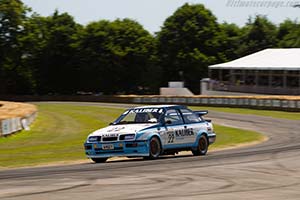
Page 1 of 1  Launched at the 1985 Geneva Motor Show, the Ford Sierra RS Cosworth was one of the great homologation specials of the 1980s. Based on the front-engine, rear-wheel drive Sierra introduced in 1982, it was designed for the Group A category that had been adopted by all the major touring car championships. The driving force behind the project was Stuart Turner, who had just been hired as the head of Ford Motorsport in Europe. Launched at the 1985 Geneva Motor Show, the Ford Sierra RS Cosworth was one of the great homologation specials of the 1980s. Based on the front-engine, rear-wheel drive Sierra introduced in 1982, it was designed for the Group A category that had been adopted by all the major touring car championships. The driving force behind the project was Stuart Turner, who had just been hired as the head of Ford Motorsport in Europe.It was built around the newly developed Cosworth YB engine. This combined a reinforced Ford Pinto block with a proprietary four-valve Cosworth head. Equipped with a turbocharger, it was rated at around 180 bhp in street trim. The four-cylinder engine was mated to a Borg-Warner T5 gearbox, similar to the five-speed manual fitted in the contemporary Ford Mustang. An aggressive bodykit with a front spoiler, flared wheel arches and a massive rear wing were also part of the package. These modifications were honed in the wind tunnel at during extensive test at the high-speed Nardo circuit. For homologation purposes, at least 5,000 examples of the RS Cosworth had to be produced and Turner initially had difficulty convincing the Ford executives and dealers that there was a sufficient market for a high-performance and relatively expensive Sierra. To keep the price to a minimum, it was offered in only three exterior colours and the option list only included central locking and electric windows. By the summer of 1986, 5,545 cars had been produced. The additional run of 500 cars were earmarked to be converted to a more extreme 'Evo' specification, which was allowed by the Group A regulations once the initial 5,000 cars had been produced. Aptly dubbed the RS500, the Evo package of the Sierra RS Cosworth was produced as an upgrade kit by Aston Martin Tickford. The additional changes included a reinforced engine block, larger turbo and intercooler and further detail changes to increase engine performance. In street trim, the RS500 engine produced 224 bhp. There were also subtle difference to the aero package to improve downforce and aid cooling. Exactly 500 examples were produced of the RS500 using the upgrade package. Although the base cars were all produced in Genk, Belgium, the RS500s were right-hand drive and intended for the British market only. While a Group A version of the Sierra RS Cosworth was already used from the start of the 1987 season, the RS500 was not homologated until August. The Group A competition cars were generally built from bare and sometimes lightened shells supplied by the factory to the individual teams. They were fitted with a further modified engine equipped with a larger Garrett Turbo and an additional set of fuel injectors. At the RS500's competition debut, the two-litre four-cylinder was good for around 460 bhp, which had increased to well over 500 bhp towards the end of the car's competition career. The suspension was also further modified and the cars ran on slick tyres. After an inconspicuous debut at the 1987 Spa 24 Hours, the Sierra RS500 Cosworth would go on to absolute dominate touring car racing for several seasons to come. Run by teams like Eggenberger, Rouse, Grab and Wolf Racing, the four-cylinder engined Ford reigned supreme in the World Touring Car Championship, the European Touring Car Championship, the British Touring Car Championship and the German DTM. Victories were scored in the Nürburging 24 Hours, Bathurst 1000, the RAC Tourist Trophy and the Spa 24 Hours. The RS500 Cosworth was so dominant that it either effectively ended championships (WTCC) or was penalised so extensively that it was effectively banned from them (DTM) and as a result. Although no development work was done on the cars after 1988, victories were scored as late as 1992. According to Motorsport Magazine, the Sierra RS500 Cosworth remains the most successful production based race car of all time with 84.6% winning margins. Page 1 of 1 |
| Article | Image gallery (60) | ARE0185 | Specifications |
| All Cars - Contact us - Privacy Statement - Top | © 1998 - 2026 Ultimatecarpage.com |