
 Ultimatecarpage.com
> Cars by brand
> Italy
> Ferrari
Ultimatecarpage.com
> Cars by brand
> Italy
> Ferrari
 F80 F80
|
| Ferrari F80 |
| Article | Image gallery (27) | Specifications |
|
|
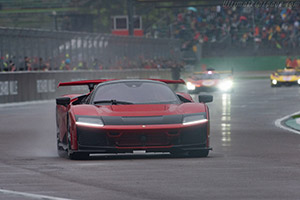
Page 1 of 3 Next >>  Ferrari unveiled the F80 and wrote a new chapter in the history of legendary supercars bearing the Prancing Horse badge. The F80 will be produced in a limited run of just 799 examples and joins the pantheon of icons such as the GTO, F40 and LaFerrari by showcasing the best that the Maranello-based marque has achieved in terms of technology and performance. Ferrari unveiled the F80 and wrote a new chapter in the history of legendary supercars bearing the Prancing Horse badge. The F80 will be produced in a limited run of just 799 examples and joins the pantheon of icons such as the GTO, F40 and LaFerrari by showcasing the best that the Maranello-based marque has achieved in terms of technology and performance.Ever since 1984, Ferrari has periodically released a new supercar that represented the pinnacle of cutting-edge technology and innovation of its era and that was destined to become enshrined in popular culture. Intended for the most discerning clients of the brand, these cars immediately became legends in their own lifetime, making an indelible mark not only on the history of Ferrari, but on the history of the automobile itself. The latest addition to this family, the F80, is tasked with embodying the ultimate in engineering for an internal-combustion-engined vehicle and employs all the most advanced technological solutions, including latest-generation hybrid technology for the powertrain, to achieve unparalleled levels of power and torque. Every aspect of the architecture is conceived to maximise performance, from the carbon-fibre chassis and extreme aerodynamic solutions far beyond anything seen before in a road-legal car, to the new active suspension optimised to let the driver wring every ounce of performance from the car on the track. Unlike anything else in the current supercar world, the F80 combines all these attributes with uncompromising levels of usability on the road, where it can be driven with ease. This ability shaped every choice made in terms of technology and architecture to achieve the goal, which at first sight seems impossible, of creating a track-oriented supercar that’s just as driveable as a production range model. All this means that the driver will spend even more time in the car and can truly get to know and revel in its performance and the thrilling driving experience it offers. The architecture of the F80 is so extreme that the layout chosen results in a narrower cabin with a driver-centric layout, which nonetheless still offers excellent space and comfort for a passenger. This choice had crucial benefits in terms of minimising drag and weight. The cockpit area therefore has a distinct single-seater feel, despite the fact that the car is homologated for two occupants, resulting in a architecture that we could call “1+”. The primary reason for this choice was to minimise width, to the benefit of aerodynamics (with less drag) and weight saving. This concept is completely in keeping with the motorsport world from which this car not only draws inspiration but also inherits technological solutions. As has always been the case with the Ferrari supercars preceding the F80, the powertrain is based on the finest expression of technology in motorsport. The GTO and F40 were powered by a turbo V8, because Formula 1 cars used turbocharged engines in the 1980s. Today in both Formula 1 and the World Endurance Championship (WEC), powertrains consist of turbo V6 ICE engines mated with an 800 V hybrid system. It was only natural then that this architecture - the same architecture used by the 499P, which has taken two consecutive victories at the 24 Hours of Le Mans - would be transferred into the new F80. Here though the powertrain is further complemented by the introduction, for the first time ever on a Ferrari, of electric turbo technology (e-turbo), which, with an electric motor installed between the turbine and compressor of each turbo, allows for an extraordinary specific power output and instantaneous response from low down in the rev range. Aerodynamics play a key role on the F80, with solutions such as the active rear wing, rear diffuser, flat underbody, front triplane wing and S-Duct working in concert to generate 1000 kg of downforce at 250 km/h. This result is further enhanced thanks to the active suspension, which contributes directly to generating ground effect. Performance is boosted by the electric front axle, which brings four-wheel drive capability to make even more effective use of the torque and power on tap, and the new brakes with motorsports-derived CCM-R Plus technology. As with all the supercars preceding it, the F80 marks the start of a new design era for Ferrari, with a more tense, extreme design language accentuating its race-bred soul. There are clear references to cues borrowed from aerospace, which underscore the cutting-edge technology and elegant engineering of each and every technical solution. But there are also nods to its hallowed progenitors which clearly declare the illustrious lineage of the F80. The three-litre 120° V6 F163CF of the F80 is the ultimate expression of the Ferrari six cylinder engine: this unit produces an astonishing peak power of 900 hp, making it the Ferrari engine with the highest specific power of all time (300 cv/l), to which the electric front axle (e-4WD) and rear motor (MGU-K) of the hybrid system add another 300 cv. The link with motorsports, and endurance racing in particular, is strong: the architecture of this engine and many of its components are closely derived from the powerplant of the 499P which won the last two editions of the 24 Hours of Le Mans. Commonalities with the car competing in the World Endurance Championship (WEC) include the architecture, crankcase, layout and drive chains of the timing system, oil pump recovery circuit, bearings, injectors and GDI pumps. Naturally, there is also technology carried over from Formula 1, from which the F80 inherits both the concept of the MGU-K (with the development of an industrially manufacturable electric motor similar to the unit used in Ferrari F1 cars) and the MGU-Hs (which generate power from the excess kinetic energy from the rotation of the turbines created by the heat energy from the exhaust gases) with a bespoke e-turbo application. For maximum performance in all possible conditions, every aspect of the calibration of the engine has been taken to the extreme, focusing in particular on the ignition and injection timing, the number of injection events per stroke and the management of the variable-phase valve timing. The F80 is equipped with the first Ferrari road car engine to benefit from a new approach for statistical knock control, which lets the engine operate even closer to the knock limit, allowing the use of higher combustion chamber pressures than ever (+20% compared with the 296 GTB) to unleash even more of the engine’s potential. Another crucial aspect has been the work dedicated to the dynamic calibration of the torque curve in every gear, an all-time first for a Ferrari road car. This part of the project focused on real road-driving conditions and the management of the e-turbo system, because knock and compressor surge limits vary depending on whether they are measured in dynamic or stationary conditions. As a result of this research, a dedicated calibration was developed for each gear, allowing the engine to attain levels of responsiveness comparable to a naturally-aspirated engine in all operating conditions. The e-turbos, with an electric motor installed axially between the turbine and the compressor housing, let the engineers optimise the fluid dynamics of the engine for maximum power at mid to high engine speeds without the usual compromise this entails in terms of turbo lag at low engine speeds. Bringing electric power into the equation makes it possible to define e-turbo management strategies which negate turbo lag and ensure lightning-quick response times. The 350 bar injectors of the GDI system are situated at the centre of the combustion chamber for optimal fuel/air mixing and, together with the multiple injection strategies adopted, ensure efficiency for outstanding performance with lower emissions. The intake and exhaust cam profiles have been revised to optimise fluid dynamic efficiency and increase maximum engine speed to 9000 rpm, with a dynamic limiter at 9200 rpm. Both the intake and exhaust runners are polished for better performance; the intake runners have been shortened to reduce resistance and cool the air/fuel mixture through fluid dynamic detuning, and are specifically designed to increase turbulence in the combustion chamber. The three-brick (matrices) exhaust line complies with current emissions standards (Euro 6E-bis), but already takes future evolutions in emissions regulations on a global level into account. The Inconel© exhaust manifolds are designed to minimise pressure losses and are tuned to emphasise the distinctive sound of a Ferrari V6. The steel crankshaft is machined from a die-cast element and features hot-forged crankpins with an offset angle of 120°. The 1-6-3-4-2-5 firing order lends the F80 a typical Ferrari timbre. To reduce weight, the crankshaft webs and counterweights have been lightened. The connecting rods and pistons have also been revised: the titanium connecting rods feature a toothed interface at the mating surface between the shank and the big end cap to ensure perfect alignment between the two parts and absolute assembly precision with the bearings. The aluminium pistons have been optimised to reduce weight and withstand the higher pressure and thermal loads in the combustion chamber due to the incredibly high torque and power. Specifically, high strength DLC (diamond-like carbon) coated steel has been used for the piston pin. Additionally, a dedicated oil passage hole has been added to the zone between the piston pin and the connecting rod to improve lubrication. To lower the centre of gravity of the car, the engine has been installed as close as physically possible to the flat undertray. As a result, none of the components situated at the bottom of the sump are more than 100 mm below the centreline of the crankshaft. It was also decided to tilt the engine-transmission unit by 1.3° in the Z axis, raising the gearbox so that it does not compromise the efficacy of the aerodynamic undertray. To lighten the engine, the cylinder block, crankcase, timing cover and other components have been revised, while titanium screws have also been adopted. As a result of these measures, the engine weighs no more than the V6 of the 296 GTB despite a power increase of 237 hp. The lowered installation position of the engine-transmission unit was permitted by the new smaller diameter flywheel, conceived and designed from scratch for this application. This innovative solution was made possible by the use of two sets of springs, which also contributed to reducing the overall stiffness of the system and filtering vibrations transferred to the transmission more effectively. The damper was also developed specifically for this application to attenuate the higher torsional vibration forces in the driveline and dissipate the higher thermal loads due to the increased performance. The electric motors used for the F80 are the first units developed, tested and manufactured entirely by Ferrari at Maranello, all with the specific goal of maximising performance and reducing weight. Their design (with two on the front axle and one at the rear of the car) draws directly from Ferrari’s experience in racing; specifically, the stator and rotor in a Halbach array configuration (which uses a special layout of the magnets to maximise magnetic field strength) and magnet sleeve in carbon fibre are all solutions derived from the design of the MGU-K unit used in Formula 1. The rotor adopts Halbach array technology to maximise magnetic flux density and minimise weight and inertia. The carbon fibre magnet sleeve, on the other hand, has been used to raise maximum motor speed to 30,000 rpm. The concentrated winding stator reduces the weight of copper used for the end windings, while the Litz wire minimises high-frequency losses. The Litz consists of multiple insulated strands instead of a single wire, reducing the ‘skin effect’ and allowing the current to flow uniformly through the entire cross section of the wire to minimise losses. The resin coating for all the active parts of the stator improves heat dissipation. A DC/DC converter transforms DC current at one voltage to DC current at a different voltage. This innovative technology makes it possible to use a single component to handle three different voltages simultaneously: 800 V, 48 V and 12 V. Using the direct current produced by the high-voltage battery at 800 V, the Ferrari converter generates direct current at 48 V to power the active suspension and e-turbo systems, and 12 V direct current to power the electronic control units and all other electric ancillaries on the vehicle. Innovative resonant technology allows this component to convert current with no latency with a conversion efficiency in excess of 98%, so that it behaves to all intents and purposes as an accumulator. This component eliminated the need for a 48 V battery, saving weight and simplifying the layout of the electrical system. Also developed and manufactured entirely in-house by Ferrari, the front axle includes two electric motors, an inverter and an integrated cooling system. This component makes it possible to use torque vectoring for the front axle. Integrating different functions in a single component and the new mechanical layout have offered a weight saving of around 14 kg over previous applications, and the entire component weighs just 61.5 kg. Optimising mechanical efficiency was a primary goal: low viscosity oil (Shell E6+) and a dry sump active lubrication system with an oil tank integrated directly into the axle reduced mechanical power losses by 20%. The use of high coverage ratio (HCR) gears contributed to reducing noise emissions by 10 dB. The direct current received from the high-voltage battery is transformed into the alternating current necessary to power the electric motor by the inverter. The inverter integrated in the front axle is bidirectional, meaning that it also transforms alternating current produced by the axle under regenerative braking into direct current for recharging the battery. The inverter used to convert power and control the two front motors is capable of delivering a total of 210 kW of power to the axle. On the F80, the inverter is integrated directly into the axle and weighs just 9 kg, contributing to the lower mass of this component compared to its counterpart on the SF90 Stradale. Another inverter is used for the rear electric motor (MGU-K). This performs three functions: starting the internal combustion engine, recovering energy to recharge the high voltage battery and supplementing the torque of the engine in certain dynamic conditions. It can generate up to 70 kW in regeneration mode and assist the internal combustion engine with up to 60 kW of power. Integrated into both of these inverters is the Ferrari Power Pack (FPP) system, a power module with all the elements necessary for power conversion combined in the most compact unit possible. This unit consists of six modules in silicon carbide (SiC), gate driver boards and a dedicated cooling system. The core of the energy accumulation system - the high-voltage battery - is conceived for very high power density. The innovative design of the battery is based on three principles: lithium-cell chemistry derived from Formula 1, an extensive use of carbon fibre for the construction of the monocoque casing, and a patented design and assembly method (cell-to-pack) which minimises the weight and volume of the unit. Situated low down in the engine bay, the pack contributes to even better dynamic vehicle behaviour by lowering the car’s centre of gravity. All electrical and hydraulic circuit connectors are built into the component to reduce cable and hose length, while the pack is configured with 204 cells connected in series and subdivided equally into 3 modules, for a total energy capacity of 2.3 kWh and a maximum power output of 242 kW. Page 1 of 3 Next >> |
| Article | Image gallery (27) | Specifications |
| All Cars - Contact us - Privacy Statement - Top | © 1998 - 2026 Ultimatecarpage.com |