
 Ultimatecarpage.com
> Cars by brand
> Italy
> Ferrari
Ultimatecarpage.com
> Cars by brand
> Italy
> Ferrari
 F80 F80
|
| Ferrari F80 |
| Article | Image gallery (27) | Specifications |
|
|
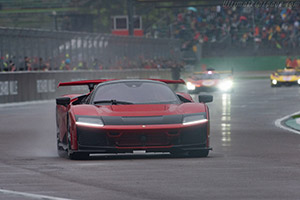
<< Prev Page 2 of 3 Next >>  The F80 pushes aerodynamic performance to levels never seen before on a Ferrari road car, as testified by the 1000 kg of downforce produced at 250 km/h. This astonishing achievement was made possible by perfect symbiosis between all the internal Ferrari departments working on the definition of the car’s architecture; for each department, the perfect balance between downforce and top speed was the basis for every design choice, giving shape to a suite of extreme solutions befitting a true supercar. The F80 pushes aerodynamic performance to levels never seen before on a Ferrari road car, as testified by the 1000 kg of downforce produced at 250 km/h. This astonishing achievement was made possible by perfect symbiosis between all the internal Ferrari departments working on the definition of the car’s architecture; for each department, the perfect balance between downforce and top speed was the basis for every design choice, giving shape to a suite of extreme solutions befitting a true supercar.The front end of the F80, which develops 460 kg of total downforce at 250 km/h, was inspired by the aerodynamic concepts employed in Formula 1 and the World Endurance Championship (WEC), innovatively reinterpreted for this application to become cornerstones of the entire design. On the one hand, the recumbent racing driving position allowed for a chassis with a high centre keel, while on the other, the cooling system layout has freed up the entire central portion of the vehicle, maximising the space usable for other functions. The body-coloured central volume of the nose acts as the generously-sized main plane of the front wing. Inside the S-Duct are two flaps following the main profile to complete the triplane wing configuration with curvatures and blower slots clearly inspired by the 499P. Crucial for the aerodynamic efficacy of the front of the vehicle is the way the triplane works in perfect concert with the S-Duct and the high central keel, minimising blockage of the air flow towards the wing and maximising performance. As a result, the air flow from the underbody and bumper undergoes violent vertical expansion and is redirected within the duct towards the front bonnet, generating a potent upwash which translates into a powerful low-pressure zone under the underbody. This accounts for 150 of the 460 kg of the maximum downforce generated at the front of the car which, however, is very sensitive to changes in ground clearance. The aerodynamic balance of the car is therefore ensured by the active suspension, which controls the attitude of the vehicle in real time and adjusts the distance between the underbody and the road in response to driving conditions. The volume freed up under the feet of the driver also made room for three pairs of bargeboards. These devices generate powerful, concentrated vortices which introduce a velocity component to the airflow field in the outwash direction. In addition to improving the underbody’s suction, the outwash also reduces blockage and improves the performance of the front triplane. The bargeboards also help mitigate the detrimental effects of the wake of the front wheel by confining it and keeping it away from the undertbody, preventing contamination of the air flow directed to the rear of the car. The aerodynamic performance of the rear zone of the car, which generates the remaining 590 kg of downforce at 250 km/h, is a result of the combined action of the rear wing-diffuser system. The efficiency of this system is highly dependent on the quantity of downforce produced by the underbody, as this has very little impact on drag. To take the performance of the diffuser of the F80 to extreme levels, the expansion volume of the diffuser itself has been maximised by inclining the engine-gearbox unit by 1.3° in the Z axis, and by the configuration of the rear chassis and suspension components. The starting point of the upward curvature of the diffuser has been brought forward, resulting in a diffuser measuring a record-breaking 1800 mm in length, which generates a huge low-pressure zone underneath the vehicle, which in turn draws a massive flow of air into the underbody area. The geometry of the chassis, with narrow, curved sills, contributes to creating an aerodynamic seal effect around the underbody by forming a duct that captures the flow adhering to the flank and blows air into the interior of the rear wheelarch housing under the lower suspension arm. The interaction between this air flow and the outer strake of the diffuser interferes with the vortices generated in the wheel-road contact zone, preventing air from entering the diffuser too far forwards. These solutions work in such perfect harmony that the downforce generated by the diffuser alone is 285 kg, or more than 50% of the total downforce on the rear axle. The active wing is the most visually distinctive aero feature of the F80, which completes the entire aerodynamic concept of the vehicle. The actuator system of the rear wing adjusts not only its height but also controls angle of attack continuously and dynamically, for precisely modulable downforce and drag. In the High Downforce (HD) configuration, which is used during braking, turn-in and cornering, the wing assumes an angle of 11° relative to the direction of the air flow to generate over 180 kg of downforce at 250 km/h. At the extreme opposite of its range of rotation, the wing is in Low Drag (LD) configuration, with the leading edge pitched upwards. Drag is much lower in this configuration, not only because of the reduction in lift, but also due to the tractive effect generated by the residual low-pressure zone impinging on the underside of the wing itself. The rear wing is the keystone of the entire adaptive aero system, allowing the F80 to adapt to any possible dynamic conditions, which are monitored and evaluated in real time by the vehicle control systems. In response to the requests of the driver in terms of acceleration, speed and steering angle, the system determines the optimal blend of downforce, aerodynamic balance and drag, and tells the active suspension and active aero systems to implement the ideal attitude accordingly. In the case of the aero system, this means controlling the angle of attack of the rear wing and the activation state of the Active Reverse Gurney flap under the front triplane. With its two different configurations, the flap also allows control over downforce and drag at the front of the car: the closed position generates maximum downforce, while in the open position the device is at right angles to the air flow and, similarly to how DRS systems work in Formula 1, stalls the underbody to reduce drag and let the car reach a higher top speed. Defining the layout of the cooling system demanded in-depth studies and painstaking development to reconcile the thermal needs of the engine (which has to dissipate over 200 kW of thermal power during performance usage) and the new hybrid system with aerodynamic requisites. The aim was to design a cooling system with the least possible impact on the overall packaging, to attain a functionally and aerodynamically valid configuration that perfectly accommodates both the aerodynamic and thermal demands of the F80. The radiators are positioned optimally to maximise the flow of cold air and minimise interference with the hot air flow, for better thermal exchange efficiency. A number of other innovative solutions were also adopted to improve the overall thermal balance of the car, such as the transparent film embedded in the windscreen which uses power from the 48V circuit to demist the screen and reduce the power demand on the HVAC system. Additionally, the climate control circuit is controlled by electrically actuated valves which modulate the flow of refrigerant in relation to the needs of the HVB circuit, improving energy management. At the front are two condensers serving the climate control, battery and active suspension circuit, plus three high temperature radiators for cooling the V6. Two of these are situated laterally, in outboard positions, to make the most effective use possible of the space between the underfloor and the headlights, while the third is situated at the centre and takes advantage of the upwash generated by the triplane to ensure adequate air flow. The venting of the hot air flows has been optimised to not interfere with the front aerodynamics and the flows of cooling air directed towards the rear. The main vent of the lateral radiators opens inside the wheelarch housing, a solution offering the least possible blockage to ensure excellent permeability for the radiating masses. Another aperture in the flank of the front wing ahead of the wheel contributes to containing the wheel wake while also directing hot air around the exterior of the wheel. The centre radiator vents heat into the zone between the bumper and the front bonnet without interfering with the flow exiting the S-Duct. A number of different functions are integrated into the flank of the F80 in a single formal solution described by the upper volume of the door, where the surface drops away gradually to give shape to a channel incorporated in the bodywork itself. The shape of this channel protects the air flow along the wing from thermal contamination by the hot wake of the front wheel and guides it along the surface of the door to the inlet at the leading edge of the flank. This air intake is topped by a winglet that reinterprets the distinctive form of NACA aeronautical inlets: a solution that exploits the vorticity of the air to capture part of the air stream flowing in the region above the duct. Inside the duct, the incoming air is split into two flows, with one feeding the induction system of the engine, which benefits from up to 5 hp of extra power as a result of ram effect, and the other feeding the intercooler, which cools the intake air, and the rear brakes. Here too, the engineers opted for innovative solutions to keep the braking system - developed around state-of-the-art CCM-R Plus discs - working in optimal thermal conditions. These include a front duct that uses the hollow inner cavities of the front impact-absorbing chassis longerons to channel the high-energy cold air flow from the bumper to the discs, pads and callipers, which are the most sensitive elements of the system. For the first time ever, this solution, patented by Ferrari, turns what was a packaging constraint into a means to maximise cooling performance, and offers a 20% increase in cooling air flow compared the LaFerrari with no penalty in terms of front aerodynamics. The F80 is equipped with the most advanced suite of technological solutions currently available for managing vehicle dynamics in all possible conditions on the road or track. The Ferrari active suspension system is undoubtedly one of the showpieces of these and has been re-engineered from the ground up compared with the version used on the Ferrari Purosangue to tailor it to the F80’s supercar soul. The system features completely independent suspension all round actuated by four 48V electric motors, a double wishbone layout, active inboard dampers and upper wishbones created with 3D printing and additive manufacturing technology, which is used here for the first time on a Ferrari road car. This solution offers a number of advantages, such as an optimised layout, more precise wheel control, reduced unsprung mass, no requirement for an anti-roll bar and the introduction of a dedicated camber angle correction function. This system fulfils two apparently irreconcilable requirements - the need for a very flat ride on the track, where variations in ride height must be minimised as much as possible, and the need for the compliance to effectively soak up bumps in road surfaces during normal driving. This means that the car boasts outstanding driveability on the road and can also manage downforce optimally in all possible conditions. At low speeds, the system prioritises mechanical balance and centre of gravity control, while with increasing speed, the ride height control system works to optimise aerodynamic balance in each different cornering state in concert with the active aero system. When under hard braking, such as when entering a bend, ride height control minimises variations to prevent instability caused by the weight transfer towards the front that would usually occur in this scenario. While cornering, the system contributes to increasing downforce to maintain the optimal balance. As the car exits the bend, the system contrasts the tendency for the balance to shift towards the rear, maintaining the best possible conditions for traction for all four wheels and stability. Another major evolution introduced by the F80 is the new SSC 9.0 (Side Slip Control) system, which now benefits from the integrated FIVE (Ferrari Integrated Vehicle Estimator) function. The new estimator is based on the concept of the digital twin, a mathematical model that uses the parameters acquired by sensors installed on the car to replicate its behaviour virtually. As well as estimating yaw angle in real time, which was already possible with the previous generation, the new system also estimates the velocity of the centre of mass of the car, calculating each with a precision of under 1° and 1 km/h respectively. The new estimator improves the performance of all the dynamic control systems on board the vehicle, including traction control, for example. Featuring the eManettino like all PHEV Ferrari models, the hybrid powertrain of the F80 offers three different driving modes: ‘Hybrid’, ‘Performance’ and ‘Qualify’. There is no eDrive mode, which is available on the SF90 Stradale and 296 GTB, because the F80 cannot be driven in full-electric mode, considered not be in keeping with the car’s mission. ‘Hybrid’ mode is selected by default when the vehicle is switched on and enables all the functions intended to make the vehicle more efficient and useable in all real-world conditions. This mode prioritises energy recovery and battery charge maintenance to prolong the ability of the MGU-K motor to deliver boost when needed. ‘Performance’ mode is geared towards delivering continuous levels of performance during extended stints on the track, optimising energy flows towards the battery to always keep a battery state of charge of around 70%. The most extreme performance mode, ‘Qualify’, lets the driver unleash all the power that the F80 has at its disposal, using electronic torque shaping during upshifts at the rev limiter to use the torque curves of the electric motor and ICE engine in the best combination possible for maximum performance. ‘Performance’ and ‘Qualify’ eManettino modes also offer the driver access to an all-new function marking a first not only for Ferrari but for the automotive industry as a whole: Boost Optimization, a technology that records the track where the vehicle is driving and delivers an extra power boost in the sections of the circuit where it is most needed. After selecting this function, the driver first drives around the track in a reconnaissance lap, during which the system identifies the curves and straights of the circuit, acquiring the data it needs to optimise power delivery. Once this lap is complete, the vehicle is ready to deliver the extra power needed automatically with no further action from the driver. How Boost Optimization is implemented depends on whether it is used in ‘Performance’ mode – where it maintains constantly available performance for as long as possible – or ‘Qualify’ mode, where it maximises the boost zones, even at the cost of a drop in high-voltage battery charge. The braking system of the F80 introduces another important innovation: CCM-R Plus technology, developed in collaboration with Brembo. The adoption of materials and technologies derived directly from Ferrari’s experience in motorsports has given shape to a product with distinctly superior performance to any other road-going carbon ceramic system. CCM-R Plus uses longer carbon fibres to significantly improve mechanical strength (+100%) and thermal conductivity (+300%) over the previous-generation solution. The braking surfaces are coated with layer of silicon carbide (SiC), which offers incredible wear resistance while also reducing bedding-in times. These discs work in conjunction with brake pads with a specific new compound that ensures an extraordinarily constant coefficient of friction even during prolonged extreme usage on the circuit. << Prev Page 2 of 3 Next >> |
| Article | Image gallery (27) | Specifications |
| All Cars - Contact us - Privacy Statement - Top | © 1998 - 2026 Ultimatecarpage.com |