
| groupc |
 Ultimatecarpage.com
> Cars by brand
> Germany
> Porsche
Ultimatecarpage.com
> Cars by brand
> Germany
> Porsche
 Racing cars
> Group C / IMSA GTP Kremer CK5 Racing cars
> Group C / IMSA GTP Kremer CK5
|
| Porsche Kremer CK5 |
| Article | Image gallery (18) | CK5-02 | Specifications |
|
|
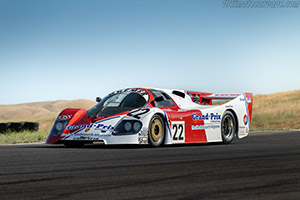
Page 1 of 1  Kremer Racing emerged as one of the leading Porsche privateer teams during the 1970s. Not only did the Erwin and Manfred Kremer led company race Porsche products, Kremer Racing also reworked and improved existing designs to give the team and its customers an edge over the rivals. This all culminated with an outright victory for a Kremer modified Porsche 935 at Le Mans in 1979. Kremer Racing emerged as one of the leading Porsche privateer teams during the 1970s. Not only did the Erwin and Manfred Kremer led company race Porsche products, Kremer Racing also reworked and improved existing designs to give the team and its customers an edge over the rivals. This all culminated with an outright victory for a Kremer modified Porsche 935 at Le Mans in 1979.The introduction of the all-new Group C regulations for 1982 left Kremer Racing without a car to compete at the highest level. Porsche did develop the 956 Group C car but this was available only to the works team, at least during its first season of racing. This prompter the Cologne-based privateer effort to build a Group C car of their own design to ensure the team could race in the 1982 Sports Car World Championship, and, crucially, at the 24 Hours of Le Mans. Dubbed the CK5, it was based on the Porsche 936 and 917K/81 that Kremer Racing had built previously using the drawings supplied by Porsche. As such, it was constructed around a tubular spaceframe chassis. Most of the running gear was derived from the 917 like the wishbones, uprights, hubs, steering and brake system. It was initially powered by 935-derived, twin-turbo flat-six engine that varied in size in a quest to optimise performance in the Group C formula that had a restriction on fuel consumption. The new Porsche Kremer Group C car featured bespoke fibreglass coupe bodywork that was constructed by long-time partners DP Motorsport. Its distinct design featured a blunt nose with flat sides and an integrated rear wing. The instantly recognisable feature of the CK5 was the lateral fin on the engine cover, which was added for stability on the long Le Mans straights. The complete CK5 tipped the scales at just 877 kg. Entered as a Porsche CK5, the Kremer Racing Group C car was ready in time for the 24 Hours of Le Mans. It was entered for Ted Field, Danny Ongais and 1979 Le Mans winner Bill Whittington. After qualifying eighth, an engine failure brought an early retirement. The car was then raced for the remainder of the season with a third at the DRM Nürburgring Supersprint as the best result. At the end of year, the first CK5 was sold to British privateer Richard Cleare. While Kremer Racing had a customer Porsche 956 on order, a second CK5 was produced, which featured an enlarged venturi, further refined bodywork and 19-inch wheels. It was raced at Le Mans in 1983 with Derick Warwick, Frank Jelinski and Patrick Gaillard. Once again, an engine failure forced the car to retire. It was raced by Kremer Racing alongside its 956s well into the 1985 season but it struggled against the purpose built Group C cars that featured lighter and stronger monocoque chassis. Effectively produced by one of the foremost Porsche privateers as a stop-gap, the Porsche Kremer CK5 holds a special place in history as one of the very first Group C cars built. Page 1 of 1 |
| Article | Image gallery (18) | CK5-02 | Specifications |
| All Cars - Contact us - Privacy Statement - Top | © 1998 - 2026 Ultimatecarpage.com |