<< Prev Page 2 of 2 Having once almost walked away from Team Lotus for their active suspension system a decade earlier, the burly Nigel Mansell turned out to be the perfect driver to manhandle the FW14B. Above all, the 'active' Williams relied more on brute force to drive while the more delicate Riccardo Patrese found it difficult to get to terms with the car. He was more a seat-of-the-pants driver but most of those sensations were filtered out by the sophisticated suspension system.
Mansell wasted no time and won five races in a row with Patrese placing second in four of those five despite his struggles. It was the start of a season dominated by Williams with the FW14B winning 10 of the 16 rounds. The dominance was such that at the British Grand Prix, Mansell was two seconds faster in qualifying than his team-mate, who himself was a full second ahead of the third placed Ayrton Senna. After round 11 of the season, the Hungarian Grand Prix, Mansell and Williams had already scored enough points to be crowned World Champions.
With an all-new driver line-up, Newey and Williams pushed the envelop one step further in 1993 when the even more sophisticated FW15C continued the domination. At the end of that season, most of the elaborate driver aids were banned, ensuring that the FW14B and FW15C remain as some of the most sophisticated and complicated Grand Prix cars ever built. Demonstrating just how good the Newey Williams Grand Prix cars were, was the fact that in the first season of the new 'analog era', Williams was once again crowned World Champion.
Particularly in B specification, the FW14 ranks as one of the most important Grand Prix cars of all time. It not only dominated the 1992 season but it was also the first of many World Championship winning machines designed by legendary engineer Adrian Newey. << Prev Page 2 of 2

 Ultimatecarpage.com
> Cars by brand
> Great Britain
> Williams
Ultimatecarpage.com
> Cars by brand
> Great Britain
> Williams
 Racing cars
> Formula 1
Racing cars
> Formula 1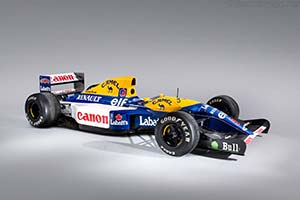
 Having once almost walked away from Team Lotus for their active suspension system a decade earlier, the burly Nigel Mansell turned out to be the perfect driver to manhandle the FW14B. Above all, the 'active' Williams relied more on brute force to drive while the more delicate Riccardo Patrese found it difficult to get to terms with the car. He was more a seat-of-the-pants driver but most of those sensations were filtered out by the sophisticated suspension system.