<< Prev Page 2 of 2 Throughout the 1991 season Peugeot developed the heavily revised 905 'Evolution 1 Bis'. Apart from the monocoque chassis, no part of the car was left untouched. The most notable difference was the completely revised bodywork that had far fewer road going design cues. For high-downforce tracks a separate wing could be bolted onto the nose and the massive rear wing could just as well been taken off a World War I double-decker airplane. The engine was also revised and this SA35-A2 was good for an additional 20 bhp. Although the Evo 1 Bis did not win first time out, its debut at the 1991 Nürburgring (WssC) was a true turning point in the 905's racing career. In the subsequent Magny Cours and Mexico rounds of the championship, Peugeot scored convincing 1-2 victories. Peugeot finished second in the championship standings behind Jaguar, but ahead of defending champions Sauber Mercedes.
Peugeot's main rivals in 1991 both withdrew at the end of the season, although the XJR-14 was fielded (thinly disguised) as the Mazda MXR-01 powered by a Judd V10 instead of the Cosworth V8 used by Jaguar in 1991. The rule changes were completed that season, which meant that the likes of the Porsche 962 and Jaguar XJR-12s and its privateer entrants were no longer allowed to run, which translated to very small fields. Peugeot's biggest competitor was the Toyota TS010, which won the season opening round at Monza. Peugeot did not make a mistake and won the subsequent five rounds of the season, including the 24 Hours of Le Mans. There the rule changes saw the grid down to just 30 cars; a record for the post-War era. Needless to say, Peugeot also won the World Championship, well ahead of Toyota and Mazda. The FIA's plans to somewhat put the limelight back on Formula 1 had clearly worked, but at the expense of sports car racing; 1993 was the first time in forty years that there was no World Sports Car Championship.
Before the cancellation of the 1993 championship was announced, Peugeot had already started developing a second evolution of the 905. Officially known as the 'Evo 2', its rather striking aerodynamics quickly earned it the nickname 'Supercopter'. Compared to the previous evolution the new nose was the most notable difference. No longer hiding its F1 similarities, the nose looked quite like a single seater with added fenders. The fenders were open on the inside to release high pressure normally built up inside the wheel well. Sadly it was never raced, but it, together with the similar Allard J2X, most certainly inspired the LMP designers of the late 1990s. Although there was no World Championship, there of course was a 24 Hours of Le Mans and Peugeot put a true crown on the 905's career by scoring a 1-2-3 victory. That was the last time the 905 was raced and Peugeot not surprisingly turned their focus to Formula 1 as an engine supplier for McLaren in 1994. The 80-degree V10 might have faired well at Le Mans, it was rather unimpressive in F1. << Prev Page 2 of 2

 Ultimatecarpage.com
> Cars by brand
> France
> Peugeot
Ultimatecarpage.com
> Cars by brand
> France
> Peugeot
 Racing cars
> Group C / IMSA GTP
Racing cars
> Group C / IMSA GTP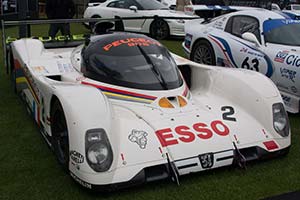
 Throughout the 1991 season Peugeot developed the heavily revised 905 'Evolution 1 Bis'. Apart from the monocoque chassis, no part of the car was left untouched. The most notable difference was the completely revised bodywork that had far fewer road going design cues. For high-downforce tracks a separate wing could be bolted onto the nose and the massive rear wing could just as well been taken off a World War I double-decker airplane. The engine was also revised and this SA35-A2 was good for an additional 20 bhp. Although the Evo 1 Bis did not win first time out, its debut at the 1991 Nürburgring (WssC) was a true turning point in the 905's racing career. In the subsequent Magny Cours and Mexico rounds of the championship, Peugeot scored convincing 1-2 victories. Peugeot finished second in the championship standings behind Jaguar, but ahead of defending champions Sauber Mercedes.