<< Prev Page 3 of 3 To commemorate the Le Mans win, McLaren produced the limited edition F1 LM late in 1995. It used a restrictor-free version of the GTR engine, which produced a staggering 680 bhp. The big rear wing was also carried over from the racing car. One prototype and five (the number of cars that finished the 1995 Le Mans) production cars were constructed, most of which were painted in the striking papaya orange also used for the company's legendary Can-Am cars. For the 1996 season, a second generation of the GTR was developed. The car was lowered further and made lighter courtesy of a magnesium gearbox casing. A longer front splitter was also fitted. Another nine cars were constructed and despite strong competition from the newly developed F40 GTE, all nine BPR races were won. The tally was further increased with five victories in the All-Japan GT Championship. At Le Mans, the F1 GTR was not able to keep with the intrinsically faster prototypes.
The success of the McLaren F1 GTR had other companies interested and in 1997, the British team faced opposition from the likes of Porsche, Mercedes-Benz and Nissan. Unlike McLaren, they had constructed purpose-built racing cars with the derived road cars built for homologation purposes only. McLaren anticipated the stronger competition with a third evolution of the GTR, which sported a completely different and much longer body. It was also considerably lighter, only weighing 915 kg. A sequential gearbox was also installed. For homologation purposes, McLaren constructed three road cars with the 1997 style body, dubbed the F1 GT. BMW had also taken an interest and bought several of the ten 1997 spec GTRs and raced them in what was now known as the FIA GT Championship. BMW Motorsport scored five victories that year in the championship. Le Mans was again a trophy for the prototypes, but with a second and third place, the F1 GTR took the top two positions in the highly competitive GT1 class. It's fitting that the final chapter in the McLaren F1 history was again written by the road car, when it broke the production car speed record in 1998, clocking 240 mph at Ehra-Leissen in Germany.
The McLaren F1 remained the supreme supercar for many years and with a racing record to match, it has gone into history as one of the classic GT racers in the tradition of the Ferrari 250 GTO and Porsche 911 RS. The next generation supercars that finally surpassed the performance benchmarks still do not offer the McLaren's complete package and most certainly do no have the car's immaculate racing record. The only blemish on the car's record is the failure to come anywhere near the proposed production number of 300. A few years later Murray helped McLaren and Mercedes-Benz design the rather bulky SLR, which did not come close in any respect to the fabled F1. He is now in the process of designing and producing a revolutionary lightweight (of course) city car. McLaren have more recently re-entered their road car business with the MP4-12C sports car and at the time of writing the P1 supercar is being developed, which can be considered the F1's spiritual successor. << Prev Page 3 of 3


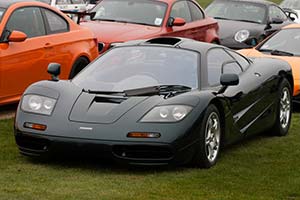
 To commemorate the Le Mans win, McLaren produced the limited edition F1 LM late in 1995. It used a restrictor-free version of the GTR engine, which produced a staggering 680 bhp. The big rear wing was also carried over from the racing car. One prototype and five (the number of cars that finished the 1995 Le Mans) production cars were constructed, most of which were painted in the striking papaya orange also used for the company's legendary Can-Am cars. For the 1996 season, a second generation of the GTR was developed. The car was lowered further and made lighter courtesy of a magnesium gearbox casing. A longer front splitter was also fitted. Another nine cars were constructed and despite strong competition from the newly developed F40 GTE, all nine BPR races were won. The tally was further increased with five victories in the All-Japan GT Championship. At Le Mans, the F1 GTR was not able to keep with the intrinsically faster prototypes.