<< Prev Page 3 of 3 Following a near perfect season, McLaren allocated more time and funds to develop the F1 GTR further for 1996. More weight was shed and the aerodynamics tweaked even further, while remaining close to the original design. The BMW engine was mounted slightly lower in the chassis to bring the centre of gravity down further. In an attempt to slow the McLarens down, tighter restrictors were mandated. BMW answered by tweaking the road car engine for the first time, which helped keep the power at around 600 bhp. A further nine chassis were constructed and two of the existing nine cars were updated to the latest specification. McLaren also added the 'F1 LM' to line-up, which was basically a road legal version of the original F1 GTR. With the restrictors removed, the V12 produced a hefty 680 bhp. Only five customer cars were built in honour of the five cars that reached the finish at Le Mans.
McLaren's success had not gone by unnoticed in Stuttgart and for the 1996 Le Mans, Porsche wheeled out a GT1 car of their own. It combined the front half of a Porsche 911 road car with a bespoke rear section. To meet with the homologation requirements, Porsche did offer a road legal version but it was obvious that the German manufacturer had built a racing car to compete in a production based class. Strictly speaking the new Porsche was legal but it was certainly not in the spirit of the rules. At Le Mans the new McLarens were classified 4th, 5th and 6th behind the two Porsche 911 GT1s and the Porsche powered TWR prototype that won the race outright. Three more F1 GTRs reached the finish in 8th, 9th and 11th, completing another remarkable achievement for the road car turned racer in the classic endurance race.
Porsche did not bother with the BPR series until the final rounds of the season, so the McLaren could continue its reign for most of the year. Now teamed with James Weaver, Bellm was again the most successful F1 GTR pilot. With their Gulf liveried machine the British pairing won four rounds, which this time was enough for the championship. When the works 911 GT1s did show up, they won three races out of three attempts. The writing was on the wall for the original McLaren F1 GTR and work was already on the way for a far more aerodynamically advanced version for 1997. Unlike its main rivals that year, the 'Longtail' McLaren still used a road car chassis, which did not prevent it from scoring additional victories in the newly established FIA GT Championship. It also won its class at Le Mans.
It was already a unique achievement when the F1 GTR, a thinly disguised road car, dominated its class for nearly two seasons and won at Le Mans. In this modern era, a repeat is even less likely. The exploits on the track have contributed further to the absolutely legendary status of the F1 road car. With its historic Le Mans victory, the McLaren F1 GTR brought back memories of a long bygone time when the racing cars could be drive to the race on the road. Ray Bellm proved this point by using his GTR for his trip to Le Mans in 1997, crossing the English Channel with the car on the train. McLaren and F1 experts Lanzante have since made many of the other GTRs road legal by, among other things, raising the ride-hide, removing the restrictors and adding catalytic converter. << Prev Page 3 of 3

 Ultimatecarpage.com
> Cars by brand
> Great Britain
> McLaren
Ultimatecarpage.com
> Cars by brand
> Great Britain
> McLaren
 Racing cars
> GT Cars
Racing cars
> GT Cars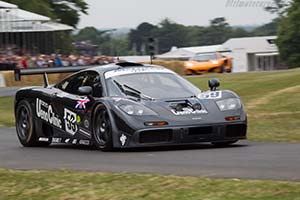
 Following a near perfect season, McLaren allocated more time and funds to develop the F1 GTR further for 1996. More weight was shed and the aerodynamics tweaked even further, while remaining close to the original design. The BMW engine was mounted slightly lower in the chassis to bring the centre of gravity down further. In an attempt to slow the McLarens down, tighter restrictors were mandated. BMW answered by tweaking the road car engine for the first time, which helped keep the power at around 600 bhp. A further nine chassis were constructed and two of the existing nine cars were updated to the latest specification. McLaren also added the 'F1 LM' to line-up, which was basically a road legal version of the original F1 GTR. With the restrictors removed, the V12 produced a hefty 680 bhp. Only five customer cars were built in honour of the five cars that reached the finish at Le Mans.