<< Prev Page 3 of 3 Alongside the Paris Dakar rally machines, Porsche's engineers developed a second racing derivative of the 959. Although officially known as the 961 it shared a close visual and technical resemblance to the 959 road car. The project had its origins very early in the 959 development and was to form the basis for the Group B racer. The plans were delayed and changed considerably. The 961 was eventually turned into a circuit racer and destined to compete in Porsche's home away from home; Le Mans. It finally appeared during the official Le Mans test in May of 1986. A wider body and larger wing distinguished the all-white 961 from its road going counterpart. The engine was tweaked to produce a hefty 640 bhp. Entered in the IMSA GTX class for experimental cars, the 961 was the first 4WD car to race at Le Mans. The sole IMSA GTX, the 961 scored a default class win when it finished a credible 7th overall, after problems early in the race had thrown it right down the order. Porsche hoped to sell copies of the new racer to the United States and shipped the sole 961 to Daytona for the season ending three-hour race. The track's banking proved very destructive for the tires and the 961 finally limped home in 24th. Due its relatively high price, Porsche failed to sell a single example. Liveried in the Works Rothmans colors, the 961 was raced at Le Mans again in 1987. An accident 17 hours into race saw the 961's racing career come to a very fiery end.
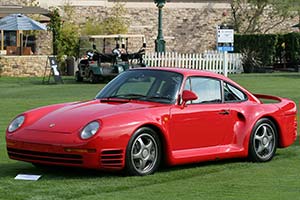
A final version of the 959 was developed late in 1987. Dubbed the 'Sport,' it was an extensively lightened version of the standard, or 'Comfort' 959. By stripping luxury items like electric windows, leather power seats and air-conditioning, as well as removing the adjustable ride height control, a total of 100 kg was shaved off the kerb weight of the original 959. An ingenious attempt to make the 959 available for some of its American customers a second version of the 'Sport' was developed. Fitted with a full roll cage and stripped of its adjustable dampers, it was marketed as a racing car. This meant that the strict emission and safety standards did not apply. The American government thought otherwise and sent the first batch of seven cars back to Germany. After trying one on a track they stated that the stripped down version 959 was still far too smooth and comfortable to be considered a racing car. Since then several examples have been imported to United States under the 'Show and Display' law. One of the conditions of this type of approval is that the car can only be driven on the road for 2500 miles per year. Canepa Motorsports have more recently developed a package that both increases the performance and meets the strict emission standards. The latest version of the 'Canepa 959' produces a mind boggling 610 bhp. The modifications take an equally amazing 1100 hours to be completed.
Today the Porsche 959 is considered one of the finest and certainly the most advanced car built in the 1980s. Where the other supercars of the era were raw, uncomfortable and hard to drive, the 959 managed to combine the superb performance with a smooth ride and fully equipped interior. All this did come at price; Porsche lost money on every one of the 329 examples built. It is estimated that each 959 sale covered only a quarter of its cost. It must be said that much of the technology developed for the 959 was put to good use in the Porsche 911 range like the 4WD system that now comes standard on the Turbo models. For nearly two decades the 959 remained the sole Porsche supercar and it was only 'replaced' in 2003 by the all carbon-fibre and V10 engined Carrera GT. There may have been better looking and better performing cars built before and since, but no supercar can match the 959 for its technological advancements. In this respect it is unlikely the Porsche 959 will ever be surpassed. << Prev Page 3 of 3

 Ultimatecarpage.com
> Cars by brand
> Germany
> Porsche
Ultimatecarpage.com
> Cars by brand
> Germany
> Porsche
 959 Sport
 Alongside the Paris Dakar rally machines, Porsche's engineers developed a second racing derivative of the 959. Although officially known as the 961 it shared a close visual and technical resemblance to the 959 road car. The project had its origins very early in the 959 development and was to form the basis for the Group B racer. The plans were delayed and changed considerably. The 961 was eventually turned into a circuit racer and destined to compete in Porsche's home away from home; Le Mans. It finally appeared during the official Le Mans test in May of 1986. A wider body and larger wing distinguished the all-white 961 from its road going counterpart. The engine was tweaked to produce a hefty 640 bhp. Entered in the IMSA GTX class for experimental cars, the 961 was the first 4WD car to race at Le Mans. The sole IMSA GTX, the 961 scored a default class win when it finished a credible 7th overall, after problems early in the race had thrown it right down the order. Porsche hoped to sell copies of the new racer to the United States and shipped the sole 961 to Daytona for the season ending three-hour race. The track's banking proved very destructive for the tires and the 961 finally limped home in 24th. Due its relatively high price, Porsche failed to sell a single example. Liveried in the Works Rothmans colors, the 961 was raced at Le Mans again in 1987. An accident 17 hours into race saw the 961's racing career come to a very fiery end.