<< Prev Page 2 of 3 Next >> Less than a half year after the first design was penned, the 936 hit the track early in April of 1976. The use of 'off the shelf' parts certainly contributed to the quick to development. In its latest guise, the six cylinder engine now produced 520 bhp, which looked sufficient to take on the latest Alfa Romeos and Renaults. Painted flat-black, the 936 made its competition debut in the Nürburgring 1000 km race, where a stuck throttle cable slowed the car down. Porsche's day was saved as Joest's Turbocharged 908/3 took the win. Throughout the season the 936 was developed and most notably grew a large central air scoop that fed air to the fan cooling the engine block; the heads were water cooled through a front mounted radiator. Although it was by no means a perfect race, Jacky Ickx and Gijs van Lennep piloted one of the two 936s to victory at Le Mans that year. The 936 would continue to dominate the season and won every one of the remaining six rounds of the World Sports Car Championship.
Needless to say, Porsche were crowned World Sports Car Champion, but it was not the championship they were really after; that was the World Manufacturer Championship, which was contested for Group 5 cars only and was also won by Porsche with the 935. The other Sports Car championship was created to keep the other Group 6 manufacturers happy and they convinced Porsche's sponsor Count Rossi to back the German's entry for 1976. At the end of the season they must have regretted that. Porsche's sole intention for the 936 had been a win at Le Mans and for 1977 they decided to concentrate on the 'big-one' and contest the other races with the 935. With no need to race on the twisty tracks anymore, both 936s were equipped with a much sleeker low-drag body. The frontal area was further decreased by decreasing the track. The Turbocharged flat six was modified and equipped with two smaller Turbochargers for better throttle response. It was quoted at 540 bhp, sufficient to propel the car to a 217 mph top speed.
Following hot on Porsche's heels, Renault had also taken the Turbo route and countered the German's two-car effort at Le Mans with three of their A442s. These sported a Turbocharged two-litre V6 engine and they got the better of the Porsches in qualifying. Some three hours into the race it did not look any better for Porsche as one car was out and the other delayed considerably and running nine laps in arrears. Ickx was mounted in the surviving car and put in one stunning lap after another, gradually reeling in the leaders. As the sun rose on Sunday morning, the Porsche was in second, but still well behind the leading Renault. Fortunately for Porsche that was struck by mechanical problems and the Germans scored a win after one of the most remarkable come-backs in Le Mans history. It all literally looked to go up in smoke for the 936 right at the end as Hurley Haywood entered the pitlane followed by a trail of smoke. One of the pistons had failed and the Porsche still had to complete the final lap under fifteen minutes and with the plugs and injection removed from the problem cylinder, the Porsche limped to the finish. << Prev Page 2 of 3 Next >>

 Ultimatecarpage.com
> Cars by brand
> Germany
> Porsche
Ultimatecarpage.com
> Cars by brand
> Germany
> Porsche
 Racing cars
> Other Sportscars
Racing cars
> Other Sportscars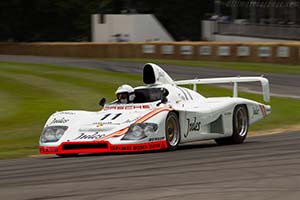
 Less than a half year after the first design was penned, the 936 hit the track early in April of 1976. The use of 'off the shelf' parts certainly contributed to the quick to development. In its latest guise, the six cylinder engine now produced 520 bhp, which looked sufficient to take on the latest Alfa Romeos and Renaults. Painted flat-black, the 936 made its competition debut in the Nürburgring 1000 km race, where a stuck throttle cable slowed the car down. Porsche's day was saved as Joest's Turbocharged 908/3 took the win. Throughout the season the 936 was developed and most notably grew a large central air scoop that fed air to the fan cooling the engine block; the heads were water cooled through a front mounted radiator. Although it was by no means a perfect race, Jacky Ickx and Gijs van Lennep piloted one of the two 936s to victory at Le Mans that year. The 936 would continue to dominate the season and won every one of the remaining six rounds of the World Sports Car Championship.