
 Ultimatecarpage.com
> Cars by brand
> Germany
> Porsche
Ultimatecarpage.com
> Cars by brand
> Germany
> Porsche
 918 Spyder 918 Spyder
|
| Porsche 918 Spyder |
| Article | Image gallery (161) | Chassis (7) | Specifications | Video (1) |
|
|
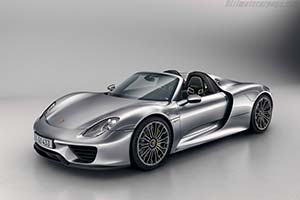
<< Prev Page 2 of 3 Next >>  The core of the 918 Spyder concept is its distribution of propulsive power among the three power units; their cooperation is controlled by an intelligent management system. To best exploit these different approaches, the Porsche developers defined five operating modes that can be activated via a "map switch" on the steering wheel, just like in motorsport cars. On the basis of this pre-selection, the 918 Spyder applies the most suitable operating and boost strategy without driver intervention, thus allowing the driver to concentrate fully on the road. The core of the 918 Spyder concept is its distribution of propulsive power among the three power units; their cooperation is controlled by an intelligent management system. To best exploit these different approaches, the Porsche developers defined five operating modes that can be activated via a "map switch" on the steering wheel, just like in motorsport cars. On the basis of this pre-selection, the 918 Spyder applies the most suitable operating and boost strategy without driver intervention, thus allowing the driver to concentrate fully on the road.When the vehicle is started up, the "E-Power" mode is the default operating mode as long as the battery is sufficiently charged. In ideal conditions, the 918 Spyder can cover over 30 kilometres on purely electric power. Even in pure electric mode, the 918 Spyder accelerates from 0 to 100 km/h in less than seven seconds and can reach speeds of up to 150 km/h. In this mode, the combustion engine is only used when needed. If the battery's charge state drops below a set minimum value, the vehicle automatically switches to hybrid mode. In "Hybrid" mode, the electric motors and combustion engine work alternately with a focus on maximum efficiency and minimum fuel consumption. The use of individual drive components is modified as a function of the current driving situation and the desired performance. The Hybrid mode is typically used for a fuel economy-oriented driving style. In more dynamic situations, the 918 Spyder selects the "Sport Hybrid" mode for its power sources. The combustion engine now operates continuously and provides the main propulsive force. In addition, the electric motors provide support in the form of electric boosting or when the operating point of the combustion engine can be optimised for greater efficiency. The focus of this mode is on performance and a sporty driving style at top speed. "Race Hybrid" is the mode for maximum performance and an especially sporty driving style. The combustion engine is chiefly used under high load, and charges the battery when the driver is not utilising its maximum output. Again, the electric motors provide additional support in the form of boosting. Furthermore, the gear-shifting programme of the PDK is set up for even sportier driving. The electric motors are used up to the maximum power output limit to deliver the best possible performance for the race track. In this mode, the battery charge state is not kept constant, rather it fluctuates over the entire charge range. In contrast to Sport Hybrid mode, the electric motors run at their maximum power output limit for a short time for better boosting. This increased output is balanced by the combustion engine charging the battery more intensively. Electric power is thus available even with several very fast laps. The "Hot Lap" button in the middle of the map switch releases the final reserves of the 918 Spyder and can only be activated in "Race Hybrid" mode. Similar to a qualification mode, this pushes the traction battery to its maximum power output limits for a few fast laps. This mode uses all of the available energy in the battery. The main source of propulsion is the 4.6-litre, eight cylinder engine that produces 608 hp of power. The engine is derived directly from the power unit of the successful RS Spyder, which explains why it can deliver engine speeds of up to 9,150 rpm. Like the race engine of the RS Spyder, the 918 Spyder power unit features dry-sump lubrication with a separate oil tank and oil extraction. To save weight, components such as the oil tank, the air filter box integrated into the subframe and the air induction are made of carbon fibre reinforced polymer. Further extensive lightweight design measures have resulted in such features as titanium connecting rods, thin-wall, low-pressure casting on the crank case and the cylinder heads, a high-strength, lightweight steel crankshaft with 180 degrees crankpin offset and the extremely thin-walled alloy steel/nickel exhaust system. Striking features of the V8 are that it no longer supports any auxiliary systems, there are no external belt drives and the engine is therefore particularly compact. Weight and performance optimisations achieve a power output per litre of approx. 132 hp/l - the highest power output per litre of a Porsche naturally aspirated engine - which is significantly higher than that of the Carrera GT (106 hp/l) and outstanding for a naturally aspirated engine. It isn't just this engine's performance but also the sound it makes that stokes the emotionality of the 918 Spyder. This is attributable first and foremost to the so-called top pipes: the tailpipes terminate in the upper part of the rear end immediately above the engine. No other production vehicle uses this solution. The top pipes' greatest benefit is optimal heat removal, because the hot exhaust gases are released via the shortest possible route, and exhaust gas back pressure remains low. This design requires a new thermodynamic air channelling concept. With the HSI engine, the hot side is located inside the cylinder V, the intake channels are on the outside. There is another benefit as well: the engine compartment remains cooler. This is especially beneficial to the lithium-ion traction battery, as it provides optimum performance at temperatures between 20 and 40 degrees Celsius. Consequently, less energy needs to be used for active cooling of the battery. << Prev Page 2 of 3 Next >> |
| Article | Image gallery (161) | Chassis (7) | Specifications | Video (1) |
| All Cars - Contact us - Privacy Statement - Top | © 1998 - 2026 Ultimatecarpage.com |