
 Ultimatecarpage.com
> Cars by brand
> Germany
> Porsche
Ultimatecarpage.com
> Cars by brand
> Germany
> Porsche
 918 Spyder 918 Spyder
|
| Porsche 918 Spyder |
| Article | Image gallery (161) | Chassis (7) | Specifications | Video (1) |
|
|
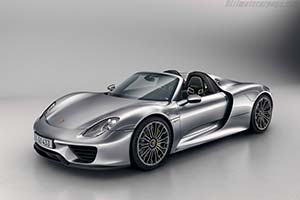
<< Prev Page 3 of 3  The V8 engine is coupled to the hybrid module, since the 918 Spyder is designed as a parallel hybrid like the current hybrid models from Porsche. Essentially, the hybrid module comprises a 115 kW electric motor and a decoupler that serves as the connection with the combustion engine. Because of its parallel hybrid configuration, the 918 Spyder can be powered at the rear axle either individually by the combustion engine or electric motor or via both drives jointly. As is typical for a Porsche super sports car, the power pack in the 918 Spyder has been placed in front of the rear axle, and does not have any direct mechanical connection to the front axle. The V8 engine is coupled to the hybrid module, since the 918 Spyder is designed as a parallel hybrid like the current hybrid models from Porsche. Essentially, the hybrid module comprises a 115 kW electric motor and a decoupler that serves as the connection with the combustion engine. Because of its parallel hybrid configuration, the 918 Spyder can be powered at the rear axle either individually by the combustion engine or electric motor or via both drives jointly. As is typical for a Porsche super sports car, the power pack in the 918 Spyder has been placed in front of the rear axle, and does not have any direct mechanical connection to the front axle.A seven-speed Doppelkupplung (PDK) transmission handles power transmission to the rear axle. The high-performance transmission is the sportiest version of the successful PDK; it has undergone a complete redesign for the 918 Spyder and has been further optimised for high performance. To ensure a low mounting position for a low centre of gravity of the entire vehicle, the gear unit was turned "upside down" by rotating it 180 degrees about its longitudinal axis, in contrast to other Porsche series. If no power is required on the rear axle, the two motors can be decoupled by opening the decoupler and PDK clutches. This is the action behind the Porsche hybrid drive's typical "coasting" with the combustion engine switched off. On the front axle, there is another independent electric motor with an output of approximately 95 kW. The front electric drive unit drives the wheels at a fixed ratio. A decoupler decouples the electric motor at high speeds to prevent the motor from over-revving. Drive torque is independently controlled for each axle. This makes for very responsive all-wheel drive functionality that offers great potential in terms of traction and driving dynamics. The electric energy for the electric motors is stored by a liquid-cooled lithium-ion battery comprising 312 individual cells with an energy content of about seven kilowatt hours. The battery of the 918 Spyder has a performance-oriented design in terms of both power charging and output, so that it can fulfil the performance requirements of the electric motor. The power capacity and the operating life of the lithium-ion traction battery depend on several factors, including thermal conditions. That is why the battery of the 918 Spyder is liquid-cooled by a dedicated cooling circuit. The global warranty period for the traction battery is seven years. To supply it with energy, Porsche developed a new system with a plug-in vehicle charge port and improved recuperation potential. This vehicle charge port in the B-column on the front passenger side lets users connect the storage battery to a mains supply at home and charge it. The charge port is standardised for the country of purchase. The on-board charger is located close to the traction battery. It converts the alternating current of the mains supply into direct current with a maximum charge output of 3.6 kW. Using the supplied Porsche Universal Charger (AC), the traction battery can be charged within four hours from a ten ampere rated, fused power socket on the German 230 Volt mains supply, for example. Furthermore, the Porsche Universal Charger (AC) can be installed at home in the garage using the Charging Dock. It enables rapid and convenient charging within approximately two hours, irrespective of regional conditions. The Porsche Speed Charging Station (DC) is available as an optional extra. It can fully charge the high-voltage battery of the 918 Spyder in just 25 minutes. The driver is the focus of all technology in the future Porsche super sports car. A cockpit was created for the driver that is typical of the brand and pioneering in its clarity. It is partitioned into two basic areas. First, there are the controls that are important for driving, which are grouped around the multifunction steering wheel, combined with driver information displayed on three large round instruments. Second, there is the infotainment block that is housed in the lifted centre console, which was introduced in the Carrera GT. Control functions, e.g. for the automatic climate control system, wing adjustment, lighting and Porsche Communication Management (PCM), including a Burmester high-end sound system, can be intuitively operated by multitouch with a new type of black panel technology. For very performance-oriented customers of the 918 Spyder, Porsche offers the "Weissach" package. These modified super sports cars can be recognised at first glance by special colours and designs that are based on legendary Porsche race cars. The roof, rear wings, rear-view mirrors and frames of the windscreen are made of visible carbon. Parts of the interior are upholstered with Alcantara instead of leather, and visible carbon replaces much of the aluminium. Sound insulation has been reduced. The emphasis on performance is not just visual: very lightweight magnesium wheels reduce unsprung masses; gross weight was reduced by about 35 kg. The benefits are experienced in further improved dynamic performance. Other references from motorsport are six-point seatbelts for driver and front passenger, optional film-coating instead of body paint, as well as additional aerodynamic body parts in visible carbon. The 918 Spyder continues a long tradition of super sports cars at Porsche; as technology platforms, as the driving force behind both car emotion and car evolution and as the ultimate sports cars of their decades: the Carrera GTS, the first Porsche Turbo, the 959, the 911 GT1, the Carrera GT. More than any of its predecessors, the 918 Spyder is providing key impetus for developing technologies for future vehicle concepts. It offers a complete package of components that reflect Porsche DNA - more concentrated than ever before. << Prev Page 3 of 3 |
| Article | Image gallery (161) | Chassis (7) | Specifications | Video (1) |
| All Cars - Contact us - Privacy Statement - Top | © 1998 - 2026 Ultimatecarpage.com |