<< Prev Page 2 of 3 Next >> Known as the 500I, the new engine was developed in absolute secrecy. Constructed from light alloys, the V8 featured the same 82º V-angle as Ilmor's familiar engine. The increased displacement limit for push-rod engines was just over 3.4 litre compared to the 2.65 litre of a twin-cam unit. As prescribed by the regulations, it came equipped with a single, centrally mounted camshaft that actuated the valves through push-rods. With the Garrett turbo running at 1.86 bar (55 inch Mercury), the 500I produced a staggering 1024 bhp, giving Team Penske a 200 bhp 'Unfair Advantage'.
In January of 1994 the new engine was bolted onto the latest Penske for the first test. Dubbed the PC23, the new-for-1994 Penske was a subtle evolution of the Nigel Bennett designed PC22 that had scored eight victories, including at the Indy 500, during the previous season. It featured a carbon-fibre monocoque chassis with double wishbones and push-rods on all four corners. Power came from an updated version of the previously Chevrolet-badged Ilmor V8 engine. Team Penske signed Emerson Fittipaldi, Al Unser Jr. and Paul Tracy to drive its fleet of three cars throughout the 1994 season.
Even without the imminent 'Unfair Advantage', Team Penske was immediately competitive at the season opening CART race at Surfer's Paradise. Electrical problems prevented the Penskes to fight for the victory but in the following two races there was no stopping Fittipaldi and Unser respectively. Meanwhile the Penske mechanics worked on special parts for the Indy 500, most of them unaware exactly why. The biggest visible change to the PC23 was a restyled rear deck to clear the much taller push-rod engine.
Team Penske managed to keep the covert operation a secret until the middle of April, the final deadline for the Indy 500 entries. By this time it was too late to change the regulations even though both the governing bodies and rivals were of course far from happy with Penske's biggest 'Unfair Advantage' yet. The three PC23s were immediately on the pace and Team Penske looked set to repeat the unique 1988 front-row lock-out until a crash in practice stopped Tracy from running on 'pole-day'. Unser eventually set the fastest time while Fittipaldi was disappointed with third on the grid. << Prev Page 2 of 3 Next >>

 Ultimatecarpage.com
> Cars by brand
> United States
> Penske
Ultimatecarpage.com
> Cars by brand
> United States
> Penske
 Racing cars
> Indy
Racing cars
> Indy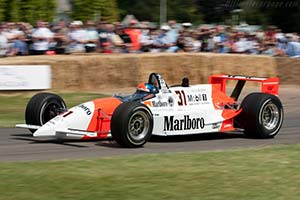
 Known as the 500I, the new engine was developed in absolute secrecy. Constructed from light alloys, the V8 featured the same 82º V-angle as Ilmor's familiar engine. The increased displacement limit for push-rod engines was just over 3.4 litre compared to the 2.65 litre of a twin-cam unit. As prescribed by the regulations, it came equipped with a single, centrally mounted camshaft that actuated the valves through push-rods. With the Garrett turbo running at 1.86 bar (55 inch Mercury), the 500I produced a staggering 1024 bhp, giving Team Penske a 200 bhp 'Unfair Advantage'.