
 Ultimatecarpage.com
> Cars by brand
> Germany
> Porsche
Ultimatecarpage.com
> Cars by brand
> Germany
> Porsche
 Macan Turbo Macan Turbo
|
| Porsche Macan Turbo |
| Article | Image gallery (8) | Specifications | User Comments (1) |
|
|
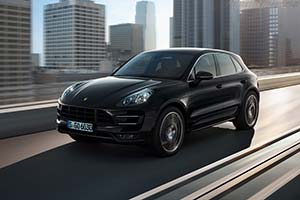
<< Prev Page 3 of 3  For the first time in a new Porsche model range, all variants of the Macan feature the high- performance seven-speed Porsche Doppelkupplung (PDK) as standard. The advantages of this transmission design include excellent start-up performance, extremely fast gear changes without any interruption in tractive force, short reaction times, low fuel consumption and outstanding shift comfort. As in virtually all Porsche vehicles that feature the PDK, there are two shifting gates: On the right, the required switching level is engaged via a typical Porsche gear selector, while the left-hand gate can be engaged manually, or with the standard shift paddles on the steering wheel. For the first time in a new Porsche model range, all variants of the Macan feature the high- performance seven-speed Porsche Doppelkupplung (PDK) as standard. The advantages of this transmission design include excellent start-up performance, extremely fast gear changes without any interruption in tractive force, short reaction times, low fuel consumption and outstanding shift comfort. As in virtually all Porsche vehicles that feature the PDK, there are two shifting gates: On the right, the required switching level is engaged via a typical Porsche gear selector, while the left-hand gate can be engaged manually, or with the standard shift paddles on the steering wheel.Active all-wheel drive is part of the Porsche Traction Management (PTM) system and comes as standard for all Macan models. Together with the other elements of the system - the electronically controlled, map-controlled multi-plate clutch, the Automatic Brake Differential (ABD) and Anti-Slip Regulation (ASR) - the all-wheel drive looks after traction and safety. The all-wheel drive system is one of the systems with the fastest response times on the market and its design underpins the sportscar characteristics of the Macan. The rear axle is always driven, the front axle receives its drive torque from the rear axle, and the torque is dependent on the locking ratio of the electronically controlled multi-plate clutch. Off-road mode comes as standard in the Macan, and the function is activated by pressing a button in the centre console at a speed of between 0 and 80 km/h. This function switches all the relevant systems to a traction-oriented off-road programme: For example, the shift revolutions and speeds are geared towards a greater level of traction, the clutch is pre-tensioned to a greater degree in order to provide the front axle with the appropriate drive torque more rapidly, and the standard torque split between the front and rear axle as well as the accelerator pedal response are adapted to off-road conditions. What's more, the ground clearance can be increased by 40 millimetres above its normal level thanks to the optional air suspension chassis, which gives a maximum ground clearance of 230 millimetres. The Porsche Torque Vectoring Plus (PTV Plus) system has been specially tailored to the Macan in order to improve driving dynamics and driving stability. The PTV Plus uses a variable standard torque split at the rear wheels combined with an electronically controlled rear-axle differential lock. In response to the steering angle, steering speed, accelerator pedal position, yaw rate and vehicle speed, the PTV Plus improves steering behaviour and steering precision through targeted brake interventions on the inside rear wheel to enhance agility. This gives the outside rear wheel a greater propulsion force and enables an additional turning impulse in the steered direction. The result is direct and dynamic steering into the bend. The PTV Plus also makes a positive impact when the Macan is taken off-road: On loose ground, rear wheel spin is reduced through targeted locking and braking interventions. All Macan models are fitted with a Sport button as standard, which can be found on the centre console to the left of the gear selector. When the Sport button is pressed, the electronic engine management system makes the engine even more responsive: A touch on the accelerator pedal results in a noticeably more direct response from the engine, the rev-limiter is set to a more specific level and the engine dynamics take on a motorsport feel. In addition, the PDK enables the shift points to be moved towards the upper speed range, adding an even sportier touch. The response times are shorter, while the gear changes are tighter and instantaneous, particularly for double-clutch downshifts. The engine sound is also adapted to sound even more robust. In addition, the Porsche Active Suspension Management (PASM) chassis control system (part of the standard equipment in the Macan Turbo) is set to sport mode to achieve a sportier feel for the suspension and direct steering, therefore offering even more agile handling characteristics. The optional Sport Chrono package offers improved performance at the push of a button. The Sport Chrono package enables the chassis, engine and transmission to be tuned to an even sportier level, accompanied by a sound that is even more emotive. The Sport Chrono package is characterised by the analogue and digital stopwatch on the dashboard, as well as the additional Sport Plus button in the centre console. Another element of the package is the performance display on the optional Porsche Communication Management (PCM) system, which provides information on the total driving time, distance travelled around the current lap or the time taken for each lap, for instance. "Launch Control" is also included - this function enables a level of acceleration similar to that required in a race when moving off. The time advantage gained in a standard sprint from 0 to 100 km/h is 0.2 seconds for all models. "Launch Control" enables improved lap times and a better spread between comfort and sportiness when it comes to the vehicle handling to achieve a significant boost in driving pleasure. There are three chassis versions available for the Macan. The steel spring design fulfils the very highest of standards for performance, driving pleasure, off-roading capabilities and comfort. The consistent lightweight construction philosophy embodied by the aluminium axles and chassis components contributes to driving dynamics and comfort. The front axle is based on a five-link design while the rear axle is formed by a trapezoidal-link design. At the rear axle, the separate arrangement of the springs and dampers on the wheel carrier improves ride comfort and the handling response of the dampers. This arrangement is also responsible for the large loading width of luggage compartment. The second version of the Macan chassis is a combination of the steel spring design and the PASM system, which comes as standard in the Macan Turbo top model. The PASM can be selected as an option for the Macan S and the Macan S Diesel. Combining the steel spring design and PASM allows the vehicle to fulfil high standards for long-distance comfort, performance and agility even more successfully. This chassis variant also offers a considerably better spread of the suspension damping across the three PASM programmes of "Comfort", "Sport" and "Sport Plus" at the touch of a button. The electronically controlled PASM adjustable shock absorber system increases driving pleasure, safety and comfort and is part of the standard equipment for the Macan Turbo. The system actively and continuously regulates the damper force on the front and rear axles. Vehicles normally demonstrate noticeable body movement in response to a very dynamic driving style involving sharp acceleration and brake phases or when off-roading. The PASM is designed to intervenes and reduce body movement. Depending on their preferences and requirements, drivers can choose between three programmes: "Comfort", "Sport" and "Sport Plus". The third version of the Porsche Macan chassis, and exclusive in this vehicle segment, is the optional air suspension including levelling system, height adjustment and PASM. This chassis variant also satisfies the highest demands for comfort, sportiness and performance, and puts the vehicle in pole position in comparison to every other chassis design. In comparison to the steel spring design, the Macan with air suspension sits 15 millimetres lower at Normal Level and, due to the associated lower centre of gravity, it offers both increased driving dynamics and improved comfort. The air suspension maintains a consistent vehicle position automatically, regardless of the load distribution. The ground clearance can be adjusted to three different levels as required: "High Level I", "Normal Level" and "Low Level". In "High Level I", the vehicle sits 40 millimetres above "Normal Level", with a maximum ground clearance of 230 millimetres. This option is activated via the off-road button and can be used at speeds between 0 and 80 km/h. The brakes of the Porsche Macan match the vehicle's exceptional performance level. In line with the usual high standard set by the brand, the Macan is leading the way with the most powerful braking system in its market segment. The Macan relies on six-piston fixed-calliper front brakes with aluminium monobloc brake callipers. In the Macan S and the Macan S Diesel, the brake callipers press on brake discs with a diameter of 350 millimetres, while the brake discs in the Turbo have a diameter of 360 millimetres. In all models, the braking action at the rear is provided by combined floating calliper brakes with an integrated electric parking brake. The rear brake discs for the Macan S and Macan S Diesel have a diameter of 330 millimetres and the rear brake discs of the Turbo have a diameter of 356 millimetres. The electric parking brake offers greater comfort and safety when parking the vehicle. The parking brake is released automatically when moving off. Another feature making its debut is the hold function. The use of tyres on the Macan is typical of a sportscar: The vehicle is designed to use mixed tyres with different dimensions at the front and rear axle. The mixed tyres emphasise the sportscar look of the Porsche Macan and also offer some functional advantages: In combination with the all-wheel drive system designed for tail-heavy vehicles, the wide tyres on the rear axle increase traction and enhance driving stability. The narrower front tyres enable sporty yet precise steering manoeuvres, thereby contributing to the agility of the vehicle, too. Overall, the mixed tyres play a key role in the excellent driving performance of the Macan. 235/60 R 18 (front) and 255/55 R 18 (rear) tyres are standard equipment for the Macan S and Macan S Diesel, while the Macan Turbo features 235/55 R 19 (front) and 255/50 R 19 (rear) tyres. The wheels available for the Porsche Macan perfectly capture its character. And on the road. There is a vast range of wheels in attractive designs to choose from. The range includes wheels of up to 21 inches in size, which are available for all Macan models. The electromechanical power steering system - the first to be found in a Porsche SUV - allows the Macan to be driven precisely and more directly with the responsiveness typical of the Porsche brand in all driving situations. The steering system also offers a number of fuel consumption benefits: In comparison to conventional hydraulic steering systems, electro- mechanical steering saves up to 0.1 litres of fuel per 100 kilometres because the system only requires energy for steering. An important effect of the system is the fact that the Macan can be fitted with a lane departure warning system that works with the electro-mechanical power steering and controls the active steering interventions when they are necessary. A key consideration for the development of the Macan body was the aim to create a vehicle that immediately stood out as a Porsche in comparison to other compact SUVs, i.e. to create a sportscar for this market segment. This aim has certainly been achieved. as demonstrated by several of the vehicle's features: For example, the bonnet covers the wheel arches and encloses the main headlights, making the front of the car look broad and robust. The crisp design lines on the bonnet that ex tend forwards emphasise the width of the vehicle even further. The body is manufactured completely from aluminium, leading to a reduction in weight and therefore contributing to efficiency and dynamism. The passenger compartment of the Porsche Macan picks up on the current Porsche sports car design, delivering a premium look. Among the equipment on offer in the interior is the Burmester High-End Surround Sound system, available for the first time in a vehicle of this class. Other new equipment options include the lane departure warning system and lane change assist system. Features such as the Adaptive Cruise Control (ACC) with Porsche Active Safe (PAS) deliver a further boost to comfort and safety. Ergonomics support sporty driving: The forward-sloping centre console and the driver's seat position ensure a very short distance between the steering wheel and gear selector, while the driver is now even more closely integrated within the interior thanks to the high-set gear selector typical of racing cars. Controls for all the key functions and settings are clustered in logical groups on the centre console, with buttons located within easy reach to ensure quick, intuitive operation. As with all Porsche models, the ignition lock is positioned to the left of the steering wheel. The instrumentation is also typically Porsche, offering three conventional round dials with a centrally positioned tachometer. A gear indicator within the tachometer tells the driver which gear has been engaged by the Porsche Doppelkupplungsgetriebe (PDK). A high-resolution, 4.8-inch colour display is contained in the right-hand dial. In addition to the most important on-board computer functions, this feature also displays the maps for the optional Porsche Communication Management (PCM) system with navigation module. << Prev Page 3 of 3 |
| Article | Image gallery (8) | Specifications | User Comments (1) |
| All Cars - Contact us - Privacy Statement - Top | © 1998 - 2026 Ultimatecarpage.com |