<< Prev Page 2 of 2 Talbot Lago nevertheless persevered and prepared for the all-important French Grand Prix at Reims, where the two off-set single seaters were joined by a brand-new single seater. During the practice Rene le Begue, in the fast Talbot Lago, was over 18 seconds a lap slower than Hermann Lang in the fastest of the German cars. Following the retirement of all Mercedes-Benz W154s and two of the four Auto Unions, Le Begue eventually ended the race best of the rest in third.
Clearly not suitable for international Grand Prix racing, the Moncoplace Décalée was soon after converted for use in sports car events. The off-set driving position made this relatively easy as the car already looked like a two-seater. The most obvious changes were the addition of headlights and cycle fenders. In this guise, the car proved immediately successful as Le Begue scored an outright win in the Grand Prix de Comminges ahead of Jean-Pierre Wimille in a Bugatti.
With war looming, the cars were subsequently sold to the United States where they were raced in events as diverse as the Indy 500 and the Pikes Peak Hill Climb where one finished a commendable fourth overall. After the War, the cars were raced in Europe again and one placed second at Le Mans in 1950 where a similarly engined T26C won the race outright. The final contemporary outings came in 1951 when one was raced to fourth at Le Mans.
While the Monoplace Décalée failed to take on the mighty German Silver Arrows, it had a more than successful career as a sports racer. Its derivatives would continue to be raced in Grand Prix and sports car events well into the 1950s. << Prev Page 2 of 2

 Ultimatecarpage.com
> Cars by brand
> France
> Talbot Lago
Ultimatecarpage.com
> Cars by brand
> France
> Talbot Lago
 Racing cars
> Other Sportscars
Racing cars
> Other Sportscars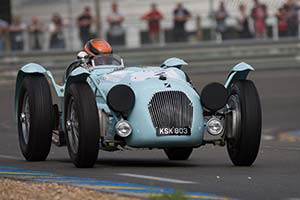
 Talbot Lago nevertheless persevered and prepared for the all-important French Grand Prix at Reims, where the two off-set single seaters were joined by a brand-new single seater. During the practice Rene le Begue, in the fast Talbot Lago, was over 18 seconds a lap slower than Hermann Lang in the fastest of the German cars. Following the retirement of all Mercedes-Benz W154s and two of the four Auto Unions, Le Begue eventually ended the race best of the rest in third.