<< Prev Page 2 of 2 At least three cars (some sources suggest four examples) were readied for the 24 Hours of Le Mans. Unfortunately, the Le Mans curse continued for Bugatti as the 1936 edition was cancelled due to labour issues. Instead the three cars made their competition debut a fortnight later in the French Grand Prix at Montlhéry. The Type 57 G driven by Jean-Pierre Wimille and Raymond Sommer managed to score a debut victory for the Bugatti racer. Later that year Wimille repeated this result at the hotly disputed Marne Grand Prix, beating larger engined Delahayes and Talbot Lagos. During the winter, the slippery Bugatti was used to set a whole series of world records for naturally aspirated engines.
Success continued into the new year and Bugatti arrived at the 24 Hours of Le Mans as the clear favourites. After many fruitless attempts, the 1937 edition was finally Bugatti's with Robert Benouist and Jean-Pierre Wimille winning the race at a record average of 137 km/h. That year a 4.5 litre engine Type 57 Tank, known as the 57S 45, also appeared and for 1939 a supercharged version was fielded in the 24 Hours of Le Mans. Driven by Pierre Veyron and Jean-Pierre Wimille, it added another victory to Bugatti's tally with an average speed just shy of 140 km/h.
The Type 57 Tank story unfortunately did end with a very sad note as Jean Bugatti fatally crashed the 1939 Le Mans winner in August of 1939 while testing it ahead of its next outing. The subsequent history of the surviving cars is shrouded in mystery prompting even noted Bugatti authority Hugh Conway to remark: "Bugatti's racing programme became involved and very confusing to the humble historian, without accurate factory records." It is believed that today only the 1937 Le Mans winning car has survived. << Prev Page 2 of 2

 Ultimatecarpage.com
> Cars by brand
> France
> Bugatti
Ultimatecarpage.com
> Cars by brand
> France
> Bugatti
 Racing cars
> Other Sportscars
Racing cars
> Other Sportscars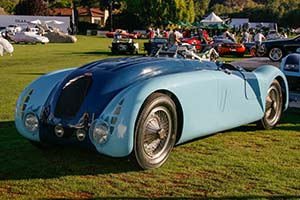
 At least three cars (some sources suggest four examples) were readied for the 24 Hours of Le Mans. Unfortunately, the Le Mans curse continued for Bugatti as the 1936 edition was cancelled due to labour issues. Instead the three cars made their competition debut a fortnight later in the French Grand Prix at Montlhéry. The Type 57 G driven by Jean-Pierre Wimille and Raymond Sommer managed to score a debut victory for the Bugatti racer. Later that year Wimille repeated this result at the hotly disputed Marne Grand Prix, beating larger engined Delahayes and Talbot Lagos. During the winter, the slippery Bugatti was used to set a whole series of world records for naturally aspirated engines.