
 Ultimatecarpage.com
> Cars by brand
> Germany
> Audi
Ultimatecarpage.com
> Cars by brand
> Germany
> Audi
 TTS Coupé TTS Coupé
|
| Audi TTS Coupé |
| Article | Image gallery (9) | Specifications |
|
|
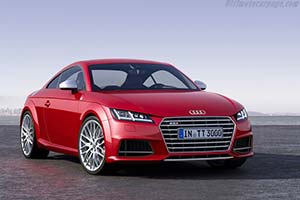
<< Prev Page 2 of 3 Next >>  Clearly structured volumes with a taut surface and light, almost floating lines - the interior is the embodiment of the new Audi TT's pure sports car character. As with the exterior, horizontal lines and surfaces emphasize the width of the interior. The center tunnel console, which supports the calves when driving fast through bends, and the door panels have similar flowing shapes. Clearly structured volumes with a taut surface and light, almost floating lines - the interior is the embodiment of the new Audi TT's pure sports car character. As with the exterior, horizontal lines and surfaces emphasize the width of the interior. The center tunnel console, which supports the calves when driving fast through bends, and the door panels have similar flowing shapes.The rule was once again: "less is more." Clear, purist lines underscore both the lightness and the uncompromising sportiness of the Audi TT's interior. Two other ingenious design and technically innovative tricks enabled the designers to create an instrument panel that is impressively slender: The instrument cluster and the MMI screen have been combined to form a central, digital unit - the so-called Audi virtual cockpit. In addition, the controls for the air conditioning system are positioned directly in the air vents. Seen from above, the instrument panel resembles the wing of an aircraft; the round air vents - a classic TT feature - are reminiscent of jet engines with their turbine-like design. The vents also contain all the controls for the standard air conditioning system and the optional automatic air conditioning system (standard in the TTS). The controls for seat heating, temperature, direction, air distribution and air flow strength are located at their center; the setting selected is shown on small displays in the automatic air conditioning system. The horizontal control panel is located under the central air vents. The 3D-designed toggle switches activate the hazard warning lights, Audi drive select and the assistance functions. The standard sports seats in the new Audi TT have integrated head restraints and are positioned lower than in the predecessor model. Compared with the seats in the predecessor model, they are more than five kilograms (11.02 lb) lighter. As an option - and as standard in the TTS - there are newly developed S sport seats with highly contoured and pneumatically adjustable side sections that are exceptionally comfortable and provide excellent support. The new multifunction steering wheel has a flattened rim, and aluminum-look clasps encompass the spokes. It also has a driver airbag that takes up 40 percent less space without compromising safety, and hence emphasizes the sense of visual lightness. Countless details demonstrate the high standards which Audi places on interior design and craftsmanship. They include the newly designed, split gear lever, the very precisely engaging MMI rotary pushbutton and the finely finished loudspeaker covers with light guides in the optional Bang & Olufsen sound system. As a 2+2 seater, the new Audi TT is a sports car that is highly suitable for everyday use. The trunk has a capacity of 305 liters (10.77 cubic ft), which is 13 liters (0.46 cubic ft) more than before, and can be extended by folding the rear seat backrests forward. The new Audi TT offers a far more distinct and colorful range of colors than its predecessor. There are 11 exterior colors, one of which is exclusively for the S line. Seven of the colors in the range are new for the TT, and two of these are completely new for Audi: Nano Gray and Tango Red. There are also two additional paints available for the TTS - crystal-effect Panther Black and the highly expressive Sepang Blue. There is a completely new range of colors for the interior, too - the Audi TT and the TTS each offer three interior colors to choose from. For the first time, Audi is offering a two-tone interior including sporty contrasting stitching for S line models. The equipment for the new Audi TTS includes extended interior elements that add individually selectable color accents to the S sport seats clasps, the sides of the center console and the rings of the air vents. Customers with exquisite taste have many options for customization. Upholstery in various cloths and leather grades are available for the seats, as well as three leather packages. The S sport seats have characteristic diamond quilting in the center section. One special highlight is the exclusive design selection which comprises a combination of two fine leather colors: dark murillo brown on the seats and a slightly metallic shimmering stone-grey pearl on the armrests, knee supports and cowl. Alternating contrasting stitching, dark aluminum, matching paint for the extended interior elements and a special woven floor mat are further features of this elegant upholstery and trim. For the TTS, the Audi designers have come up with an innovative technical laser texture for the wings of the instrument panel: It has a honeycomb-patterned, slightly raised surface that gives the Audi TTS a unique sporty feel. The operating concept for the new TTS has been revised from the ground up - in line with the consistent sports car character, all the elements focus on the driver. There are two variants of the multifunction steering wheel available. Drivers selecting the top version can activate almost all functions from the steering wheel without taking their eyes off the road. The second control unit is the likewise newly developed MMI terminal on the console of the center tunnel. Two toggle switches activate the navigation/map, telephone, radio and media menus. There are two buttons on both sides of the central rotary pushbutton, supplemented by a main menu and a back button. The driver can easily enter destinations using the touchpad on the top of the rotary pushbutton (from the Connectivity package upwards) - the MMI touch recognizes your personal handwriting. It is also possible to scroll through lists or zoom in on maps. The menu structure of the MMI resembles that of a smartphone, including the free-text search. All important functions can be accessed directly. One special highlight is the MMI direct search. This enables you to start writing immediately when navigating, without having to use a set form. In most cases, inputting four letters is enough for you to see relevant destinations throughout Europe. The two side buttons activate context-dependent functions (right button) and options (left button). The operating logic is easy to understand and conveys a completely novel "joy of use." Alongside the operations possible using the control panel, the Audi TT offers a further possibility: the voice control system. Audi is also breaking new ground in this area, too. For the first time in the Audi TT, natural voice controls are used that enable simple commands - such as "Take me to Munich" or "I want to talk to Sabine" - to control the vehicle systems without having to take your hands off the steering wheel. Instead of the conventional analog displays, the new TT has the Audi virtual cockpit on board - this fully digital instrument cluster sets new standards with its dynamic animations and precise graphics. Drivers can choose between two display modes: In the classic view, the speedometer and rev counter are in the foreground; in "infotainment" mode the virtual instruments are smaller. The space that becomes free as a result provides ample room for other functions, such as the navigation map. In the Audi TTS there is a third, sporty mode. Here, the centrally positioned rev counter dominates the display. With a resolution of 1,440 x 540 pixels, the 12.3" TFT screen boasts brilliantly sharp images. At work in the background is a Tegra 30 graphic processor from market leader Nvidia's Tegra 3 series. At the lower edge of the Audi virtual cockpit, the displays for outside temperature, time and mileage are permanently visible. Warning or information symbols may also appear there. << Prev Page 2 of 3 Next >> |
| Article | Image gallery (9) | Specifications |
| All Cars - Contact us - Privacy Statement - Top | © 1998 - 2026 Ultimatecarpage.com |