
 Ultimatecarpage.com
> Cars by brand
> Germany
> Audi
Ultimatecarpage.com
> Cars by brand
> Germany
> Audi
 TTS Coupé TTS Coupé
|
| Audi TTS Coupé |
| Article | Image gallery (9) | Specifications |
|
|
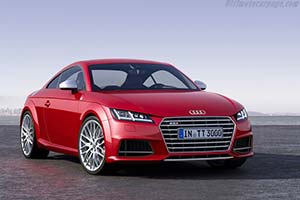
<< Prev Page 3 of 3  Audi offers the new TT and TTS with three different four-cylinder engines with turbocharging and direct injection. Their power output ranges from 135 kW (184 hp) to 228 kW (310 hp). The two TFSI gasoline engines and the TDI combine athletic power with trailblazing efficiency. The start-stop system is a standard feature. Audi offers the new TT and TTS with three different four-cylinder engines with turbocharging and direct injection. Their power output ranges from 135 kW (184 hp) to 228 kW (310 hp). The two TFSI gasoline engines and the TDI combine athletic power with trailblazing efficiency. The start-stop system is a standard feature.For the launch of the TT, the 2.0 TDI will be available with manual shift and front-wheel drive. It delivers 135 kW (184 hp) and torque of 380 Nm (280.27 lb-ft). The new sports car can thus accelerate from 0 to 100 km/h (62.14 mph) in 7.2 seconds and reaches a top speed of 235 km/h (146.02 mph). Standard fuel consumption is a mere 4.2 liters per 100 km (56.00 US mpg), which translates into CO2 emissions of 110 g/km (177.03 g/mile), a new record low level in the sports car world. The 2.0 TDI features two balancer shafts in the crankcase, adjustable camshafts and a common rail injection system delivering maximum pressure of 2,000 bar. The Audi TT 2.0 TDI meets the Euro 6 standard and, thanks to its high efficiency, bears the "ultra" label. The 2.0 TFSI is available in two versions - a 169 kW (230 hp) version for the TT and a 228 kW (310 hp) version for the TTS. In both versions it unites various ultramodern technologies - the additional indirect injection supplementing the direct injection of the FSI, the Audi valvelift system (AVS) to adjust the valve stroke on the exhaust side and thermal management, which uses a rotary valve module and an exhaust manifold integrated into the cylinder head. In the Audi TT, the 2.0 TFSI delivers torque of 370 Nm (272.90 lb-ft) from 1,600 to 4,300 rpm. It accelerates the Coupé - which has a six-speed manual transmission and front-wheel drive - from 0 to 100 km/h (62.14 mph) in 6.0 seconds, and on up to an electronically governed top speed of 250 km/h (155.34 mph). On the version with six-speed S tronic and quattro all-wheel drive, the key figures are as follows: the sprint from 0 to 100 km/h (62.14 mph) takes 5.3 seconds; top speed is 250 km/h (155.34 mph); fuel consumption of 6.8 liters per 100 km (34.59 US mpg) and CO2 emissions of 159 g per km (255.89 g/mile). The dual-clutch transmission shifts through the six gears without any noticeable interruption in traction, and in manual model it can be controlled by paddles on the steering wheel. In the "efficiency" mode of Audi drive select, the S tronic selects freewheel as soon as the driver takes his or her foot off the gas pedal. The Audi TTS is a peak performer. It covers the standard sprint in 4.7 seconds; its top speed is electronically governed at 250 km/h (155.34 mph). The 2.0 TFSI produces 380 Nm (280.27 lb-ft) of torque at an engine speed of between 1,800 and 5,700 rpm. Controllable flaps in the exhaust system modulate the sporty sound and make it even richer. A manual transmission is standard. The S tronic option includes launch control, which regulates maximum acceleration from a standstill. In the new Audi TT, quattro permanent all-wheel drive delivers additional stability, traction and driving fun. It has been consistently advanced and optimized especially for the new TT. Its electro-hydraulically controlled multi-plate clutch is mounted on the rear axle. The special pump design reduces weight by around 1.5 kg (3.31 lb) compared with the previous model. The distribution of drive torque between the axles is controlled electronically within fractions of a second. The intelligence of quattro drive - in other words, the software that determines precisely the possible torque distribution between the front and rear axles - is a completely new development especially for the TT. The innovative control philosophy continuously senses the ambient conditions, driving status and the driver's wishes. This means that the ideal distribution of torque is calculated and the TT's dynamic drive characteristics enhanced in every situation. By networking quattro drive with Audi drive select, the driver of the new Audi TT can adjust the all-wheel-drive properties to suit his or her individual requirements. In "auto" mode, this produces optimum traction and balanced driving dynamics. In "dynamic" mode, torque is distributed to the rear axle earlier and to a higher degree, which means that driving dynamics are enhanced further, especially on surfaces with low friction coefficients. Alongside optimizing the driving dynamics, the advances made to quattro drive also focused on the subject of efficiency. In the drive select "efficiency" mode the torque distribution is adjusted to optimize the level of efficiency. Determining driving conditions and driver type precisely allows for efficiency-optimized all-wheel-drive control - which can even result in the temporary shutdown of the quattro drive system. In this operating state, the intelligent software carefully monitors the driving situation and activates the all-wheel drive before torque is once again required at all four wheels. In this way, quattro drive provides optimum efficiency along with a level of traction and dynamic handling that is typically quattro. The chassis also reflects the technological expertise behind the new Audi TT. The front suspension is based on a McPherson system; aluminum components reduce the weight of the unsprung chassis masses. The four-link rear suspension can process the longitudinal and transverse forces separately. One particular highlight is the new third generation of the adaptive damper control system, Audi magnetic ride. Compared with the previous version, it has been improved in terms of characteristic spread, control dynamics and precision as well as user friendliness. Audi magnetic ride can be adjusted to three settings (comfort - auto - dynamic) via Audi drive select and, at the press of a button, either makes the compact sports car hug the road more tightly or lets it glide smoothly across the road irrespective of which mode the driver selects. Magnetic ride technology delivers ultra-swift wheel-selective control of the damper forces, which means that in all driving situations there is optimum contact between wheel and road. In this way, the new Audi TT's superb driving dynamics are further optimized, and body control also ensures good comfort behavior. The system is unique in this market segment. Audi magnetic ride is standard on the Audi TTS and is available as an option for all other TT versions. Another highlight is the standard progressive steering - its rack is designed such that the ratio becomes more direct as the steering is turned. In this way, the new TT can be steered agilely and precisely with little movement of the steering wheel in downtown traffic and on winding country roads. The electromechanically driven and thus highly efficient progressive steering adapts its assistance to speed and forms the basis for the optional assistance systems - Audi active lane assist and park assist. With its elaborate chassis design and firm setup, the new Audi TT handles superbly in all situations. The body is lowered by 10 mm (0.39 inch) on the TTS, with the S line sport package and with the adaptive damper control system, Audi magnetic ride. The dynamic driving system known as Audi drive select is an option for the new Audi TT, but standard on the TTS. It controls the engine characteristics and the steering assistance. The driver can choose between comfort, auto, dynamic, efficiency and individual modes. In addition, Audi drive select influences several optional modules - the S tronic, quattro drive, the Audi magnetic ride system, which at the press of a button makes the compact sports car hug the road even more closely, and the engine sound. In efficiency mode, Audi drive select influences the air conditioning and the start-stop system accordingly. There are 11 different wheel versions available. The TT 2.0 TFSI and the 2.0 TDI come as standard with 17" forged wheels in five-spoke design, each of which weighs only 8.7 kg (19.18 lb), and with size 225/50 tires. On request, Audi can supply other wheel designs with diameters of 17", 18" or 19", and tires up to 245/35 R19. quattro GmbH also offers wheels with a diameter of up to 20". The front discs are ventilated and, depending on engine version, have a diameter of up to 338 mm (13.31 in). The new electromechanical parking brake that the driver actuates by pressing a button is integrated into the rear braking system. The TTS uses newly developed aluminum fixed-caliper brakes to slow the front wheels; these are five kilograms (11.02 lb) lighter than on the predecessor model - another example of Audi's expertise in lightweight construction. The electronic stabilization control (ESC), which can be switched off either partly or completely, perfectly complements the car's sporty handling. When driving through bends, torque vectoring takes effect. If required, the drive torque is distributed from the inside front wheel to the outside front wheel (front-wheel drive) or, on quattro models, to the rear wheels, too. Thanks to the difference in propulsive forces, the car turns very easily into the curve, which is helpful for the driver. In this way, bends can be navigated with great precision and neutrally. This significantly boosts the TT's dynamism and stability. Sport mode supports particularly sporty driving, facilitating steering and control when drifting. The way that all components interact and harmonize enhances agile handling and consequently the driving pleasure that an Audi TT offers - just as you would expect of a sports car. All versions of the new Audi TT Coupé come with a generous range of standard equipment. Alongside those features already mentioned above, the MMI radio and the electromechanical parking brake deserve a special mention. The options include - alongside the S sport seat with numerous leather and trim variants - the convenience key, hold assist, high-beam assist, the LED interior lighting package, front seat heating, and the storage and luggage compartment package. As regards infotainment, customers can choose from various options. The connectivity package boasts a touchpad, MMI touch. At the top of the modular range is the MMI Navigation plus with its large flash memory, two card readers, DVD drive, Bluetooth interface and voice control system. The T30 chip from market leader Nvidia's Tegra 3 series, which is used in the new generation of the modular infotainment platform, controls all navigation and multimedia functions in the car and, together with the processor, presents all content in the Audi virtual cockpit. The Audi connect system complements the MMI Navigation plus perfectly - it connects the new TT to the internet using the fast LTE transmission standard. The integrated Wi-Fi hotspot means passengers can surf the internet and e-mail as they please, while the driver can rely on the customized Audi connect services. The infotainment package is rounded out by attractive components. The Audi Phone Box smoothly links a cell phone to the car. Its centerpiece is a universal planar antenna which is integrated into the storage tray in the center armrest. Thanks to close-range coupling, the phone communicates with the flat planar antenna, which uses an amplifier to transmit the signals to the car antenna. The Bang & Olufsen Sound System features a 14-channel amplifier and 12 loudspeakers; the woofers in the doors gleam in the dark thanks to an adjustable, discrete light conductor. Powerful assistance systems make driving the new TT an even more pleasurable experience. As an option the car can be equipped with Audi side assist, which uses rear-mounted radar sensors to help drivers change lane more safely; camera-based traffic sign recognition; Audi active lane assist, which helps the driver if required by steadily correcting steering or warning him or her if there is a danger of unintentionally drifting out of lane and the park assist system with display of surroundings, which independently guides the car into suitable spaces. << Prev Page 3 of 3 |
| Article | Image gallery (9) | Specifications |
| All Cars - Contact us - Privacy Statement - Top | © 1998 - 2026 Ultimatecarpage.com |