<< Prev Page 2 of 2 Shelby asked his designer Peter Brock to pen a roadster body for the new DeTomaso racing car. The finished designs were sent to Italy to be turned into aluminium by local metal workers. The same design was also used to body the last of the King Cobras, known as the Lang Cooper. In January of 1965 De Tomaso took the wraps off the 'Sport 5000', which used a mock-up chassis and a poor interpretation of Brock's design. Disappointed by the Italians' work, Shelby sent his designer over to personally supervise the construction of the body for the first running car. Brock worked alongside Medardo Fantuzzi in the Fantuzzi workshop. The result was a very low body, dominated by a large, moveable rear wing and partly covered rear wheels. The body also featured full doors to make it eligible for GT-racing. After being mated to a fully rolling chassis, the new racing car was christened DeTomaso P70.
Again it is uncertain when and why, but some time in 1965 Shelby withdrew his backing of the project. It is generally accepted that all his efforts were needed to turn the Ford GT40 into a Le Mans, which he duly did. With Shelby out of the picture, De Tomaso had to look for another backer. In coach builder Ghia he found an unlikely sponsor, which led to the car to be renamed to 'Ghia DeTomaso' before the Turin debut. Alongside the striking red racing car, DeTomaso also showed a rolling chassis, powered by a V8 engine at Turin. The P70 / Ghia DeTomaso was shown again in February of 1966; probably the last time the car was shown in public. At the time of the Road & Track article Brock had left Shelby and set up his own design firm. He was also going to be the distributor for the car in North America. The rear body treatment of the P70 was later used in the Brock design Suzuki Hino racing car.
While the original P70 was never raced, a second example was built much along the same lines, complying with the latest regulations. Dubbed the Sport 5000, it was first fielded at the 1966 Mugello 500 km for Roberto Businello. Sadly, the race ended after only a single lap and the car was not raced again. The project was abandoned but it did lay the foundation of the subsequent Mangusta road car, which also featured a backbone chassis and a small-block Ford V8. The Sport 5000 was displayed in the DeTomaso museum for many years. << Prev Page 2 of 2

 Ultimatecarpage.com
> Cars by brand
> Italy
> DeTomaso
Ultimatecarpage.com
> Cars by brand
> Italy
> DeTomaso
 Racing cars
> Other Sportscars
Racing cars
> Other Sportscars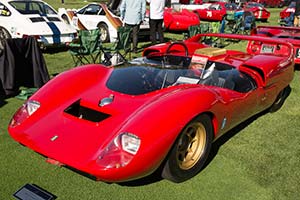
 Shelby asked his designer Peter Brock to pen a roadster body for the new DeTomaso racing car. The finished designs were sent to Italy to be turned into aluminium by local metal workers. The same design was also used to body the last of the King Cobras, known as the Lang Cooper. In January of 1965 De Tomaso took the wraps off the 'Sport 5000', which used a mock-up chassis and a poor interpretation of Brock's design. Disappointed by the Italians' work, Shelby sent his designer over to personally supervise the construction of the body for the first running car. Brock worked alongside Medardo Fantuzzi in the Fantuzzi workshop. The result was a very low body, dominated by a large, moveable rear wing and partly covered rear wheels. The body also featured full doors to make it eligible for GT-racing. After being mated to a fully rolling chassis, the new racing car was christened DeTomaso P70.