<< Prev Page 2 of 2 The mighty Sunbeam racer had a difficult first couple of outings. At its Brooklands debut, a tyre burst in practice causing Harry Hawker to crash. The repaired car then stalled on the Brooklands grid and could not start the race. The big Sunbeam was then shipped to France for René Thomas to compete in the Gaion Hill Climb. Although this did not seem as the most obvious place to race the 355 bhp beast, the very talented Frenchman managed to complete the 1 km run with a staggering average speed of 173.81 km/h. This was a new course record and sufficient for Thomas to win the event outright.
In 1921, the Sunbeam was entrusted to Kenelm Lee Guinness, who really took to the imposing machine. He first drove the car at the Brooklands Easter meeting, where he placed second despite missing a gear. In the Autumn he finished second again, averaging 187 km/h on his final lap. The following year, Guinness clocked an a flying kilometre average of just over 215 km/h at Brooklands. This represented a Land Speed Record and the last one set at the Brooklands circuit. Guinness association with the Sunbeam ended with a final outing at Brooklands in the fall of 1922.
The next driver to take to the helm of the Sunbeam was Malcolm Campbell, who recorded a speed of 222 km/h at the Saltburn Speed Trials. This was a one way run so did not qualify as a record but Campbell was sufficiently impressed to buy the car. A new body was crafted by Boulton & Paul, which featured a longer tail. The car was painted blue like all of Campbell's racing cars and suitably nicknamed 'Blue Bird'. In 1924, Campbell used the re-bodied Sunbeam to set a new World Land Speed Record at Pendine Sands with an average of 235 km/h. A year later Campbell became the first man to breach the 150 mph (241.40 km/h) barrier.
After a six-season career, the Sunbeam 350hp V12 was retired from active service. It passed through various hands before finding a permanent home in the British National Motor Museum. << Prev Page 2 of 2

 Ultimatecarpage.com
> Cars by brand
> Great Britain
> Sunbeam
Ultimatecarpage.com
> Cars by brand
> Great Britain
> Sunbeam
 Racing cars
> Pre 1950 GP
Racing cars
> Pre 1950 GP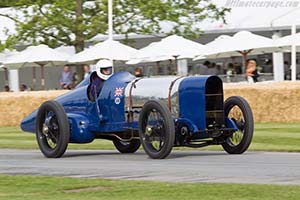
 The mighty Sunbeam racer had a difficult first couple of outings. At its Brooklands debut, a tyre burst in practice causing Harry Hawker to crash. The repaired car then stalled on the Brooklands grid and could not start the race. The big Sunbeam was then shipped to France for René Thomas to compete in the Gaion Hill Climb. Although this did not seem as the most obvious place to race the 355 bhp beast, the very talented Frenchman managed to complete the 1 km run with a staggering average speed of 173.81 km/h. This was a new course record and sufficient for Thomas to win the event outright.