<< Prev Page 2 of 2 Based on the same 'Cleveland' V8 as the production Pantera, the competition engine was equipped with a bespoke aluminium head. This reduced the weight of the engine and in turn raised the compression. The V8 was originally fitted with a single, Holley carburettor but in Italy was soon equipped with a revised intake and four Weber carburettors. Helped by GT40-inspired 'spaghetti' exhausts, the rumbling V8 was good for around 500 bhp.
The first Group 4 Panteras were ready early in 1972 and several were entered at Le Mans. Here the weaknesses of the car became quickly apparent. The engine proved very fragile and the Pantera was further hampered by its homologation weight of 1,250 kg. This was reportedly set so high by the governing body on the insistence of rival Porsche. Another inherent problem was the lack of the rigidity of the monocoque chassis.
Regardless of the issues, the Panteras continued to be raced for many more years, with some success, and gradually evolved over this period. The engine issues were ultimately addressed by sourcing revised engines, with a slightly lower compression ratio, while some competitors went as far as to build a separate subframe for the rear suspension to improve the rigidity. One of the reasons the Pantera remained popular that it was considerable cheaper to buy and run as the similar Ferraris and Porsches.
In 1972, DeTomaso built a run of just 14 Group 4 Panteras. Since then, the Italian manufacturer built up others to special order and several of the regular production cars as well as the Group 3 racers were modified to Group 4 specification by privateers. These cars are regularly seen at historic events. The original Group 4 cars, however, are a much rarer sight. << Prev Page 2 of 2

 Ultimatecarpage.com
> Cars by brand
> Italy
> DeTomaso
Ultimatecarpage.com
> Cars by brand
> Italy
> DeTomaso
 Racing cars
> GT Cars
Racing cars
> GT Cars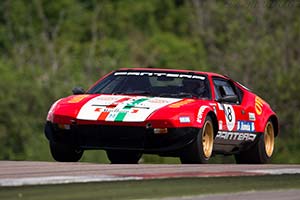
 Based on the same 'Cleveland' V8 as the production Pantera, the competition engine was equipped with a bespoke aluminium head. This reduced the weight of the engine and in turn raised the compression. The V8 was originally fitted with a single, Holley carburettor but in Italy was soon equipped with a revised intake and four Weber carburettors. Helped by GT40-inspired 'spaghetti' exhausts, the rumbling V8 was good for around 500 bhp.