<< Prev Page 3 of 3 Back on the track the quad cam engine had shown potential, but the peaky power delivery require some work to fine tune. Meanwhile, the two Coupes were prepared for the Carrera PanAmericana race for two South American customers. Complete with bright sponsor stickers, the two Coupes again dominated the 1500 cc class. Jaroslav Juhan's 550-01 was the faster of the two, but his retirement left the victory for Jose Herrarte's 550-02. A year later a quad-cam 550 Spyder (550-04) matched Herrarte's class winning performance and placed third overall. Soon after, the 'Carrera' name was adopted for 356 models equipped with the Fuhrmann engine.
Although the 550 Spyder had been announced as a production model late in 1953, Porsche spent most of 1954 finalizing the customer car's specification. On the track there was now little stopping the agile racer in its class and even larger engined competition was not safe. At the end of the year the production cars finally became available turning many privateers into race winners. A sad side note in the 550 Spyder's history was James Dean's fatal accident in 1955, which ironically only helped to further build the car's legendary status.
With over 70 examples produced the 550 RS Spyder was not just a big success on the track. The Porsche works team replaced the 550 for 1956 with the much improved 550A. Although it looked similar to the earlier version, the new 550 featured an advanced spaceframe chassis and packed the latest 135 bhp version of the 547 engine. The 550A RS Spyder continued where Porsche's first racing car had left off and formed the basis of the company's sports cars for another five years to come. With the 550 RS Spyder Porsche started a process that would eventually develop into many Le Mans winning vehicles like the 917 and 956. << Prev Page 3 of 3

 Ultimatecarpage.com
> Cars by brand
> Germany
> Porsche
Ultimatecarpage.com
> Cars by brand
> Germany
> Porsche
 Racing cars
> Other Sportscars
Racing cars
> Other Sportscars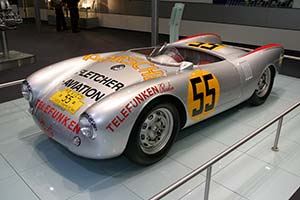
 Back on the track the quad cam engine had shown potential, but the peaky power delivery require some work to fine tune. Meanwhile, the two Coupes were prepared for the Carrera PanAmericana race for two South American customers. Complete with bright sponsor stickers, the two Coupes again dominated the 1500 cc class. Jaroslav Juhan's 550-01 was the faster of the two, but his retirement left the victory for Jose Herrarte's 550-02. A year later a quad-cam 550 Spyder (550-04) matched Herrarte's class winning performance and placed third overall. Soon after, the 'Carrera' name was adopted for 356 models equipped with the Fuhrmann engine.