
| gt |
 Ultimatecarpage.com
> Cars by brand
> China
> Techrules
Ultimatecarpage.com
> Cars by brand
> China
> Techrules
 Racing cars
> GT Cars AT96 TREV Racing cars
> GT Cars AT96 TREV
|
| Techrules AT96 TREV |
| Article | Image gallery (9) | Specifications |
|
|
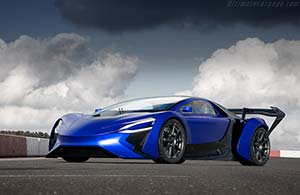
<< Prev Page 2 of 3 Next >>  TREV is an all-new proprietary, patent protected series hybrid powertrain system. It comprises a micro turbine generator that is inspired by technology commonly used in the global aviation industry and large-scale power generation industries. The turbine drives a generator which charges a battery. This in turn, provides electricity to drive the traction motors. Unlike many previously developed turbine powertrain systems, there is no direct electrical feed from the generator to the electric motors: the TREV system is purely a series hybrid range extender system. TREV is an all-new proprietary, patent protected series hybrid powertrain system. It comprises a micro turbine generator that is inspired by technology commonly used in the global aviation industry and large-scale power generation industries. The turbine drives a generator which charges a battery. This in turn, provides electricity to drive the traction motors. Unlike many previously developed turbine powertrain systems, there is no direct electrical feed from the generator to the electric motors: the TREV system is purely a series hybrid range extender system.Air drawn into the micro turbine is passed through a heat exchanger where heat from the exhaust air is transferred to the cold intake air after it has been compressed. Ignition of the compressed and heated fuel-air mixture generates enormous energy which is channelled to at very high speeds to turn the turbine vanes. As this hot exhaust gas is expelled, it passes through the heat exchanger to ensure the heat energy is recuperated and transferred to cold intake air. Techrules Chief Technology Officer, Matthew Jin, explains: "In the conventional cars that dominated the 20th century, the combustion engine that converts a fuel's chemical energy into a useful mechanical energy is also the driving engine that turns the wheels. "Because turbines have always been a very inefficient way to convert chemical energy into useful wheel turning mechanical energy, only a few have tried to use a turbine in the powertrain system, and none have ever succeeded commercially. "But, with electric vehicles, an electric motor is used to drive the wheels, which effectively frees the combustion engine to exclusively convert chemical energy into mechanical energy and finally into electric energy. This is a major breakthrough, making it possible for us to use the highly efficient turbine engine as a superb range extender on our vehicles." Micro turbines are significantly more efficient than piston engines in range extender applications, because significantly less energy is sacrificed in frictional losses, meaning more of the fuel's chemical energy is harnessed. The turbine shaft powers a generator that produces electricity to charge the battery cells. In Techrules' TREV configuration, the turbine and the generator share the same shaft and rotate at the same speed: over 96,000 revolutions per minute. The total weight of the TREV range extender system (micro-turbine, inverters, fuel pumps, air pumps, and generator, but excluding batteries and motors) is approximately 100 kg. The TREV system incorporates several new technologies that make it approximately 50 per cent more efficient thanrange extender systems using petrol engines, which dramatically increases the viability of its commercial series production. The high rotational speeds that the shaft requires in order to draw in the required volume of air means that achieving low friction is paramount to the efficiency of the TREV system. Techrules employs air bearing technology - a high pressure feed of compressed air - instead of a traditional oil lubricant film to separate the shaft from the bearing. This results in fewer frictional energy losses, since it eliminates parasitic losses of a mechanical bearing. The use of an air bearing system is not unique, but how Techrules uses the air bearing involves genuine world-first innovations. Of particular note is that the air bearing is also supported by a magnetic field that allows for precise adjustment of the high speed shaft. Both bearing solutions work together to maintain exceptional stability. The magnetic bearing allowsa far greater clearance between the shaft and its wall lining, which delivers significant advantages for the long-term durability of the system. This is an especially important consideration in automotive applications of turbine systems because - unlike in stable power generation conditions - the entire assembly must be able to be capable of withstanding volatile operating conditions that result from, for example, vertical shocks from uneven road surfaces and lateral forces in cornering. Techrules' hybrid bearing system is also more economic to produce, because the built-in extra clearance space reduces the extreme tolerances usually required. In addition, a new design of internal foil - an intrinsic component within an air bearing - is used for the bearing liner that supports the air pressure and flow. It is made of a new compound material that gives it superior durability. Of equal importance is that the new foil enables the mass production of the bearing liner at the required production tolerances to be achieved at a high volume scale at low cost. Techrules has also introduced a new and innovative heat exchanger design that is more thermally efficient than conventional designs. A new material has been introduced in the hybrid heat exchanger which greatly increases the efficiency of heat recuperation from the exhaust gases. The turbine - rotating at 96,000 revolutions per minute - produces 36 kW. Of this output, 30 kW powers the generator, with 6 kW directly powering auxiliary equipment such as the inverters. The 30 kW electrical output from the generator is used to charge the battery pack. The TREV system employs an innovative smart battery management system that optimises the efficiency of battery charging and power balancing between battery cells. In a conventional lithium-ion battery management system, to avoid cells being damaged by overcharging, the cells - which each charge at a slightly different rate - must be balanced as they charge. This balancing is conventionally achieved by actively discharging the cells that are charging more quickly in order to enable the other cells to 'catch up'. This process sees a proportion of energy wasted during the charging process and increases the time required to charge all cells fully. To address the shortcomings with this standard industry practice, Techrules has introduced an innovative new charge balancing strategy. The smart battery balancing system harnesses the 'excess' voltage in cells that are charging more quickly, sharing their charge with slower-charging neighbouring cells to achieve the required balance. As a result, the entire pack charges more quickly, and there is no energy wasted in actively discharging the best-performing cells. The TREV system uses readily available cylindrical 18650 Lithium-Manganese-Oxide battery cells. Techrules is focusing its capabilities on the efficiency of the battery management rather than the battery chemistry itself. Its insight and smart battery management system will be applicable to any future, higher capacity battery technology. Unlike most EV development programmes, because the TREV system incorporates a series hybrid range extender, Techrules is prioritising power density - the capability of the batteries to deliver peak power - ahead of energy density - the capability of the batteries to hold maximum energy. TREV's advanced smart battery management system optimises the efficiency of battery charging, reducing the time to charge batteries and reducing wasted energy. << Prev Page 2 of 3 Next >> |
| Article | Image gallery (9) | Specifications |
| All Cars - Contact us - Privacy Statement - Top | © 1998 - 2026 Ultimatecarpage.com |