
| gt |
 Ultimatecarpage.com
> Cars by brand
> China
> Techrules
Ultimatecarpage.com
> Cars by brand
> China
> Techrules
 Racing cars
> GT Cars AT96 TREV Racing cars
> GT Cars AT96 TREV
|
| Techrules AT96 TREV |
| Article | Image gallery (9) | Specifications |
|
|
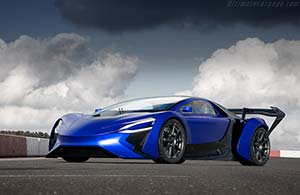
<< Prev Page 3 of 3  TREV technology lowers the whole-life environmental impact of EVs by addressing or avoiding several major shortcomings of current technology. TREV technology lowers the whole-life environmental impact of EVs by addressing or avoiding several major shortcomings of current technology.TREV is capable of delivering an unprecedented range for a series hybrid supercar. Projections, based on initial testing, indicate that the range of a future production supercar under battery power alone will be up to 150 km. Where charging points are unavailable TREV technology can recharge batteries anywhere, either while underway or when parked - eliminating range anxiety. It is envisioned that this parked recharging process could be completed unsupervised, overnight for example. Maximum range - based on the battery configuration in the concept supercar presented at Geneva - is projected to be over 2,000 km from 80 litres of aviation kerosene (in urban driving conditions), or a fuel with equivalent calorific value. Another fundamental challenge to the feasibility of mass adoption of EVs in several markets is the massive draw on the electricity grid that would be impossible to meet within the current grid capacity. If the Chinese market, for example, adopted plug-in EVs, the result would be a massive increase in pollution from coal-fired power stations. And many markets in the western world, too, are precariously close to the limit of the electricity generation capacities of their power generation infrastructures. These markets would not be able to sustain a widespread adoption of plug-in EVs. With a common core architecture, the TREV system can be tailored to run on one of a variety of fuels. This means that the configuration of the TREV system can be matched to the fuel which is already prevalent in a specific market with a comprehensive supply and distribution infrastructure. As a result, adoption of the TREV system by the fuel supply industry, vehicle manufacturers and consumers requires no major investment in new networks - as with plug-in EVs or hydrogen fuel cells. The TREV system's turbine has been tested in various guises, with alternative versions running natural gas, biogas, diesel, gasoline and aviation kerosene. Since the significant uptake of EVs is dependent on the availability of charging point networks, which require major investments in new infrastructure, harnessing the existing fuel distribution infrastructures reduces the absolute reliance on these networks. The TREV system delivers very high efficiency and very low emissions, and is a sealed-for-life powertrain solution which requires almost zero maintenance throughout the ownership cycle. The only service item is the air intake filter. Techrules is showcasing its TREV technology at the 2016 Geneva International Motor Show in a two-seater all-wheel drive concept supercar. The turbine generator is carried behind the passenger cabin and in front of the rear wheels, making the concept a 'mid-engined' electric vehicle. It is presented in two designs, the AT96 and GT96. These designs - each offering an alternative configuration of the TREV system - are two variations of a vision of how turbine-recharging supercars might look when the technology enters production in China's first supercar. 'AT' refers to 'Aviation Turbine', indicative that the turbine is configured to run on a liquid fuel such as aviation kerosene, diesel and gasoline. The AT96 is a vision of a track-focused version of the supercar and features management large rear wing, which provides both straight-line stability as well as downforce to aid high speed cornering. The GT96 - for gas turbine - is designed to run on a gaseous fuel such as biogas and natural gas and is styled as a road-going hypercar. The supercar also incorporates plug-in charging capability for markets where public or residential off-street parking charging networks - ideally powered by renewable energy sources - are in place. A first supercar development prototype - based on the AT96 aviation turbine configuration - has been produced by Techrules' specialist vehicle engineering partners in Italy and the UK. Initial testing began in February 2016 at the iconic Silverstone race circuit in the UK. The range of the supercar concept on plug-in battery power alone is projected to be up to150 km, with a total range of over 2,000 km from 80 litres of aviation kerosene - or a fuel with the equivalent calorific value - with the TREV range extender deployed. The combined peak output of the motors is 768 kW (1,030 bhp / 1,044 PS) and maximum torque at the wheels is projected to exceed 8,600 Nm (6,300 lb ft). With such power available with such brutal immediacy, the Techrules supercar concept boasts performance to rival today's hypercars: 0 - 100 km/h in 2.5 seconds; top speed electronically restricted to 350 km/h. Fuel consumption is projected to be just 0.18 l/100km. With a full charge provided solely by the TREV system, fuel consumption is expected to be approximately 4.8 l/100 km. The kerb weight of the development vehicle is currently 1,380 kg. The target for the future production supercar is a sub-1,000 kg dry weight. At the heart of the concept is a carbon-fibre monocoque to provide exceptional torsional rigidity and passenger safety. The body structure is also lightweight carbon fibre, including the dihedral doors. The rear subframe carries the primary range extender components, including the micro turbine generator and direct ancillary systems, as well as the cooling systems for the electric traction motors and battery pack, and the rear motors and inverters. Under the carbon-fibre body, a longitudinal T-shaped battery back runs down a central spine of the car - providing the same appearance in the passenger cabin as a transmission tunnel would in a front-engine, rear wheel drive car. The battery pack is liquid cooled to maintain an optimal operating temperature for the cells. The battery pack comprises 2,376 individual 18650 cylindrical cells that use the ultra-safe Lithium-Manganese-Oxide chemistry (LiMn) chemistry with a capacity of 20 kWh usable and with a voltage of 720 V. Thanks to its smart battery management system, the battery pack can be charged by the turbine generator in approximately 40 minutes. The supercar concept is driven by six electric traction motors, each weighing 13 kg and each one of which is coupled to its own dedicated inverter. Each front wheel is driven by a single motor, while each rear wheel is driven by a pair of motors. The primary advantage of using two smaller motors instead of a single larger motor for each rear wheel is packaging efficiency and simpler mounting to the monocoque. This six-motor layout with independent power feeding each wheel provides an ideal configuration for torque vectoring which is managed by an electronic control unit. Four-way torque vectoring guarantees maximum cornering stability at high speed and eliminates the requirement for complex and heavy mechanical differentials. With such power and speed available from the accelerator pedal, so is there due consideration for high performance stopping power. Rapid retardation is achieved with 405 mm ventilated discs with six-piston calipers at the front, and 380 mm ventilated discs with four-piston calipers at the rear. The current plan is for a TREV-powered supercar to be produced and sold in low volumes within the next few years. The low volumes will help Techrules perfect the production process of the TREV system and learn from its performance in real world conditions as it further develops the system for higher volume production. Introducing TREV technology in its own supercar will also allow Techrules to demonstrate its credentials as an environmentally-friendly technology that can deliver exceptional dynamic performance. As it evolves quickly from an automotive research and development business into a car manufacturer, Techrules aims to lead a symbolic shift by the Chinese car industry towards world-class automotive quality and performance standards. Following its launch with low volume supercars, Techrules' will then develop its capabilities to realise its next ambition: the development of the technology for high volume applications including sub-compact and compact (B- and C-segment) cars, to be introduced to the market a few years later. Techrules is a Beijing-based automotive research company focused on developing groundbreaking powertrain technology and fuel-efficient and environmentally friendly vehicles. Its founders believe that future cars should be more efficient, more environmentally-friendly, and with better user experience than what is available on the market today. To achieve this, vehicles need to minimize whole-life well-to-wheel emissions that piston engine and plug-in EVs are failing to make significant progress with. Techrules is a subsidiary of Txr-S, a research and development company which has other subsidiaries operating in the fields of new materials development, biogas production and aerospace. << Prev Page 3 of 3 |
| Article | Image gallery (9) | Specifications |
| All Cars - Contact us - Privacy Statement - Top | © 1998 - 2026 Ultimatecarpage.com |