
 Ultimatecarpage.com
> Cars by brand
> France
> Bugatti
Ultimatecarpage.com
> Cars by brand
> France
> Bugatti
 Divo Divo
|
| Bugatti Divo |
| Article | Image gallery (40) | VF9SD3V34LM795015 | Specifications | User Comments (1) |
|
|
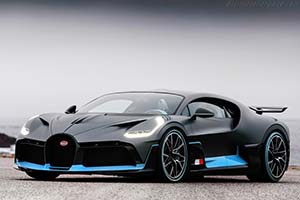
<< Prev Page 2 of 3 Next >>  "The modern interpretation of coachbuilding gave us engineers new freedom," says Stefan Ellrott, Head of Technical Development at Bugatti. "The step that we have taken with the Divo in terms of agility and high-performance cornering dynamics can be compared with the overall development from the Veyron to the Chiron." "The modern interpretation of coachbuilding gave us engineers new freedom," says Stefan Ellrott, Head of Technical Development at Bugatti. "The step that we have taken with the Divo in terms of agility and high-performance cornering dynamics can be compared with the overall development from the Veyron to the Chiron."A sophisticated aerodynamics programme makes for optimum vehicle cooling and 90 kilograms more downforce. The aerodynamic properties of the Divo were improved by a considerable amount of detailed work. The front cover is equipped with air intakes which reduce the effective cross-sectional area of the vehicle at the same time as ensuring improved air flow at the front and increasing aerodynamic efficiency. An optimized "air curtain" makes for better air flow over the front and rear sections of the car's sides. The newly-designed, wide front spoiler provides higher downforce and guides more air to the front air inlets. The cooling system therefore receives a higher mass flow and overall cooling performance is improved. The brakes are cooled by four independent air sources on each side of the vehicle: air flows in from the high-pressure area above the front bumper, the inlets on the front wings, one inlet on the front radiator and the diffusers ahead of the tyres. Vanes direct the cold air from these areas onto the brake discs. A heat shield carries the hot air out through the wheels. This means that the brakes do not overheat and the tyre temperature is always kept in the optimum range. This system, which is already used on the Chiron, receives additional support from the vacuum generated by the air curtain on the tyres in the case of the Divo. In addition, the wheel arches are ventilated via slats on the wings. The roof of the Divo has been designed to form a NACA air duct, a flow-optimized air inlet. In combination with the specially designed engine compartment cover, this ensures a very high air mass flow to the engine compartment, playing a key role in temperature management in this area of the vehicle. The rear end of the Divo features a new, height-adjustable rear spoiler which functions as an air brake when turned forwards and is set to different angles for the individual driving modes. The rear spoiler has a width of 1.83 metres (72") and is therefore 23 percent wider than on the Chiron. The wider spoiler improves efficiency and results in higher air brake performance as well as significantly more downforce. The downforce is also boosted by the rear diffuser which has been entirely redesigned for greater efficiency and accommodates four tailpipes. The total downforce generated is 456 kilograms, 90 kg more than on the Chiron. The main objective of chassis development work was to improve cornering dynamics; the Divo was to be sharper, more agile and more nimble. For this purpose, the camber was increased. As a result the maximum speed of the Divo is limited to 380 km/h. In contrast to the Chiron, there is therefore no Top Speed mode. As regards lateral acceleration, the Divo reaches 1.6 g. These changes alone ensure a perceptibly different driving experience on winding roads. The steering and suspension have been set to ensure more direct response and significantly sportier driving behaviour in all modes (EB, Autobahn and Handling). The Divo is 35 kilograms lighter than the Chiron. The weight reduction is the result of a number of design modifications including new lightweight wheels and a carbon fibre intercooler cover. Weight was also saved by the fixing of the front diffuser flaps, a reduction in the amount of insulation material used and the installation of a lighter sound system. In order to reduce the weight, stowage compartments on the central console and in the door trims have also been omitted. The Divo can therefore lap the Nardò handling circuit eight seconds faster than the Chiron. "The Divo is a further example of our design philosophy 'Form follows Performance'. In this case, the engineers and designers aimed to create a vehicle focusing on cornering speeds and lateral dynamics," says Achim Anscheidt, Director of Design of Bugatti Automobiles S.A.S., describing the design language of the new Bugatti. "The Divo project was also a welcome opportunity for our team to add a modern chapter to the coachbuilding story of Bugatti which had been so successful in the early years of the brand." "Our task was to develop a vehicle which would look different from the Chiron but still be immediately recognizable as a Bugatti," Anscheidt adds. "For us designers, this meant that the three key style elements of Bugatti had to remain in place: the horseshoe-shaped front grille, the typical Bugatti signature line along the sides of the vehicle and the characteristic fin that defines the longitudinal axis of the car when viewed from above, which was derived from the Type 57 Atlantic." The design team continued the evolution of the design elements for the Divo in line with the design brief and reinterpreted the design philosophy "Form follows Performance". The outer skin of the Divo was designed in an uncompromising way to emphasize lateral acceleration. The main objective was to achieve optimum aerodynamic and thermodynamic efficiency. At the same time, the Divo represents a new styling approach which the design team has developed especially for a coachbuilt Bugatti and which is distinguished from the modern core products of the brand. The slimmer side line of the Divo helps make the vehicle look lower and longer. The new proportions allow a visual horizontal division of the body, which is reinforced by a special colour scheme. The top, more elegant section is painted with a matt finish in a silver colour "Titanium Liquid Silver" developed especially for the Divo. This effectively underpins the sculptural, muscular form of the car. The long domed areas with their smooth surfaces along the C-pillar and the rear side sections optically shift the driver's cab forwards. This gives the Divo an extremely dynamic appearance even when the vehicle is standing still. The lower part of the sides has more of a functional, technical design, reinforcing the car's forceful appearance and giving it a confident stance on the road. This section features exposed carbon fibre tinted in a petroleum blue shade, "Divo Carbon", developed especially for this model. An entirely new architecture was developed for the front of the car. There are additional air inlets for brake cooling. The new, vertically oriented front lights with daytime running light on the outer edge in each case give the Divo an appearance of greater width. With a light opening which is only 35 millimetres (1 3/8") flat, the extremely compact, lightweight LED headlights move into a new technical dimension. A light animation developed especially for the Divo underlines the distinctive signature of the front end. The horizontal split into a lower carbon and an upper matt silver section also makes the Divo look lower and underlines the optical impression of width. The NACA air inlet on the roof creates an optical connection with the air outlet in the centre of the front cover and guides the air towards the rear spoiler. The fact that the central line runs from the front over the roof to the rear spoiler is not only a reminiscence of Bugatti's legendary past but also serves a function. This configuration prevents air eddies from forming over the vehicle, creating turbulence on the rear spoiler. One highlight at the rear of the vehicle is definitely the new, highly sophisticated 3-D rear light. This is actually part of the rear grille, which is partly produced by a 3-D printing process and has special lightweight fins with a variety of sizes. A total of 44 of these fins light up, forming the rear light of the Divo. At the outer edge, the fins become wider, creating a more intensive light. Towards the centre of the vehicle, they are narrower, resulting in gradual fading of the light. The result is a striking appearance which means that the Divo is also unmistakable from the rear. The two-tone colour scheme also intensifies the forceful impression created by the rear. The fenders are painted in "Titanium Liquid Silver" with a matt finish and are optically distinguished from the parts which control airflow at the rear end. Air outlets, rear spoiler and diffuser have a carbon finish. "Divo Racing Blue", a bright turquoise blue shade developed especially for the Divo, underlines the three-dimensional character of the three surfaces leading to the air inlets and outlets on the front, sides and rear, creating dynamically contrasting effects. The technical character of the colour scheme and materials used for the exterior is continued in the interior. A matt version of the exclusive high-gloss carbon fibre used on the exterior is to be found in the interior. The colour effects of the carbon tint and exterior paintwork are reflected on a 1:1 basis by the dark "Divo Grey" petroleum tone of the Alcantara in the interior, providing a subtle contrast with the glass-blasted anodized grey surfaces of the metal parts. The distinctive "Divo Racing Blue" is also used as an Alcantara leather tone in the interior, where it plays a special role by providing an optical split in the interior surfaces. This colour is used almost throughout the driver's section while it only provides selected accents in the darker passenger's section. Another stylistic link between interior and exterior is created by the door trims and seat areas, which feature an embroidered three-dimensional rhomboid structure with an algorithmic configuration, reinterpreting the structure of the grille and rear lights. Technical innovations in the interior include the seats, which not only feature a new design but offer greater lateral support. The steering wheel is partly covered with Alcantara and has larger paddles fitted firmly on both sides of the wheel. Thanks to larger armrests and calf supports, the central console ensures greater comfort. << Prev Page 2 of 3 Next >> |
| Article | Image gallery (40) | VF9SD3V34LM795015 | Specifications | User Comments (1) |
| All Cars - Contact us - Privacy Statement - Top | © 1998 - 2026 Ultimatecarpage.com |