<< Prev Page 3 of 3 Albert Divo was born in Paris on 24 January 1895 under the name of Albert Eugène Diwo (he called himself Divo later). After service as a fighter pilot in the First World War, he worked as a mechanic. His career as a racing driver started with Sunbeam and Talbot-Darracq in 1919. He enjoyed rapid success and won the 1923 Spanish Grand Prix in Sitges In 1924, he moved to Delage and entered a number of sprint races in France. In 1926 and 1927, he again raced for Talbot, where he was less successful as a result of problems with an insufficiently mature design. He then returned to Delage but was not entered for any races. When Talbot and Delage retired from racing, Divo joined Bugatti's works team in 1928. The same year, he won the Targa Florio in Sicily driving a Type 35 B. He repeated this success the following year. He took third place at Spa in 1930. Up to 1933 he entered further races for Bugatti with the Types 51, 53 and 54, as well as hillclimbs with the Types 45 and 47. From 1936, he raced for Delahaye and Talbot. He retired from racing in 1939. Following the Second World War, Albert Divo worked as racing manager for Castrol. In 1962, he was a founder member of the Club International des Anciens Pilotes de Grand Prix F1 in Villars-sur-Ollon (Switzerland). Divo received the Legion of Honour. He then led a withdrawn life and died in Morsang-sur-Orge to the south of Paris on 19 November 1966.
Divo definitely celebrated his greatest success with Bugatti, whose dominance of the Targa Florio started in 1925. The legendary Targa Florio, held on a mountain circuit in Sicily each year until 1977, was certainly one of the most arduous of all the endurance races of its time. Bugatti won the race five times in succession with the Type 35.
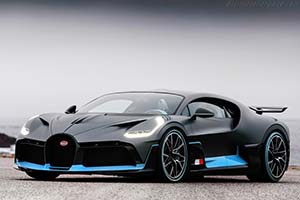
With the Divo, Bugatti is reviving its coachbuilding tradition. While Ettore Bugatti's vehicles of the 1920s represented lightweight design and technical innovation, it was his son Jean who made the Bugatti bodies of the 1930s into style icons of their time. To this day, Jean's creations embody the golden era of French coachbuilding. In their own way, father and son both contributed to the very special myth of the Bugatti marque.
In the mid 1920s, Ettore Bugatti involved his son more and more in the business of the company and it was Jean who developed concepts for Bugatti bodywork, first for the Type 41 Royale and, from 1926, also for the Type 40. Up to that point, two-seater and four-seater sports convertibles and coupés had been made by coachbuilders such as Gangloff or Lavocat & Marsaud. In order to realize his ideas, Jean engaged the services of talented body designer Joseph Walter.
It was Walter who put Jean's ideas into practice and developed the classical Bugatti coachbuilding tradition with the Grand Sport bodies for Types 40 and 43 through to the Type 57 bodies of the 1930s. For the Type 57, various bodies such as Stelvio, Aravis, Galibier, Ventoux or Atalante could be ordered as factory options. The best-known coachbuilt creations from Bugatti were definitely the streamlined Type 50, the Type 55 roadster and the Type 57SC Atlantic. << Prev Page 3 of 3

 Ultimatecarpage.com
> Cars by brand
> France
> Bugatti
Ultimatecarpage.com
> Cars by brand
> France
> Bugatti
 Divo
Divo
 Albert Divo was born in Paris on 24 January 1895 under the name of Albert Eugène Diwo (he called himself Divo later). After service as a fighter pilot in the First World War, he worked as a mechanic. His career as a racing driver started with Sunbeam and Talbot-Darracq in 1919. He enjoyed rapid success and won the 1923 Spanish Grand Prix in Sitges In 1924, he moved to Delage and entered a number of sprint races in France. In 1926 and 1927, he again raced for Talbot, where he was less successful as a result of problems with an insufficiently mature design. He then returned to Delage but was not entered for any races. When Talbot and Delage retired from racing, Divo joined Bugatti's works team in 1928. The same year, he won the Targa Florio in Sicily driving a Type 35 B. He repeated this success the following year. He took third place at Spa in 1930. Up to 1933 he entered further races for Bugatti with the Types 51, 53 and 54, as well as hillclimbs with the Types 45 and 47. From 1936, he raced for Delahaye and Talbot. He retired from racing in 1939. Following the Second World War, Albert Divo worked as racing manager for Castrol. In 1962, he was a founder member of the Club International des Anciens Pilotes de Grand Prix F1 in Villars-sur-Ollon (Switzerland). Divo received the Legion of Honour. He then led a withdrawn life and died in Morsang-sur-Orge to the south of Paris on 19 November 1966.