<< Prev Page 2 of 2 The success of the Mk III during its debut season resulted in several new orders. Among them was Doyle Racing, which received funding from General Motors to run Oldsmobile V8 engines in a Riley & Scott factory backed program. This effort proved immediately successful as Aurora-engined Mk III scored back to back victories in the 1996 Daytona 24 Hours and Sebring 12 Hours. It was the start of a dominant season that saw driver Wayne Taylor seal the drivers' title while Oldsmobile won the manufacturers' championship. One of the factory cars was also entered at Le Mans where it qualified ninth but retired with gearbox issues.
More cars were sold and eventually Riley & Scott managed to build 17 Mk IIIs and a further five of the new-for-1999 Series 2 cars. These were developed to meet the revised LMP regulations in Europe. Fitted with a variety of engines that ranged from a Formula 1 derived Judd V10 to a production-based BMW V8, the Mk III remained hugely successful until the end of the decade. Among the 47 wins were three Daytona 24 Hours victories, while the Mk III also propelled the various teams, drivers and constructors to six, eight and three championships respectively.
Owing to the success of the Oldsmobile-powered Mk IIIs, Riley & Scott was tasked to develop the all-new Cadillac LMP car for the 2000 season. While this featured a carbon-fibre composite monocoque design, the final, 'C', evolution of the Mk III, introduced in 2001, still boasted the tube-frame chassis of the original. It was raced on both sides of the Atlantic for many years to come but never managed to match the huge success of the original Riley & Scott Mk III.
Successfully fending off machinery from the likes of Ferrari and Porsche, the Mk III ranks as one of the all time great sports prototypes. The 47 victories are a testament to the very effective and versatile design that was ahead of the curve thanks to the use of CFD, which would not become commonplace until the end of the decade. << Prev Page 2 of 2

 Ultimatecarpage.com
> Cars by brand
> United States
> Riley & Scott
Ultimatecarpage.com
> Cars by brand
> United States
> Riley & Scott
 Racing cars
> LMP
Racing cars
> LMP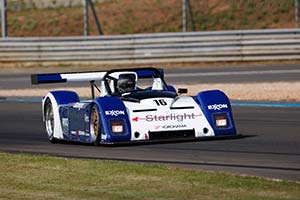
 The success of the Mk III during its debut season resulted in several new orders. Among them was Doyle Racing, which received funding from General Motors to run Oldsmobile V8 engines in a Riley & Scott factory backed program. This effort proved immediately successful as Aurora-engined Mk III scored back to back victories in the 1996 Daytona 24 Hours and Sebring 12 Hours. It was the start of a dominant season that saw driver Wayne Taylor seal the drivers' title while Oldsmobile won the manufacturers' championship. One of the factory cars was also entered at Le Mans where it qualified ninth but retired with gearbox issues.